The Conclusion of Genesis and Its Deeper Meaning
Lamplighter | December 28, 2023
Print This Article
View Original PDF

The Conclusion of Genesis and Its Deeper Meaning

Lamplighter | December 10, 2025

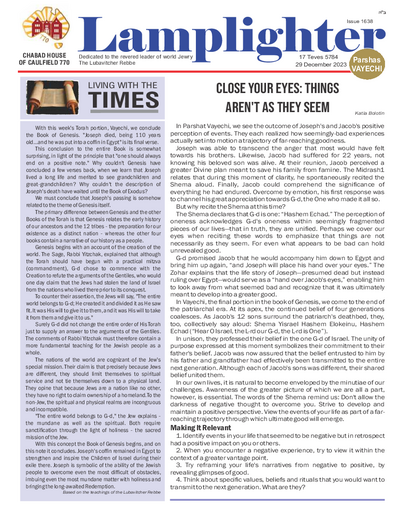
With this week's Torah portion, Vayechi, we conclude the Book of Genesis. "Joseph died, being 110 years old...and he was put into a coffin in Egypt" is its final verse.

This conclusion to the entire Book is somewhat surprising, in light of the principle that "one should always end on a positive note." Why couldn't Genesis have concluded a few verses back, when we learn that Joseph lived a long life and merited to see grandchildren and great-grandchildren? Why couldn't the description of Joseph's death have waited until the Book of Exodus?

We must conclude that Joseph's passing is somehow related to the theme of Genesis itself.

The primary difference between Genesis and the other Books of the Torah is that Genesis relates the early history of our ancestors and the 12 tribes - the preparation for our existence as a distinct nation - whereas the other four books contain a narrative of our history as a people.

Genesis begins with an account of the creation of the world. The Sage, Rabbi Yitzchak, explained that although the Torah should have begun with a practical mitzva (commandment), G-d chose to commence with the Creation to refute the arguments of the Gentiles, who would one day claim that the Jews had stolen the land of Israel from the nations who lived there prior to its conquest.

To counter their assertion, the Jews will say, "The entire world belongs to G-d; He created it and divided it as He saw fit. It was His will to give it to them, and it was His will to take it from them and give it to us."

Surely G-d did not change the entire order of His Torah just to supply an answer to the arguments of the Gentiles. The comments of Rabbi Yitzchak must therefore contain a more fundamental teaching for the Jewish people as a whole.

The nations of the world are cognizant of the Jew's special mission. Their claim is that precisely because Jews are different, they should limit themselves to spiritual service and not tie themselves down to a physical land. They opine that because Jews are a nation like no other, they have no right to claim ownership of a homeland. To the non-Jew, the spiritual and physical realms are incongruous and incompatible.

"The entire world belongs to G-d," the Jew explains - the mundane as well as the spiritual. Both require sanctification through the light of holiness - the sacred mission of the Jew.

With this concept the Book of Genesis begins, and on this note it concludes. Joseph's coffin remained in Egypt to strengthen and inspire the Children of Israel during their exile there. Joseph is symbolic of the ability of the Jewish people to overcome even the most difficult of obstacles, imbuing even the most mundane matter with holiness and bringing the long-awaited Redemption.

Based on the teachings of the Lubavitcher Rebbe
With this week's Torah portion, Vayechi, we conclude the Book of Genesis. "Joseph died, being 110 years old...and he was put into a coffin in Egypt" is its final verse.

This conclusion to the entire Book is somewhat surprising, in light of the principle that "one should always end on a positive note." Why couldn't Genesis have concluded a few verses back, when we learn that Joseph lived a long life and merited to see grandchildren and great-grandchildren? Why couldn't the description of Joseph's death have waited until the Book of Exodus?

We must conclude that Joseph's passing is somehow related to the theme of Genesis itself.

The primary difference between Genesis and the other Books of the Torah is that Genesis relates the early history of our ancestors and the 12 tribes - the preparation for our existence as a distinct nation - whereas the other four books contain a narrative of our history as a people.

Genesis begins with an account of the creation of the world. The Sage, Rabbi Yitzchak, explained that although the Torah should have begun with a practical mitzva (commandment), G-d chose to commence with the Creation to refute the arguments of the Gentiles, who would one day claim that the Jews had stolen the land of Israel from the nations who lived there prior to its conquest.

To counter their assertion, the Jews will say, "The entire world belongs to G-d; He created it and divided it as He saw fit. It was His will to give it to them, and it was His will to take it from them and give it to us."

Surely G-d did not change the entire order of His Torah just to supply an answer to the arguments of the Gentiles. The comments of Rabbi Yitzchak must therefore contain a more fundamental teaching for the Jewish people as a whole.

The nations of the world are cognizant of the Jew's special mission. Their claim is that precisely because Jews are different, they should limit themselves to spiritual service and not tie themselves down to a physical land. They opine that because Jews are a nation like no other, they have no right to claim ownership of a homeland. To the non-Jew, the spiritual and physical realms are incongruous and incompatible.

"The entire world belongs to G-d," the Jew explains - the mundane as well as the spiritual. Both require sanctification through the light of holiness - the sacred mission of the Jew.

With this concept the Book of Genesis begins, and on this note it concludes. Joseph's coffin remained in Egypt to strengthen and inspire the Children of Israel during their exile there. Joseph is symbolic of the ability of the Jewish people to overcome even the most difficult of obstacles, imbuing even the most mundane matter with holiness and bringing the long-awaited Redemption.

Based on the teachings of the Lubavitcher Rebbe

PDF Preview