Thought of the Week Loving Another as Yourself
מגדל אור | December 28, 2023
Print This Article
View Original PDF

Thought of the Week Loving Another as Yourself

מגדל אור | December 10, 2025

“And your progeny born after them will be yours; they will be called in their brothers’ names for inheritance.” (Beraishis 48:6)

Yosef was told Efrayim and Menashe would be counted as Tribes, as if they were Yaakov’s children instead of his grandchildren. However, any other children Yosef had, would be considered Yosef’s children and not have the elevated status of being Tribal heads.

It could be that Yaakov had to clarify that although Yosef’s two sons were given special treatment, with Yosef acting in his father’s stead, so to speak, that didn’t mean that Yosef still had an inheritance of his own to leave to his offspring. All rights to the land of Israel were transferred through Menashe and Efrayim. Yaakov did not want Yosef to think that he could have more children and thereby acquire more land.

But did Yosef have more children? Some commentaries, such as the Ibn Ezra and Ramban say he did. Others say he did not. What can we learn from this, and the fact that the children were not listed in the Torah?

On the one hand, Yosef well understood the jealousy amongst siblings when some are treated differently. The fact that Efrayim and Menashe were singled out for Yosef to receive a firstborn’s double portion, but his other children would not have that, might have been a reason for him to desist from having other children, lest they suffer the pangs of jealousy that led his brothers to hate him and sell him into Egypt, even though it was part of Hashem’s Divine plan. That would comport well with those who said he had no other children. But for those who said he did have more, how do we explain this?

The answer is understood through the reason why we bless our children to be like Efrayim and Menashe. Though Menashe was older, he was not jealous of the fact that his younger brother was destined to be greater than he. He did not get upset that their grandfather Yaakov spent his time learning with Efrayim, and he did not feel slighted. He understood that each of us gets what we are supposed to get.

With that example, Yosef’s other children, born after Yaakov came to Egypt and the famine subsided, would also not feel jealous or upset about what their brothers got. They did not even have to be mentioned in the Torah, and it didn’t bother them. They would not succumb to jealousy as happened with the original sons of Yaakov, and thus Yosef had no qualms about having children even if they would not be given special status.

Perhaps, this was what Yaakov was alluding to in his blessing. He said that these lads, Efrayim and Menashe, should be called in his name. What attribute of Yaakov’s did they possess? When Eisav met Yaakov, he did not accept Yaakov’s gift until Yaakov said, “I have everything.” Yaakov was satisfied with whatever Hashem sent his way. Whether it was Yitzchak blessing Eisav, which is why Rivka had to intervene, or whether it was his acceptance of the attack on his daughter (see Now You Know), or his willingness to give up material things to Eisav, Yaakov was not jealous or desirous of more. This is the attribute of royalty which he passed to Yosef’s children, and which we would do well to aspire to.

R’ Meir Chodosh z”l gave an intriguing moshol. Imagine a fellow wants to borrow money. The lender asks what he will do with it, how he will pay it back, and for more information on the business plan. When satisfied, he writes the check.

When the time comes to repay the loan, the borrower says, “I’m ready to pay you back but first let me ask you, “What will you do with the money?” It’s laughable. When you owe someone something, you can’t ask them questions.

Every person is created in Hashem’s image. You OWE him honor and respect. Why should you be upset or hesitant to give him his due?

©2023 – J. Gewirtz
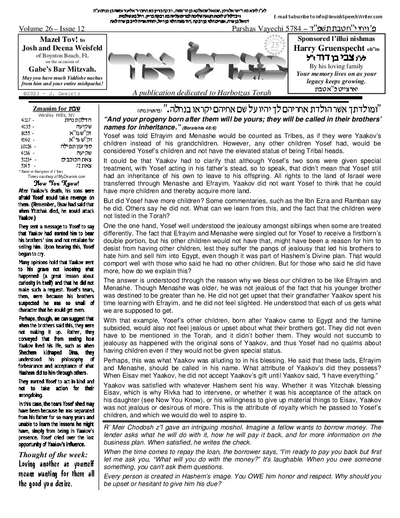
“And your progeny born after them will be yours; they will be called in their brothers’ names for inheritance.” (Beraishis 48:6)

Yosef was told Efrayim and Menashe would be counted as Tribes, as if they were Yaakov’s children instead of his grandchildren. However, any other children Yosef had, would be considered Yosef’s children and not have the elevated status of being Tribal heads.

It could be that Yaakov had to clarify that although Yosef’s two sons were given special treatment, with Yosef acting in his father’s stead, so to speak, that didn’t mean that Yosef still had an inheritance of his own to leave to his offspring. All rights to the land of Israel were transferred through Menashe and Efrayim. Yaakov did not want Yosef to think that he could have more children and thereby acquire more land.

But did Yosef have more children? Some commentaries, such as the Ibn Ezra and Ramban say he did. Others say he did not. What can we learn from this, and the fact that the children were not listed in the Torah?

On the one hand, Yosef well understood the jealousy amongst siblings when some are treated differently. The fact that Efrayim and Menashe were singled out for Yosef to receive a firstborn’s double portion, but his other children would not have that, might have been a reason for him to desist from having other children, lest they suffer the pangs of jealousy that led his brothers to hate him and sell him into Egypt, even though it was part of Hashem’s Divine plan. That would comport well with those who said he had no other children. But for those who said he did have more, how do we explain this?

The answer is understood through the reason why we bless our children to be like Efrayim and Menashe. Though Menashe was older, he was not jealous of the fact that his younger brother was destined to be greater than he. He did not get upset that their grandfather Yaakov spent his time learning with Efrayim, and he did not feel slighted. He understood that each of us gets what we are supposed to get.

With that example, Yosef’s other children, born after Yaakov came to Egypt and the famine subsided, would also not feel jealous or upset about what their brothers got. They did not even have to be mentioned in the Torah, and it didn’t bother them. They would not succumb to jealousy as happened with the original sons of Yaakov, and thus Yosef had no qualms about having children even if they would not be given special status.

Perhaps, this was what Yaakov was alluding to in his blessing. He said that these lads, Efrayim and Menashe, should be called in his name. What attribute of Yaakov’s did they possess? When Eisav met Yaakov, he did not accept Yaakov’s gift until Yaakov said, “I have everything.” Yaakov was satisfied with whatever Hashem sent his way. Whether it was Yitzchak blessing Eisav, which is why Rivka had to intervene, or whether it was his acceptance of the attack on his daughter (see Now You Know), or his willingness to give up material things to Eisav, Yaakov was not jealous or desirous of more. This is the attribute of royalty which he passed to Yosef’s children, and which we would do well to aspire to.

R’ Meir Chodosh z”l gave an intriguing moshol. Imagine a fellow wants to borrow money. The lender asks what he will do with it, how he will pay it back, and for more information on the business plan. When satisfied, he writes the check.

When the time comes to repay the loan, the borrower says, “I’m ready to pay you back but first let me ask you, “What will you do with the money?” It’s laughable. When you owe someone something, you can’t ask them questions.

Every person is created in Hashem’s image. You OWE him honor and respect. Why should you be upset or hesitant to give him his due?

©2023 – J. Gewirtz

PDF Preview


