A Thought Regarding Bikur Cholim
BET Journal | November 07, 2025
Print This Article
View Original PDF

A Thought Regarding Bikur Cholim

BET Journal | December 08, 2025

At the beginning of the parshah, HaKadosh Baruch Hu comes to Avraham Avinu. Rashi says it was to do bikur cholim, since it was the third day after his bris milah.

Question: The Gemara in Nedarim daf mem defines bikur cholim as looking out for the needs of the choleh, whether it involves his food, his drink, his dress, his comfort. Bikur cholim means to look at what the choleh needs. Where do we see here that there was bikur cholim, that HaKadosh Baruch Hu visited him? I don’t know exactly by Avraham Avinu what it means that HaKadosh Baruch Hu visited him. There must have been some type of gilui Shechinah, but be that as it may, it’s not the bikur cholim that seems to be referred to there. Interesting.

No, the answer seems to be very, very geshmak. Just the opposite. There’s a limud here. It was bikur cholim. HKB”H came to see what Avraham needed. You go to someone, see what he needs. You’re worried about him physically, his eating, his drinking, his comfort. You go to visit a choleh in the hospital, or even when taking care of him at home, he usually has the things he needs. But k’viyachol, the Ribbono Shel Olam is teaching us, sometimes what the person needs is not physical help. HaKadosh Baruch Hu sent Avraham what he needed. What did he need? To have orchim, to have guests. HKB”H k’viyachol looked to see what Avraham needed, and He saw that he needed orchim.

Many cholim need to feel useful, especially people who are, lo aleinu, sick for a while. They need the biggest gift you could give them, which is not to cover them, not to feed them, but to make them feel a purpose in their lives. Cholim very often have so much to offer, especially elderly people who talk about life in a time period that you won’t be able to find out about anymore. What it was like, the challenges that Yidden had in a previous generation. A choleh needs food and drink, comfort, certainly. A choleh also needs somebody to put his head, his mind, into figuring out what will make him happy. Very often, what the beginning of this week’s parshah teaches is an important lesson. You want to give the choleh what he needs? Guess what? Make him feel useful.

RABBI NACHUM WINKLER

RABBI YISRAEL REISMAN
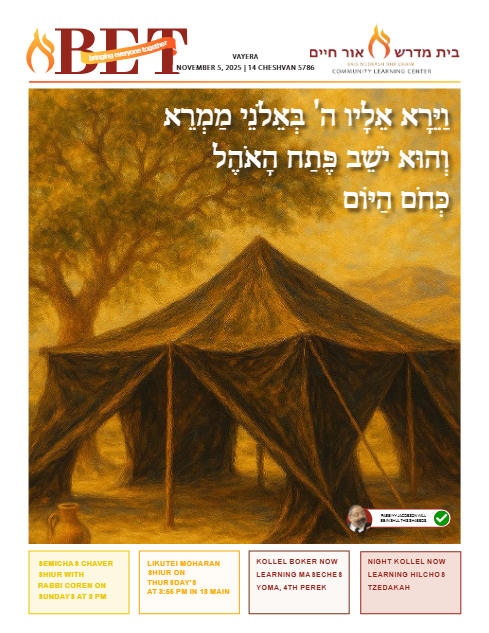
At the beginning of the parshah, HaKadosh Baruch Hu comes to Avraham Avinu. Rashi says it was to do bikur cholim, since it was the third day after his bris milah.

Question: The Gemara in Nedarim daf mem defines bikur cholim as looking out for the needs of the choleh, whether it involves his food, his drink, his dress, his comfort. Bikur cholim means to look at what the choleh needs. Where do we see here that there was bikur cholim, that HaKadosh Baruch Hu visited him? I don’t know exactly by Avraham Avinu what it means that HaKadosh Baruch Hu visited him. There must have been some type of gilui Shechinah, but be that as it may, it’s not the bikur cholim that seems to be referred to there. Interesting.

No, the answer seems to be very, very geshmak. Just the opposite. There’s a limud here. It was bikur cholim. HKB”H came to see what Avraham needed. You go to someone, see what he needs. You’re worried about him physically, his eating, his drinking, his comfort. You go to visit a choleh in the hospital, or even when taking care of him at home, he usually has the things he needs. But k’viyachol, the Ribbono Shel Olam is teaching us, sometimes what the person needs is not physical help. HaKadosh Baruch Hu sent Avraham what he needed. What did he need? To have orchim, to have guests. HKB”H k’viyachol looked to see what Avraham needed, and He saw that he needed orchim.

Many cholim need to feel useful, especially people who are, lo aleinu, sick for a while. They need the biggest gift you could give them, which is not to cover them, not to feed them, but to make them feel a purpose in their lives. Cholim very often have so much to offer, especially elderly people who talk about life in a time period that you won’t be able to find out about anymore. What it was like, the challenges that Yidden had in a previous generation. A choleh needs food and drink, comfort, certainly. A choleh also needs somebody to put his head, his mind, into figuring out what will make him happy. Very often, what the beginning of this week’s parshah teaches is an important lesson. You want to give the choleh what he needs? Guess what? Make him feel useful.

RABBI NACHUM WINKLER

RABBI YISRAEL REISMAN

PDF Preview