Answers to this Weeks Riddles
למודי משה | November 06, 2025
Print This Article
View Original PDF

Answers to this Weeks Riddles

למודי משה | December 08, 2025

(For the questions, please see second to back page)

  1. The Medrash Rabbah (Naso 14:2) teaches that when the pasuk says:והשענו תחת העץ – “They reclined under the tree”, it means that Avraham prepared for the malochim a succah. This would seem to imply that the malochim came on Succos.
  2. Similarly, the Gemara in Rosh Hashanah (11a) teaches that the malochim came on Succos and told Sorah the good news: “That by the next Yom Tov, you will have a son” (Bereishis 18:14), and the next Yom Tov was Pesach, and on Pesach Yitzchak was born.
  3. Similarly, the Pirkei D’Rabbi Eliezer (Perek 28) teaches the Avraham Avinu had his bris milah on Yom Kippur, and the malochim who came “on the third day”, came on the 13th of Tishrei, which was two days before Succos. [Tosfos in Rosh Hashanah (11a) explains, that when the Gemara says that the malochim came on Succos, it doesn’t mean literally Succos, it means two days before, and when the malochim said, “by the next Yom Tov you will have a child”, they meant the first Yom Tov after the upcoming one, as a day or two before a Yom Tov is considered like one is already in the Yom Tov.]
  4. On the other hand, the Medrash Rabbah in this week’s parsha (48:12) brings another opinion, which says that the malochim came on Pesach, and the Medrash explains that when Avraham told Sorah, ועשי עוגות – make cakes, he was telling her to make matzos.

Is there any way to reconcile these two opinions?

R’ Menachem Mendel of Rimonav (cited in Menachem Tzion, Derushim LePesach, Seudas Yom Aleph Chol HaMo’ed) says a big chiddush and he says that the malochim stayed with Avraham for more than six months. He learns that they came on Succos and stayed all the way until Pesach, and just before leaving they ate matzah. According to this there is no contradiction between the two opinions, and both are right, as the malochim were by Avraham for both Succos and Pesach.

We can ask on this from the Rekanti (Bereishis, d.h. Medrash Rus), who says that if malochim stay on this world for more than seven consecutive days, they are no longer able to return to Shomayim. According to R’ Menachem Mendel of Rimonav, that the malochim stayed for six months, surely they wouldn’t have been allowed to return to Shomayim?

However, we could answer very simply, that although the malochim stayed for six months, they never stayed for more than seven consecutive days, and they came back and forth, and this way they were allowed back into Shomayim. (Otzer Pelois HaTorah)

  1. i) The Yerushalmi in Berachos (1:1) teaches: המלאכים אין להם קפיצין. The Pnei Moshe explains this to mean that malochim don’t have in their feet the bones that are needed to help one bend his foot so that he can sit down, as a result they constantly remain standing. According to this, we can understand why Avraham told them to recline under the tree and not to sit, as it is not possible for them to sit.
  2. ii) According to what we mentioned above, that the malochim came on Pesach, and that when Avraham told Sorah ועשי עוגות, he was telling her to make matzos. We can explain, that Avraham told them to recline, as it was seder night and he was giving them matzah to eat, and one must eat matzah whilst leaning.
  1. In this week’s parsha Avraham Avinu prepared three cows for the malochim to eat, however, when he brings out the food, it says: “That he brought the butter, the milk, and the cow”, the difficulty is, he prepared three cows, so why does the pasuk mention “cow” (בן הבקר) in the singular? The Gemara in Bava Metzia (86b) explains, that although he prepared three cows, one of them was ready before the rest and as soon as it was ready he brought it to the malochim, and this is what it means ובן הבקר אשר עשה – “the cow that was ready”, because one was ready, he brought it straight away. We see that one should bring out the food that is ready as soon as possible.
  1. The Medrash Rabbah (54:10) teaches that Yitzchak Avinu was the first child in history to be placed in a crib (לא נדנדה עריסה תחילה אלא בביתו של אברהם אבינו). Until Yitzchak was born, children were born big and didn’t need crib, however, Yitzchak was the first child to be born small and needed a crib. The Medrash says: On that day, Avraham made a great feast.
  2. There is another Medrash Rabbah (36:1) which teaches: At the beginning, new born children could walk immediately from the day they were born, and when a woman would give birth in the day she would tell her son “please go and get me a stone to cut the cord”, and if she gave birth at night she would tell her son “go and light a candle for me, so I can cut the cord”.
  1. The Amar Nekay (Bartenura on Chumash) brings that everyone asks this question, and he says: They answer that Yishmael used to shoot a bow and arrow, and Hagar feared that due to his illness he might lose his mind, and start shooting arrows randomly, therefore, she distanced herself double the distance just to be safe.
  2. This is still difficult, as if she was scared about Yishmael randomly shooting arrows, surely if she would have distanced herself slightly more than the distance an arrow can go, she would be ok, why did she need to double it?
  3. R’ Aharon Leib (Ayalas HaShachar) answers: The truth is, there is no fixed distance of how far an arrow travels, and it depends on the strength put into shooting it, and on the wind etc. Therefore, she distanced herself double the distance, as even if some arrows go further than others, they never get past 2000 amos.
  1. i) Avraham was scared that they would stop him from performing the akeidah, therefore, he told them to stay behind. (Seforno, Rabbeinu Bechayeh, Chizkuni)
  2. ii) It was Yom Tov or Yom Kippur, and there is a mitzvah for one to rest his animals and children, and one isn’t allowed to let them go outside the techum, therefore, Avraham commanded them to stay where they were. However, Avraham and Yitzchak had a special commandment to go, therefore, for them it was allowed.
  3. iii) Avraham saw a special cloud on top of the mountain and he thought it was a holy place, and just like we find by Har Sinai that:צאן ובקר וגם איש לא יראה בכל ההר ההוא – “Sheep, cattle and people weren’t allowed on the mountain”, Avraham thought the same thing was by the akeidah. (Tiferes Yonason)
  4. iv) Avraham Avinu was a Kohen Gadol, the place of the akeidah was the Kodesh HaKadoshim, and the akeidah was on Yom Kippr, and the halachah is that when the Kohen Gadol enters the Kodesh HaKadoshim on Yom Kippur, no one else is allowed to enter, therefore, he never took anyone with accept Yitzchak who was being brought as the korban. (Oznayim L’Torah)
  1. v) The Medrash says that when Avraham saw from the distance a special cloud over the mountain, he turned to Yitzchak and asked him what he saw, and he said he saw the cloud. He then turned to Eliezer and Yishmael and asked them what they saw, and they said, “we see nothing”. Avraham said, you are comparable to a donkey who also can’t see anything; therefore, you should stay here. (Moshav Zekenim L’Baalei HaTosfos).
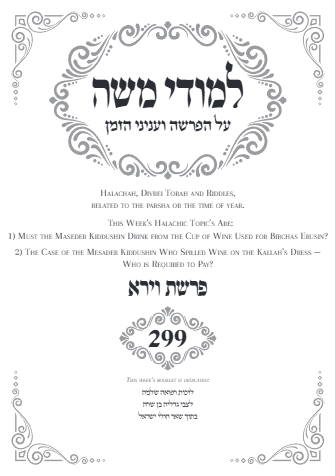

(For the questions, please see second to back page)

  1. The Medrash Rabbah (Naso 14:2) teaches that when the pasuk says:והשענו תחת העץ – “They reclined under the tree”, it means that Avraham prepared for the malochim a succah. This would seem to imply that the malochim came on Succos.
  2. Similarly, the Gemara in Rosh Hashanah (11a) teaches that the malochim came on Succos and told Sorah the good news: “That by the next Yom Tov, you will have a son” (Bereishis 18:14), and the next Yom Tov was Pesach, and on Pesach Yitzchak was born.
  3. Similarly, the Pirkei D’Rabbi Eliezer (Perek 28) teaches the Avraham Avinu had his bris milah on Yom Kippur, and the malochim who came “on the third day”, came on the 13th of Tishrei, which was two days before Succos. [Tosfos in Rosh Hashanah (11a) explains, that when the Gemara says that the malochim came on Succos, it doesn’t mean literally Succos, it means two days before, and when the malochim said, “by the next Yom Tov you will have a child”, they meant the first Yom Tov after the upcoming one, as a day or two before a Yom Tov is considered like one is already in the Yom Tov.]
  4. On the other hand, the Medrash Rabbah in this week’s parsha (48:12) brings another opinion, which says that the malochim came on Pesach, and the Medrash explains that when Avraham told Sorah, ועשי עוגות – make cakes, he was telling her to make matzos.

Is there any way to reconcile these two opinions?

R’ Menachem Mendel of Rimonav (cited in Menachem Tzion, Derushim LePesach, Seudas Yom Aleph Chol HaMo’ed) says a big chiddush and he says that the malochim stayed with Avraham for more than six months. He learns that they came on Succos and stayed all the way until Pesach, and just before leaving they ate matzah. According to this there is no contradiction between the two opinions, and both are right, as the malochim were by Avraham for both Succos and Pesach.

We can ask on this from the Rekanti (Bereishis, d.h. Medrash Rus), who says that if malochim stay on this world for more than seven consecutive days, they are no longer able to return to Shomayim. According to R’ Menachem Mendel of Rimonav, that the malochim stayed for six months, surely they wouldn’t have been allowed to return to Shomayim?

However, we could answer very simply, that although the malochim stayed for six months, they never stayed for more than seven consecutive days, and they came back and forth, and this way they were allowed back into Shomayim. (Otzer Pelois HaTorah)

  1. i) The Yerushalmi in Berachos (1:1) teaches: המלאכים אין להם קפיצין. The Pnei Moshe explains this to mean that malochim don’t have in their feet the bones that are needed to help one bend his foot so that he can sit down, as a result they constantly remain standing. According to this, we can understand why Avraham told them to recline under the tree and not to sit, as it is not possible for them to sit.
  2. ii) According to what we mentioned above, that the malochim came on Pesach, and that when Avraham told Sorah ועשי עוגות, he was telling her to make matzos. We can explain, that Avraham told them to recline, as it was seder night and he was giving them matzah to eat, and one must eat matzah whilst leaning.
  1. In this week’s parsha Avraham Avinu prepared three cows for the malochim to eat, however, when he brings out the food, it says: “That he brought the butter, the milk, and the cow”, the difficulty is, he prepared three cows, so why does the pasuk mention “cow” (בן הבקר) in the singular? The Gemara in Bava Metzia (86b) explains, that although he prepared three cows, one of them was ready before the rest and as soon as it was ready he brought it to the malochim, and this is what it means ובן הבקר אשר עשה – “the cow that was ready”, because one was ready, he brought it straight away. We see that one should bring out the food that is ready as soon as possible.
  1. The Medrash Rabbah (54:10) teaches that Yitzchak Avinu was the first child in history to be placed in a crib (לא נדנדה עריסה תחילה אלא בביתו של אברהם אבינו). Until Yitzchak was born, children were born big and didn’t need crib, however, Yitzchak was the first child to be born small and needed a crib. The Medrash says: On that day, Avraham made a great feast.
  2. There is another Medrash Rabbah (36:1) which teaches: At the beginning, new born children could walk immediately from the day they were born, and when a woman would give birth in the day she would tell her son “please go and get me a stone to cut the cord”, and if she gave birth at night she would tell her son “go and light a candle for me, so I can cut the cord”.
  1. The Amar Nekay (Bartenura on Chumash) brings that everyone asks this question, and he says: They answer that Yishmael used to shoot a bow and arrow, and Hagar feared that due to his illness he might lose his mind, and start shooting arrows randomly, therefore, she distanced herself double the distance just to be safe.
  2. This is still difficult, as if she was scared about Yishmael randomly shooting arrows, surely if she would have distanced herself slightly more than the distance an arrow can go, she would be ok, why did she need to double it?
  3. R’ Aharon Leib (Ayalas HaShachar) answers: The truth is, there is no fixed distance of how far an arrow travels, and it depends on the strength put into shooting it, and on the wind etc. Therefore, she distanced herself double the distance, as even if some arrows go further than others, they never get past 2000 amos.
  1. i) Avraham was scared that they would stop him from performing the akeidah, therefore, he told them to stay behind. (Seforno, Rabbeinu Bechayeh, Chizkuni)
  2. ii) It was Yom Tov or Yom Kippur, and there is a mitzvah for one to rest his animals and children, and one isn’t allowed to let them go outside the techum, therefore, Avraham commanded them to stay where they were. However, Avraham and Yitzchak had a special commandment to go, therefore, for them it was allowed.
  3. iii) Avraham saw a special cloud on top of the mountain and he thought it was a holy place, and just like we find by Har Sinai that:צאן ובקר וגם איש לא יראה בכל ההר ההוא – “Sheep, cattle and people weren’t allowed on the mountain”, Avraham thought the same thing was by the akeidah. (Tiferes Yonason)
  4. iv) Avraham Avinu was a Kohen Gadol, the place of the akeidah was the Kodesh HaKadoshim, and the akeidah was on Yom Kippr, and the halachah is that when the Kohen Gadol enters the Kodesh HaKadoshim on Yom Kippur, no one else is allowed to enter, therefore, he never took anyone with accept Yitzchak who was being brought as the korban. (Oznayim L’Torah)
  1. v) The Medrash says that when Avraham saw from the distance a special cloud over the mountain, he turned to Yitzchak and asked him what he saw, and he said he saw the cloud. He then turned to Eliezer and Yishmael and asked them what they saw, and they said, “we see nothing”. Avraham said, you are comparable to a donkey who also can’t see anything; therefore, you should stay here. (Moshav Zekenim L’Baalei HaTosfos).

PDF Preview