Chesed Without Limit
Nefesh Shimshon | November 15, 2024
Print This Article
View Original PDF

Chesed Without Limit

Nefesh Shimshon | June 27, 2025

He raised his eyes and saw, and there were three people standing near him. He saw, and ran toward them from the entrance of the tent. (Bereishis 18:2)

These verses tell us about the wondrous chesed of Avraham Avinu to his guests who appeared as lowly travelers. Avraham Avinu was already recognized at that time as a world leader. Although he was such a distinguished personality and was also recovering from milah at the advanced age of 100, he sat at the entrance of his tent in the searing heat because he could not tolerate the lack of guests.

When a few people finally passed by, he begged them to be his guests. Then he made himself into their servant, bringing them everything they needed and more. Three whole bulls were slaughtered for them, so each one could be served his own veal. Avraham also asked for an enormous amount of bread to be baked for them. Avraham’s chesed knew no limits.

Avraham was the very embodiment of chesed, and the idea of chesed is limitless expansiveness. The opposite of chesed is not stinginess, but restrictiveness.

A guest is normally honored according to his status. If he is a VIP he can usually expect special treatment. However, such an approach to hospitality stems from restrictiveness. The host is able to treat his guest more lavishly, but restricts the amount that is lavished on the guest according to his status.

Avraham Avinu was not like this. Even if someone as great as Moshe Rabbeinu would arrive on his doorstep, he would receive exactly the same treatment as these lowly, unknown travelers did, because there simply was no more that could be given. Avraham Avinu always gave the maximum, no matter who it was. This is the idea of chesed in its purest form: expansiveness without limit.

Rivkah did the same, as we see from the chesed test that Eliezer, Avraham’s right-hand man, put her through. She was just a three-year-old girl, and she drew enormous amounts of water for Eliezer and his ten camels, despite the fact that Eliezer had servants with him who could have done the job. She did the maximum that could be done. This is the true concept of chesed.

The question is whether we, the descendants of Avraham Avinu, who follow in his footsteps, need to do the same? Let’s see we see a ragged, lowly person walking down the street. Do we need run after him and invite him in and treat him like a king? If we saw such a person working at a building site, would we ask our little girl to go and help him lift the bricks?

The answer is there is a fundamental difference between the Avos and us. This is like the difference between the element of fire and actual fire. The element of fire is fire in its quintessential, pure state. This is not like the fire familiar to us, which is composed also of earth, water and air, because everything in the world is composed of the four elements.

How hot is the element of fire? Infinitely hot, because an element in its pure, quintessential state has unlimited power. But the fire familiar to us has a measurable, limited temperature.

Everything in the world has its ideal, quintessential state, and its practical expression. For instance, hot and cold. Hot in its pure state reaches a temperature in the millions or maybe even higher. And the opposite is true with cold. But our water starts boiling at 212 °F. This is a big difference.

Avraham Avinu didn’t just do chesed. He was the pillar of chesed. He was the very embodiment of the quality of chesed, so he gave limitlessly. And the same was true with Rivkah. She was one of the Imahos, and it was not sufficient for her to just do chesed. To be among the Imahos, she needed to embody the concept of chesed.

The word חסד denotes embarrassment and shame, as Rashi says on Vayikra 20:17. This is because a baal chesed gives to such an extent that the recipient turns white from shame. Chesed means giving to such an extent that it embarrasses the recipient.

If we give to this one more because he “deserves” it, and to that one less because he doesn’t “deserve” it, this is not chesed in its purest form. This is giving with an element of judgment mixed in. Only giving without limit and discretion is true, pure chesed.

We practice chesed as we received it from Moshe Rabbeinu. We received it through the channel of Torah. Thus, we practice it according to the halachos and parameters stated in the Torah, each person according to his abilities. We inherited the trait of chesed from Avraham Avinu, we learn about chesed from Avraham Avinu, but we practice it according to the guidelines of the Torah.

However, a Jew’s chesed is still fundamentally different from that of a non-Jew. A non-Jew who is a philanthropist will give as it seems reasonable and logical to him. He will give a million dollars to a big institution and a hundred dollars to a needy individual. But among Jews, most campaigns raise money for needy individuals and families. A hundred thousand dollars is often raised for one sick Jew. This is true chesed.

Also in avodas Hashem, there is a concept of chesed and din.

Let’s say a person picks up a cup full of a refreshing, cold drink on a hot, burning summer day. He recites a rushed berachah and immediately swallows down the drink.

We ask him: Why didn’t you recite that berachah more slowly and carefully?

He answers: Look, I don’t understand what’s the big deal. I’m a frum Jew. I recite a hundred berachos a day. In a year, there are 365 days. So I recite about 350,000 berachos during the course of a year. And I hope to live to be hundred, b’ezras Hashem. During my lifetime I will be reciting about three-and-a-half million berachos.

This berachah I recited right now is just one three-millionth of all that, or even less. What’s so special and unique about it, that I should recite it slowly and with full kavanah?

This is an example of din. This person is evaluating the relative value of this particular berachah against that of the other berachos, and according to that, he determines how he will relate to the berachah.

True chesed means acting properly, doing things right, in every moment and at all times. Without limit. This applies in mitzvos between a person and Hashem and in interpersonal matters as well.
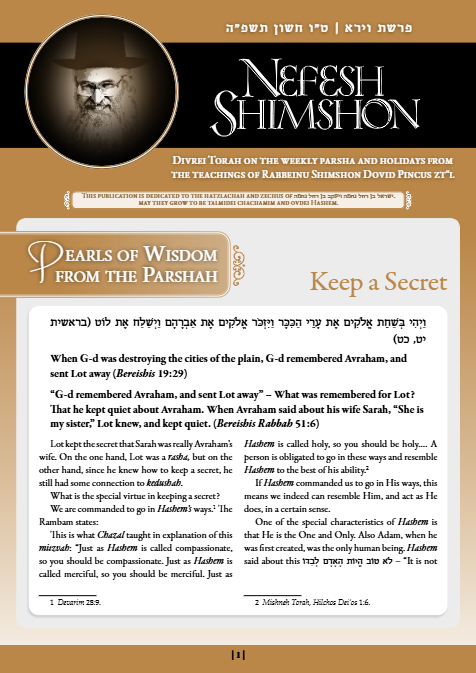

He raised his eyes and saw, and there were three people standing near him. He saw, and ran toward them from the entrance of the tent. (Bereishis 18:2)

These verses tell us about the wondrous chesed of Avraham Avinu to his guests who appeared as lowly travelers. Avraham Avinu was already recognized at that time as a world leader. Although he was such a distinguished personality and was also recovering from milah at the advanced age of 100, he sat at the entrance of his tent in the searing heat because he could not tolerate the lack of guests.

When a few people finally passed by, he begged them to be his guests. Then he made himself into their servant, bringing them everything they needed and more. Three whole bulls were slaughtered for them, so each one could be served his own veal. Avraham also asked for an enormous amount of bread to be baked for them. Avraham’s chesed knew no limits.

Avraham was the very embodiment of chesed, and the idea of chesed is limitless expansiveness. The opposite of chesed is not stinginess, but restrictiveness.

A guest is normally honored according to his status. If he is a VIP he can usually expect special treatment. However, such an approach to hospitality stems from restrictiveness. The host is able to treat his guest more lavishly, but restricts the amount that is lavished on the guest according to his status.

Avraham Avinu was not like this. Even if someone as great as Moshe Rabbeinu would arrive on his doorstep, he would receive exactly the same treatment as these lowly, unknown travelers did, because there simply was no more that could be given. Avraham Avinu always gave the maximum, no matter who it was. This is the idea of chesed in its purest form: expansiveness without limit.

Rivkah did the same, as we see from the chesed test that Eliezer, Avraham’s right-hand man, put her through. She was just a three-year-old girl, and she drew enormous amounts of water for Eliezer and his ten camels, despite the fact that Eliezer had servants with him who could have done the job. She did the maximum that could be done. This is the true concept of chesed.

The question is whether we, the descendants of Avraham Avinu, who follow in his footsteps, need to do the same? Let’s see we see a ragged, lowly person walking down the street. Do we need run after him and invite him in and treat him like a king? If we saw such a person working at a building site, would we ask our little girl to go and help him lift the bricks?

The answer is there is a fundamental difference between the Avos and us. This is like the difference between the element of fire and actual fire. The element of fire is fire in its quintessential, pure state. This is not like the fire familiar to us, which is composed also of earth, water and air, because everything in the world is composed of the four elements.

How hot is the element of fire? Infinitely hot, because an element in its pure, quintessential state has unlimited power. But the fire familiar to us has a measurable, limited temperature.

Everything in the world has its ideal, quintessential state, and its practical expression. For instance, hot and cold. Hot in its pure state reaches a temperature in the millions or maybe even higher. And the opposite is true with cold. But our water starts boiling at 212 °F. This is a big difference.

Avraham Avinu didn’t just do chesed. He was the pillar of chesed. He was the very embodiment of the quality of chesed, so he gave limitlessly. And the same was true with Rivkah. She was one of the Imahos, and it was not sufficient for her to just do chesed. To be among the Imahos, she needed to embody the concept of chesed.

The word חסד denotes embarrassment and shame, as Rashi says on Vayikra 20:17. This is because a baal chesed gives to such an extent that the recipient turns white from shame. Chesed means giving to such an extent that it embarrasses the recipient.

If we give to this one more because he “deserves” it, and to that one less because he doesn’t “deserve” it, this is not chesed in its purest form. This is giving with an element of judgment mixed in. Only giving without limit and discretion is true, pure chesed.

We practice chesed as we received it from Moshe Rabbeinu. We received it through the channel of Torah. Thus, we practice it according to the halachos and parameters stated in the Torah, each person according to his abilities. We inherited the trait of chesed from Avraham Avinu, we learn about chesed from Avraham Avinu, but we practice it according to the guidelines of the Torah.

However, a Jew’s chesed is still fundamentally different from that of a non-Jew. A non-Jew who is a philanthropist will give as it seems reasonable and logical to him. He will give a million dollars to a big institution and a hundred dollars to a needy individual. But among Jews, most campaigns raise money for needy individuals and families. A hundred thousand dollars is often raised for one sick Jew. This is true chesed.

Also in avodas Hashem, there is a concept of chesed and din.

Let’s say a person picks up a cup full of a refreshing, cold drink on a hot, burning summer day. He recites a rushed berachah and immediately swallows down the drink.

We ask him: Why didn’t you recite that berachah more slowly and carefully?

He answers: Look, I don’t understand what’s the big deal. I’m a frum Jew. I recite a hundred berachos a day. In a year, there are 365 days. So I recite about 350,000 berachos during the course of a year. And I hope to live to be hundred, b’ezras Hashem. During my lifetime I will be reciting about three-and-a-half million berachos.

This berachah I recited right now is just one three-millionth of all that, or even less. What’s so special and unique about it, that I should recite it slowly and with full kavanah?

This is an example of din. This person is evaluating the relative value of this particular berachah against that of the other berachos, and according to that, he determines how he will relate to the berachah.

True chesed means acting properly, doing things right, in every moment and at all times. Without limit. This applies in mitzvos between a person and Hashem and in interpersonal matters as well.

PDF Preview