Hosting and Attending a Bris Seudah and More
Limuday Moshe | November 02, 2023
Print This Article
View Original PDF

Hosting and Attending a Bris Seudah and More

Limuday Moshe | December 31, 2025

In this week’s parsha we learn about the first bris seudah that took place in the history of the world. The pasuk writes, in reference to Yitzchok: ויגדל הילד ויגמל ויעש אברהם משתה גדול ביום הגמל את יצחק - “The child grew and was weaned; and Avraham made a great feast on the day Yitzchok was weaned” (Bereishis 21:8). As we will see, some learn from the above pasuk the mitzvah to make a bris seudah [celebratory meal], consequently, this week we will discuss some halachos related to the seudas mitzvah made by a bris. What is the nature of the mitzvah to hold a celebratory meal in honor of the bris? Are others obligated to participate in the meal? Should a meat meal be served? And why are some careful not to invite others to their bris celebration? For answers to this and more, read on.

Pirkei D’Rabbi Eliezer

Although we translated הגמל, to mean the day Yitzchok was weaned, the Pirkei D’Rabbi Eliezer (Perek 29) translates it differently, and understands it refers to a bris seudah. The Pirkei D’Rabbi Eliezer writes as follows: רבי ישמעאל אומר לא עכב אברהם מכל אשר צוהו וכשנולד יצחק בן שמונה ימים הגישו למילה שנאמר וימל אברהם את יצחק בנו בן שמונת ימים והגישו למנחה על גבי המזבח ועשה שמחה ומשתה מכאן אמרו חכמים חייב אדם לעשות שמחה ומשתה באותו היום שזכה למול את בנו כאברהם אבינו שנאמר ויעשה אברהם משתה גדול ביום הגמל את יצחק. - “R’ Yishmoel said: Avraham didn’t delay with anything Hashem commanded him to do. As soon as Yitzchok was eight days old, Avraham performed bris milah as it says, “And Avraham circumcised his son Yitzchok when he was eight days old”. He offered him up like one offers a mincha offering on the mizbe’ach and he made a great celebration and a party. From here Chazal learn: One is obligated to make a celebration and a party on the day one merits to perform a bris milah on his son, like we find by Avraham Avinu as it says, “Avraham made a great feast on the day he performed milah on his son Yitzchok”.

Tosfos in Shabbos (130a) quotes the above Pirkei D’Rabbi Eliezer and adds a remez [hint]. The Gemara in Shabbos (130a )teaches:כל מצוה שקיבלו עליהם בשמחה כגון מילה דכתיב שש אנכי על אמרתך כמוצא שלל רב עדיין עושין אותה בשמחה – “Any mitzvah that Yisroel Klal accepted upon themselves with joy, such as bris milah, by which it is written ‘I rejoice at Your word as one who finds great spoil’, they still perform with great joy”.

On the above Gemara, Tosfos writes: במדרש (שוחר טוב) למנצח על השמינית כתיב הנדרש על המילה שהיא בשמיני וכן אמרי' (פר"א פ' כ"ט) ויעש אברהם משתה גדול ביום הג מל את יצחק ביום ה"ג מל את יצחק דהיינו ביום השמיני דמילה. - “The Medrash (Sochar Tov) on the Chapter of Tehillim that starts, “For the musician, upon the eight-stringed instrument” (למנצח על השמינית), writes that this song refers to bris milah which is performed on the eighth day. Similarly, the Pirkei D’Rabbi Eliezer writes: Avraham made a great seudah on the day he performed Yitzchok’s bris. ביום הגמל = ביום ה"ג מל, which means that on day 8 (5+3) Avraham performed bris milah on his son Yitzchok.”

Hero of the Earth

Another Medrash adds that the reward for a father making a big mishteh [feast] on the day of his son’s bris is that he will have a child who will be a gibbor aretz, which could be translated as a “hero of the earth.” The examples in the Medrash are “like Yitzchok, whose tefillos allowed a barren woman to give birth” or “like Yaakov, who defeated an angel” (Medrash Tehillim to Perek 112).

Rabbeinu Bechaye

Another fascinating early source for making a bris seudah can be found in Rabbeinu Bechaye in last week’s parsha (17:13): וע"ד המדרש מצות מילה היא כענין קרבן וכשם שדם הקרבן לכפרה על המזבח כך דם המילה מכפר ועל כן מצותה ביום השמיני כי הקרבן לא יכשר עד יום ח' שנאמר (ויקרא כ"ב:כ"ז) ומיום השמיני והלאה ירצה וכשם שכתוב בקרבן (שמות כ"ט:ל"ג) ואכלו אותם אשר כפר בהם שאכילת הקרבן לכפרה כך ישראל עושין סעודה ביום המילה ועוד גדול כחה יותר מן הקרבן שהקרבן בממונו והמילה בגופו באבר שכל גידי האברים נקשרים בו אשר מטעם זה נקרא ראש הגו יה כלומר ראש כל הגוף ועל כן חשוב לו לעקדה וזבח כאלו עקד את עצמו. – “A Medrashic approach to our pasuk views the mitzvah of milah similar to the offering up of a korban. Just like when one offers a korban on the mizbe’ach the blood of the korban achieves atonement for him, so to the blood lost by one having a bris milah acts as atonement for him. This is why this rite has to be performed on the eighth day of the baby’s life. Just as an animal korban can’t be brought until the eighth day of the animal’s life as it says (Vayikra 22:27) “and from the eighth day on it will be welcome as a korban for Hashem”. In connection with korbanos the Torah writes (Shemos 29:33) “They - who received atonement through them (the korbanos) - shall eat them” so to we make a festive meal to celebrate the day of a bris milah. In fact, the effect of a bris is far greater than that of a korban. A korban represents only a financial sacrifice by the donor whereas a bris involves his body. The organ which is cut is one that radiates feelings to all parts of the body of the person concerned. This is why it is called הגויה ראש, “head of the whole body” (Negoim 6:7). This is why this organ was chosen to serve as a demonstration of self-sacrifice and why someone who undergoes milah is considered in the eyes of Hashem as if he had sacrificed his entire body on Hashem’s behalf.”

Ramban

A further source for making a bris seudah is a Ramban in Parshas Yisro. The pasuk says:ויבא אהרן וכל זקני ישראל לאכל לחם עם חתן משה לפני אלקים – “And Aharon and all the elders of Yisroel came to eat bread with the father-in-law of Moshe (Yisro) in front of Hashem”. The obvious question is, what were they celebrating? The Ramban explains, they were having a bris seudah.

Remez

A hint to the obligation to make a bris seudah can be found in the word milah itself. The Zocher HaBris (25:1) cites the Mateh Moshe who says, the word מילה stands for, משתה יעשה לכל הקרואים – a feast shall be made for all those who are called.

Shulchan Aruch

After showing that making a bris seudah has early sources it’s not surprising that the Shulchan Aruch (Yoreh Deah 265:12) rules:נוהגים המילה ביום סעודה לעשות - “It is customary to hold a feast on the day of the bris”.

What is the Nature of the Obligation to Make a Bris Seudah?

From the aforementioned lashon [language] of the Shulchan Aruch, it would seem that the obligation to make a bris seudah is neither de’O’raisa or derabonon, rather it’s simply a minhag, a nice customary thing to do, however, if one would choose not to make one, he wouldn’t be doing anything wrong.

The Sha’arei Teshuva in Hilchos Tisha B’Av (Orach Chaim 551) cites the opinion of the Ohr Ne’elam who learns that making a bris seudah is actually a de’O’raisa. The Ohr Ne’elam cites proof from a Rashi in Niddah. The Gemara in Niddah (31b) asks: מפני מה אמרה תורה מילה לשמונה שלא יהו כולם שמחים ואביו ואמו עצבים – “Why does the Torah say that one should perform a bris milah on the eighth day? In order that it shouldn’t be a situation where everyone is rejoicing, and the father and mother are upset.” Rashi explains:שאוכלין ושותין בסעודה ואביו ואמו עצבים שאסורין בתשמיש – “Everyone else is eating and drinking at the seudah, and the father and mother are upset as they are forbidden to have marital relations”. In the times of the Gemara, a woman who gave birth was only tomei [impure] for seven days, therefore, we wait until day eight to do the bris, in order that the father and mother can get back together, and everyone will be happy.

The above Gemara is coming to explain how the Torah could say that one only needs to perform a bris on day eight, and the Gemara answers because we want everyone to be happy at the seudah. If the whole concept of a bris seudah was derabonon, why would the Torah fix the bris to be on day eight because of it, therefore, concludes the Ohr Ne’elam, it must be a bris seudah is de’O’raisa.

The above opinion however is a da’as yochid [individual opinion] and we don’t take on like this. We take on like the Mechaber who says it’s a minhag. The Sha’arei Teshuva concludes, since it’s a universal minhag [custom] it has the status of a mitzvah derabanon.

Regardless of its status, it certainly has the din of a seudas mitzvah, and in Hilchos Tisha B’Av the Mechaber (Orach Chaim 554) rules, that if one makes a seudas mitzvah in the nine days he is allowed to eat meat, and one of the examples mentioned is a seudas bris.

How Many People Need to Participate?

The Shulchan Aruch (Yoreh Deah 265:6) rules: “When possible, one should perform the bris in front of ten people. If it’s not possible, then in front of less than ten people is also ok”.

The question is, why should one ideally perform the bris in front of ten people?

Reasons for Needing Ten People

A number of reasons are mentioned by the poskim:

  1. The Chochmas Adam (149:21) offers two reasons for why one should ideally have ten people. The first reason he brings is because of pirsumay mitzvah, to publicize the mitzvah.
  2. A second reason he brings is, when a child is born it’s as if he has just come out of prison (see Rabbeinu Tam, cited in Tosfos Bava Kamma 80a), and he needs to thank Hashem in front of ten people. The Mateh Moshe adds, that this is why the tzibbur says הודו לה' כי טוב, as really the child should be thanking Hashem, but because he can’t speak, the tzibbur says it in his place (see Rosh al HaTorah, Lech Lecha who says the same thing).
  3. The Ohr Zarua (Hilchos Milah 107) cites a Pirkei D’ Rabbi Eliezer (Perek 11) which says, “Any eidus [testimony] which Hashem gives over to Klal Yisroel is always given over in front of ten”, therefore, to ensure that there is eidus that the father fulfilled the mitzvah of milah, we try to do it in front of at least ten people.
  4. The Sefer HaBris (Yoreh Deah 265:166) cites the Gemara in Kesubos (8a) which says that if it wasn’t for the fact that the infant was in pain, we would recite the berachah of שהשמחה במעונו – “joy is in His abode”. We see that the Shechinah is at the bris, however, the Shechinah only rests when there are ten people, so to ensure the Shechinah comes, we try and have ten people.
  5. Finally, the Sefer Derech Pikudecha (Mitzvas Aseh 2, ois 12) cites a Zohar, that at the time the orlah [foreskin] is cut at a bris, Hashem gathers all his malochim and increases the presence of His Shechinah on Klal Yisroel in merit of the bris. Since the Shechinah comes, we try to perform the bris in front of as many possible as possible. Therefore, he concludes, even if there is ten, the more people that can attend the better.

Based on the above, some explain that this is why we say Aleinu after performing a bris. Just like by kiddush levonah we recite Aleinu because when we recite kiddush levonah we are greeting the Shechinah (mekablim pnei haShechinah), similarly, since at a bris there is kabbolas pnei Shechinah we also end off with Aleinu.

Participating in the Meal

The Gemara in Pesochim (113b) teaches:שבעה מנודין לשמים אלו הן יהודי שאין לו אשה ושיש לו אשה ואן לו בנים ומי שיש לו בנים ואין מגדלן לתלמוד תורה ומי שאין לו תפילין בראשו ותפילין בזרועו וציצית בבגדו ומזוזה בפתחו והמונע מנעלים מרגליו ויש אומרים אף מי שאין מיסב בחבורה של מצוה – “Seven groups of people are in excommunication from Heaven: A Jew who does not have a wife, one who has a wife but has no sons, one who has sons whom he does not raise to engage in Torah study, one who does not have tefillin on his head or on his arm, tzitzis on his garment, a mezuzah on his doorway, and one who withholds shoes from his feet. And some say: Also one who does not sit with a group that is partaking of a feast in celebration of a mitzvah.”

One of the people the Gemara lists, is one who doesn’t partake of a seudas mitzvah. What type of seudas mitzvah are we talking about? Tosfos (114a) explains:היינו סעודת מילה דאמר במדרש דניצול מדינה של גיהנם וסעודת נישואין בת"ח ובת כהן לכהן ודוקא שיש שם בני אדם מהוגנין כדאמרינן בזה בורר נקיי הדעת שבירושלים לא היו מסובין בסעודה אלא אם כן יודעין מי מיסב עמהם – “The Gemara refers to a seudas bris milah, as it says in the Medrash, one who attends a seudas bris milah will be saved from gehenem, and a chasunah seudah of a talmud chocham and a daughter of a Kohen to a Kohen. (Tosfos adds:) The above only applies if the people who are attending the seudah are respectable well-mannered people, like the Gemara says in Sanhedrin: The chosuva [respectable] people in Yerusholayim wouldn’t sit down to eat, unless they knew who they were dining with.”

The Rema rules accordingly:וכל מי שאינו אוכל בסעודת מילה הוי כמנודה לשמים ודוקא שנמצאו שם בני אדם מהוגנים אבל אם נמצאו שם בני אדם שאינו מהוגנים א״צ לאכול שם – “Anyone who doesn’t eat a bris seudah is viewed as if he is excommunicated from Heaven. However, that’s only if there are respectable well-mannered people there. If, however, there are people there who are not worthy to sit with, one doesn’t need to eat there”

Inviting Others to the Meal

Due to the Rema’s ruling, some poskim write that one should not directly invite people to a bris (using the words “you are invited to the bris”). Rather, it is customary to simply inform friends and community members of the bris (“the bris will take place on such-and-such a day, at such-and-such an hour”), without issuing a formal invitation. This is done so that if the guest is unable to participate in the ceremony, his declining the invitation will not be interpreted as a refusal to take part in the festive meal, thereby sparing him the risk of “excommunication from Heaven” (Pischei Teshuvah, Yoreh De’ah 265:18). The Be’er Heitev Hayashan (Yoreh De’ah 265:5) notes that when somebody will not be able to attend he should not be invited, and the Mekom Shmuel (cited in the Pischei Teshuvah) extends this to people in general even if they can attend.

Oops! I Got Invited, Now What?

To avoid getting people in trouble for not attending, we avoid inviting directly. However, what happens if one does get invited explicitly, and he has an important meeting, work, or he needs to go kollel etc. and he can’t attend. Is there any way out?

The are a number of solutions mentioned in the poskim:

Firstly, the Kores HaBris points out, the Gemara in Pesochim from where we learn that if one doesn’t attend a bris seudah he gets excommunicated from Heaven is a machlokes [dispute]. The Gemara writes:ויש אומרים אף מי שאין מיסב בחבורה של מצוה - “And some say: Also one who does not sit with a group that is partaking of a feast in celebration of a mitzvah”, which implies others argue. So, who says we pasken like the “some say”, perhaps we pasken like the other opinion.

Practically, however, in the end of the day we follow the Rema, and the Rema paskened one does get excommunicated, so we have to come up with another solution.

The Hegyonay HaParsha (Parshas Lech Lecha) cites the sefer Sha’arei Aharon, who asked the Chazon Ish if there is any heter not to join. He cites that the Chazon Ish told him, the Rema adds that there is only a problem if: שנמצאו שם בני אדם מהוגנים – “if there are good worthy people at the seudah”, however, if there are unworthy people, then there is no problem of not attending. Nowadays, most people are considered unworthy people, therefore, there is nothing wrong if one doesn’t attend.

The Sha’arei Aharon probed the Chazon Ish a bit further and asked, what the definition of: בני אדם שאינו מהוגנים – “unworthy people” is. The Chazon Ish responded by citing three examples, 1) One who isn’t careful with netilas yodayim [washing his hands], 2) One who isn’t careful with cleaning himself after using the beis hakisay (אינו זהיר בקינוח בית הכסא), 3) One who isn’t careful about concentrating during shemonah esrei. If one isn’t careful with any of the above, he is considered אינו הגון – unworthy. According to the above, it’s virtually impossible to find a bris seudah which doesn’t have “unworthy people” sitting there, which means, nowadays there is nothing wrong with not attending a bris seudah.

Another argument mentioned by the poskim is, that the ruling of the Rema only applies to guests who are present at the bris seudah and refuse to take part, by doing so, they show disdain for the mitzvah. This cannot be said to someone who is absent altogether.

The Shu”t Sho’el Venish’al (Vol. 7, Yoreh De’ah 209) writes that the lenient ruling on inviting others emerges from the wording of the Rema himself, who states that somebody who does not participate in the bris is considered as though he is excommunicated from Heaven. The next sentence, stating that where unworthy people are present one need not join the meal, implies that the reference is to somebody actually present at the meal.

Missing Talmud Torah to Attend a Bris

If one needs to go to learn the poskim are very lenient.

The Shiltay HaGiborim (Megillah 2b, MiDafay HaRif) writes, that one is obligated to interrupt learning Torah to attend a bris. The mitzvah of bris milah is greater than the mitzvah of accompanying the dead (hotzaos hames), and if one is obligated to interrupt Torah for accompanying the dead then certainly one is obligated to interrupt Torah to attend a bris.

R’ Shlomah Zalman Auerbach (he’oras on Otzar HaBris, 1:11:3) asks why such a din is not mentioned in the Shulchan Aruch or by any of the poskim.

R’ Yaakov Yisroel Fisher, in his Shu”t Even Yisroel (7:36:8) suggests a very simple answer. By the mitzvah of accompanying the dead, everyone who partakes gets a mitzvah, by a bris, however, those in attendance don’t get any mitzvah, they simply help there be rov am hadras melech [the more people in attendance, the more glory there is for Hashem], since there is no mitzvah, there is no heter to interrupt learning.

R’ Moshe Sternbuch (Teshuvos V’Hanagos 4:226) also writes, one shouldn’t interrupt learning to attend a bris seudah, unless his absence will be noticed.

He cites proof from an interesting Leket Yosher. Some bochurim in the Leket Yosher’s yeshiva wanted to go a bris milah. The Leket Yosher told them, “why do you need to run to a bris milah to answer ‘amen’, go to a slaughterhouse and you will hear more berachos there”. We see that the Leket Yosher, the Rebbe of the Terumas HaDeshen held, that if one is busy learning he shouldn’t be running off to a bris.

However, R’ Moshe says, perhaps bochurim are different, as it’s clear from the Yerushalmi in Chagigah that bochurim shouldn’t miss learning at all costs.

Tefillah B’Tzibbur

The Kaf HaChaim (Sofer, 90:67) writes that even when formally invited to a seudas mitzvah, one who will not be able to daven with the tzibbur [congregation] if he attends the bris should not attend the bris, and he is not looked upon as one who refuses to take part in the commandment.

Already a Minyan

There are also opinions that if there is already a minyan at the meal, additional guests are not obligated to take part, for the mitzvah of the meal will be fulfilled without him (see Otzar HaBris, p. 163).

The Offended Cousin

For some, the absence of a formal, straightforward invitation can be misinterpreted as a sign of disregard, and is liable to make the person in question feel unwanted. In such cases, it is certainly better to invite him in a clear and unmistakable manner.

The Difference Between a Bris Seudah and a Chasunah

The aformentioned Tosfos in Pesochim cites two examples of what a חבורה של מצוה – “a feast in celebration of a mitzvah” is, where if one doesn’t attend he will be excommunicated from Heaven. The first one was a seudas bris milah and the second one was a chasunah. The question therefore is, how come when it comes to making a chasunah people don’t say “I am making a chasunah in such and such a place at such and such a time, I’m not inviting you, I’m just letting you know about it”. On the contrary, not only do people send invitations, they even expect reply cards responding if you will be attending or not, and we don’t find anyone makes a fuss about it, why aren’t we worried about the excommunication from Heaven?

The Igros Moshe’s Approach

R’ Moshe Feinstein (Igros Moshe, Orach Chaim 2:95) deals with the above question. He quotes the Rema who says: “Anyone who doesn’t take part in a seudas bris will be excommunicated from Heaven”. Then he asks, why does the Rema only quote the part of Tosfos which talks about a bris seudah, why doesn’t he also bring the same thing by a chasunah seudah?

On the above Rema, there is a very cryptic Gaon, the Gaon writes: עתוס׳ דפסחים קיד א׳ ד״ה ואין כו׳ – “see Tosfos in Pesochim 114a d’h v’ein etc.” R’ Moshe understands the Gaon is asking, that Tosfos mentions both a seudas bris milah and a chasunah seudah, so why does the Rema only mention a seudas bris?

R’ Moshe answers, the reason one gets excommunicated from Heaven for not attending a bris seudah, isn’t because if one is invited he has a chiyuv to go, and if he doesn’t go he gets punished. If someone doesn’t eat matzah on Pesach, or shake lulav on Succos, we don’t find he receives excommunication from Heaven. The reason one gets excommunicated from Heaven for not attending a bris seudah is because if he doesn’t attend, it shows a lack of respect for the mitzvah of bris milah. By the mitzvah of bris milah one has to be very careful to show it the correct respect, and if one doesn’t he gets punished, something which we don’t find by a chasunah.

R’ Moshe doesn’t explain why this lack of respect is only a problem by bris milah, but perhaps the reason is, we find the mitzvah of milah was: נכרת בי״ג בריתות – “given over with 13 covenants” and we also find there are only two mitzvos in the Torah that one is chayav kores for not keeping, bris milah and korban pesach. We see that the mitzvah of bris milah is a very yesodosdika [foundational] mitzvah, therefore, one has to treat it with more respect than a chasunah.

It’s worthy to note, that the Levush (Orach Chaim, Minhagim 34) in fact equates the two, mentioning both examples: a chasunah, and a bris seudah.
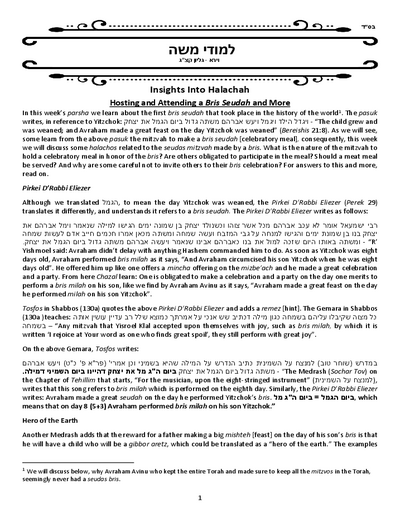
In this week’s parsha we learn about the first bris seudah that took place in the history of the world. The pasuk writes, in reference to Yitzchok: ויגדל הילד ויגמל ויעש אברהם משתה גדול ביום הגמל את יצחק - “The child grew and was weaned; and Avraham made a great feast on the day Yitzchok was weaned” (Bereishis 21:8). As we will see, some learn from the above pasuk the mitzvah to make a bris seudah [celebratory meal], consequently, this week we will discuss some halachos related to the seudas mitzvah made by a bris. What is the nature of the mitzvah to hold a celebratory meal in honor of the bris? Are others obligated to participate in the meal? Should a meat meal be served? And why are some careful not to invite others to their bris celebration? For answers to this and more, read on.

Pirkei D’Rabbi Eliezer

Although we translated הגמל, to mean the day Yitzchok was weaned, the Pirkei D’Rabbi Eliezer (Perek 29) translates it differently, and understands it refers to a bris seudah. The Pirkei D’Rabbi Eliezer writes as follows: רבי ישמעאל אומר לא עכב אברהם מכל אשר צוהו וכשנולד יצחק בן שמונה ימים הגישו למילה שנאמר וימל אברהם את יצחק בנו בן שמונת ימים והגישו למנחה על גבי המזבח ועשה שמחה ומשתה מכאן אמרו חכמים חייב אדם לעשות שמחה ומשתה באותו היום שזכה למול את בנו כאברהם אבינו שנאמר ויעשה אברהם משתה גדול ביום הגמל את יצחק. - “R’ Yishmoel said: Avraham didn’t delay with anything Hashem commanded him to do. As soon as Yitzchok was eight days old, Avraham performed bris milah as it says, “And Avraham circumcised his son Yitzchok when he was eight days old”. He offered him up like one offers a mincha offering on the mizbe’ach and he made a great celebration and a party. From here Chazal learn: One is obligated to make a celebration and a party on the day one merits to perform a bris milah on his son, like we find by Avraham Avinu as it says, “Avraham made a great feast on the day he performed milah on his son Yitzchok”.

Tosfos in Shabbos (130a) quotes the above Pirkei D’Rabbi Eliezer and adds a remez [hint]. The Gemara in Shabbos (130a )teaches:כל מצוה שקיבלו עליהם בשמחה כגון מילה דכתיב שש אנכי על אמרתך כמוצא שלל רב עדיין עושין אותה בשמחה – “Any mitzvah that Yisroel Klal accepted upon themselves with joy, such as bris milah, by which it is written ‘I rejoice at Your word as one who finds great spoil’, they still perform with great joy”.

On the above Gemara, Tosfos writes: במדרש (שוחר טוב) למנצח על השמינית כתיב הנדרש על המילה שהיא בשמיני וכן אמרי' (פר"א פ' כ"ט) ויעש אברהם משתה גדול ביום הג מל את יצחק ביום ה"ג מל את יצחק דהיינו ביום השמיני דמילה. - “The Medrash (Sochar Tov) on the Chapter of Tehillim that starts, “For the musician, upon the eight-stringed instrument” (למנצח על השמינית), writes that this song refers to bris milah which is performed on the eighth day. Similarly, the Pirkei D’Rabbi Eliezer writes: Avraham made a great seudah on the day he performed Yitzchok’s bris. ביום הגמל = ביום ה"ג מל, which means that on day 8 (5+3) Avraham performed bris milah on his son Yitzchok.”

Hero of the Earth

Another Medrash adds that the reward for a father making a big mishteh [feast] on the day of his son’s bris is that he will have a child who will be a gibbor aretz, which could be translated as a “hero of the earth.” The examples in the Medrash are “like Yitzchok, whose tefillos allowed a barren woman to give birth” or “like Yaakov, who defeated an angel” (Medrash Tehillim to Perek 112).

Rabbeinu Bechaye

Another fascinating early source for making a bris seudah can be found in Rabbeinu Bechaye in last week’s parsha (17:13): וע"ד המדרש מצות מילה היא כענין קרבן וכשם שדם הקרבן לכפרה על המזבח כך דם המילה מכפר ועל כן מצותה ביום השמיני כי הקרבן לא יכשר עד יום ח' שנאמר (ויקרא כ"ב:כ"ז) ומיום השמיני והלאה ירצה וכשם שכתוב בקרבן (שמות כ"ט:ל"ג) ואכלו אותם אשר כפר בהם שאכילת הקרבן לכפרה כך ישראל עושין סעודה ביום המילה ועוד גדול כחה יותר מן הקרבן שהקרבן בממונו והמילה בגופו באבר שכל גידי האברים נקשרים בו אשר מטעם זה נקרא ראש הגו יה כלומר ראש כל הגוף ועל כן חשוב לו לעקדה וזבח כאלו עקד את עצמו. – “A Medrashic approach to our pasuk views the mitzvah of milah similar to the offering up of a korban. Just like when one offers a korban on the mizbe’ach the blood of the korban achieves atonement for him, so to the blood lost by one having a bris milah acts as atonement for him. This is why this rite has to be performed on the eighth day of the baby’s life. Just as an animal korban can’t be brought until the eighth day of the animal’s life as it says (Vayikra 22:27) “and from the eighth day on it will be welcome as a korban for Hashem”. In connection with korbanos the Torah writes (Shemos 29:33) “They - who received atonement through them (the korbanos) - shall eat them” so to we make a festive meal to celebrate the day of a bris milah. In fact, the effect of a bris is far greater than that of a korban. A korban represents only a financial sacrifice by the donor whereas a bris involves his body. The organ which is cut is one that radiates feelings to all parts of the body of the person concerned. This is why it is called הגויה ראש, “head of the whole body” (Negoim 6:7). This is why this organ was chosen to serve as a demonstration of self-sacrifice and why someone who undergoes milah is considered in the eyes of Hashem as if he had sacrificed his entire body on Hashem’s behalf.”

Ramban

A further source for making a bris seudah is a Ramban in Parshas Yisro. The pasuk says:ויבא אהרן וכל זקני ישראל לאכל לחם עם חתן משה לפני אלקים – “And Aharon and all the elders of Yisroel came to eat bread with the father-in-law of Moshe (Yisro) in front of Hashem”. The obvious question is, what were they celebrating? The Ramban explains, they were having a bris seudah.

Remez

A hint to the obligation to make a bris seudah can be found in the word milah itself. The Zocher HaBris (25:1) cites the Mateh Moshe who says, the word מילה stands for, משתה יעשה לכל הקרואים – a feast shall be made for all those who are called.

Shulchan Aruch

After showing that making a bris seudah has early sources it’s not surprising that the Shulchan Aruch (Yoreh Deah 265:12) rules:נוהגים המילה ביום סעודה לעשות - “It is customary to hold a feast on the day of the bris”.

What is the Nature of the Obligation to Make a Bris Seudah?

From the aforementioned lashon [language] of the Shulchan Aruch, it would seem that the obligation to make a bris seudah is neither de’O’raisa or derabonon, rather it’s simply a minhag, a nice customary thing to do, however, if one would choose not to make one, he wouldn’t be doing anything wrong.

The Sha’arei Teshuva in Hilchos Tisha B’Av (Orach Chaim 551) cites the opinion of the Ohr Ne’elam who learns that making a bris seudah is actually a de’O’raisa. The Ohr Ne’elam cites proof from a Rashi in Niddah. The Gemara in Niddah (31b) asks: מפני מה אמרה תורה מילה לשמונה שלא יהו כולם שמחים ואביו ואמו עצבים – “Why does the Torah say that one should perform a bris milah on the eighth day? In order that it shouldn’t be a situation where everyone is rejoicing, and the father and mother are upset.” Rashi explains:שאוכלין ושותין בסעודה ואביו ואמו עצבים שאסורין בתשמיש – “Everyone else is eating and drinking at the seudah, and the father and mother are upset as they are forbidden to have marital relations”. In the times of the Gemara, a woman who gave birth was only tomei [impure] for seven days, therefore, we wait until day eight to do the bris, in order that the father and mother can get back together, and everyone will be happy.

The above Gemara is coming to explain how the Torah could say that one only needs to perform a bris on day eight, and the Gemara answers because we want everyone to be happy at the seudah. If the whole concept of a bris seudah was derabonon, why would the Torah fix the bris to be on day eight because of it, therefore, concludes the Ohr Ne’elam, it must be a bris seudah is de’O’raisa.

The above opinion however is a da’as yochid [individual opinion] and we don’t take on like this. We take on like the Mechaber who says it’s a minhag. The Sha’arei Teshuva concludes, since it’s a universal minhag [custom] it has the status of a mitzvah derabanon.

Regardless of its status, it certainly has the din of a seudas mitzvah, and in Hilchos Tisha B’Av the Mechaber (Orach Chaim 554) rules, that if one makes a seudas mitzvah in the nine days he is allowed to eat meat, and one of the examples mentioned is a seudas bris.

How Many People Need to Participate?

The Shulchan Aruch (Yoreh Deah 265:6) rules: “When possible, one should perform the bris in front of ten people. If it’s not possible, then in front of less than ten people is also ok”.

The question is, why should one ideally perform the bris in front of ten people?

Reasons for Needing Ten People

A number of reasons are mentioned by the poskim:

  1. The Chochmas Adam (149:21) offers two reasons for why one should ideally have ten people. The first reason he brings is because of pirsumay mitzvah, to publicize the mitzvah.
  2. A second reason he brings is, when a child is born it’s as if he has just come out of prison (see Rabbeinu Tam, cited in Tosfos Bava Kamma 80a), and he needs to thank Hashem in front of ten people. The Mateh Moshe adds, that this is why the tzibbur says הודו לה' כי טוב, as really the child should be thanking Hashem, but because he can’t speak, the tzibbur says it in his place (see Rosh al HaTorah, Lech Lecha who says the same thing).
  3. The Ohr Zarua (Hilchos Milah 107) cites a Pirkei D’ Rabbi Eliezer (Perek 11) which says, “Any eidus [testimony] which Hashem gives over to Klal Yisroel is always given over in front of ten”, therefore, to ensure that there is eidus that the father fulfilled the mitzvah of milah, we try to do it in front of at least ten people.
  4. The Sefer HaBris (Yoreh Deah 265:166) cites the Gemara in Kesubos (8a) which says that if it wasn’t for the fact that the infant was in pain, we would recite the berachah of שהשמחה במעונו – “joy is in His abode”. We see that the Shechinah is at the bris, however, the Shechinah only rests when there are ten people, so to ensure the Shechinah comes, we try and have ten people.
  5. Finally, the Sefer Derech Pikudecha (Mitzvas Aseh 2, ois 12) cites a Zohar, that at the time the orlah [foreskin] is cut at a bris, Hashem gathers all his malochim and increases the presence of His Shechinah on Klal Yisroel in merit of the bris. Since the Shechinah comes, we try to perform the bris in front of as many possible as possible. Therefore, he concludes, even if there is ten, the more people that can attend the better.

Based on the above, some explain that this is why we say Aleinu after performing a bris. Just like by kiddush levonah we recite Aleinu because when we recite kiddush levonah we are greeting the Shechinah (mekablim pnei haShechinah), similarly, since at a bris there is kabbolas pnei Shechinah we also end off with Aleinu.

Participating in the Meal

The Gemara in Pesochim (113b) teaches:שבעה מנודין לשמים אלו הן יהודי שאין לו אשה ושיש לו אשה ואן לו בנים ומי שיש לו בנים ואין מגדלן לתלמוד תורה ומי שאין לו תפילין בראשו ותפילין בזרועו וציצית בבגדו ומזוזה בפתחו והמונע מנעלים מרגליו ויש אומרים אף מי שאין מיסב בחבורה של מצוה – “Seven groups of people are in excommunication from Heaven: A Jew who does not have a wife, one who has a wife but has no sons, one who has sons whom he does not raise to engage in Torah study, one who does not have tefillin on his head or on his arm, tzitzis on his garment, a mezuzah on his doorway, and one who withholds shoes from his feet. And some say: Also one who does not sit with a group that is partaking of a feast in celebration of a mitzvah.”

One of the people the Gemara lists, is one who doesn’t partake of a seudas mitzvah. What type of seudas mitzvah are we talking about? Tosfos (114a) explains:היינו סעודת מילה דאמר במדרש דניצול מדינה של גיהנם וסעודת נישואין בת"ח ובת כהן לכהן ודוקא שיש שם בני אדם מהוגנין כדאמרינן בזה בורר נקיי הדעת שבירושלים לא היו מסובין בסעודה אלא אם כן יודעין מי מיסב עמהם – “The Gemara refers to a seudas bris milah, as it says in the Medrash, one who attends a seudas bris milah will be saved from gehenem, and a chasunah seudah of a talmud chocham and a daughter of a Kohen to a Kohen. (Tosfos adds:) The above only applies if the people who are attending the seudah are respectable well-mannered people, like the Gemara says in Sanhedrin: The chosuva [respectable] people in Yerusholayim wouldn’t sit down to eat, unless they knew who they were dining with.”

The Rema rules accordingly:וכל מי שאינו אוכל בסעודת מילה הוי כמנודה לשמים ודוקא שנמצאו שם בני אדם מהוגנים אבל אם נמצאו שם בני אדם שאינו מהוגנים א״צ לאכול שם – “Anyone who doesn’t eat a bris seudah is viewed as if he is excommunicated from Heaven. However, that’s only if there are respectable well-mannered people there. If, however, there are people there who are not worthy to sit with, one doesn’t need to eat there”

Inviting Others to the Meal

Due to the Rema’s ruling, some poskim write that one should not directly invite people to a bris (using the words “you are invited to the bris”). Rather, it is customary to simply inform friends and community members of the bris (“the bris will take place on such-and-such a day, at such-and-such an hour”), without issuing a formal invitation. This is done so that if the guest is unable to participate in the ceremony, his declining the invitation will not be interpreted as a refusal to take part in the festive meal, thereby sparing him the risk of “excommunication from Heaven” (Pischei Teshuvah, Yoreh De’ah 265:18). The Be’er Heitev Hayashan (Yoreh De’ah 265:5) notes that when somebody will not be able to attend he should not be invited, and the Mekom Shmuel (cited in the Pischei Teshuvah) extends this to people in general even if they can attend.

Oops! I Got Invited, Now What?

To avoid getting people in trouble for not attending, we avoid inviting directly. However, what happens if one does get invited explicitly, and he has an important meeting, work, or he needs to go kollel etc. and he can’t attend. Is there any way out?

The are a number of solutions mentioned in the poskim:

Firstly, the Kores HaBris points out, the Gemara in Pesochim from where we learn that if one doesn’t attend a bris seudah he gets excommunicated from Heaven is a machlokes [dispute]. The Gemara writes:ויש אומרים אף מי שאין מיסב בחבורה של מצוה - “And some say: Also one who does not sit with a group that is partaking of a feast in celebration of a mitzvah”, which implies others argue. So, who says we pasken like the “some say”, perhaps we pasken like the other opinion.

Practically, however, in the end of the day we follow the Rema, and the Rema paskened one does get excommunicated, so we have to come up with another solution.

The Hegyonay HaParsha (Parshas Lech Lecha) cites the sefer Sha’arei Aharon, who asked the Chazon Ish if there is any heter not to join. He cites that the Chazon Ish told him, the Rema adds that there is only a problem if: שנמצאו שם בני אדם מהוגנים – “if there are good worthy people at the seudah”, however, if there are unworthy people, then there is no problem of not attending. Nowadays, most people are considered unworthy people, therefore, there is nothing wrong if one doesn’t attend.

The Sha’arei Aharon probed the Chazon Ish a bit further and asked, what the definition of: בני אדם שאינו מהוגנים – “unworthy people” is. The Chazon Ish responded by citing three examples, 1) One who isn’t careful with netilas yodayim [washing his hands], 2) One who isn’t careful with cleaning himself after using the beis hakisay (אינו זהיר בקינוח בית הכסא), 3) One who isn’t careful about concentrating during shemonah esrei. If one isn’t careful with any of the above, he is considered אינו הגון – unworthy. According to the above, it’s virtually impossible to find a bris seudah which doesn’t have “unworthy people” sitting there, which means, nowadays there is nothing wrong with not attending a bris seudah.

Another argument mentioned by the poskim is, that the ruling of the Rema only applies to guests who are present at the bris seudah and refuse to take part, by doing so, they show disdain for the mitzvah. This cannot be said to someone who is absent altogether.

The Shu”t Sho’el Venish’al (Vol. 7, Yoreh De’ah 209) writes that the lenient ruling on inviting others emerges from the wording of the Rema himself, who states that somebody who does not participate in the bris is considered as though he is excommunicated from Heaven. The next sentence, stating that where unworthy people are present one need not join the meal, implies that the reference is to somebody actually present at the meal.

Missing Talmud Torah to Attend a Bris

If one needs to go to learn the poskim are very lenient.

The Shiltay HaGiborim (Megillah 2b, MiDafay HaRif) writes, that one is obligated to interrupt learning Torah to attend a bris. The mitzvah of bris milah is greater than the mitzvah of accompanying the dead (hotzaos hames), and if one is obligated to interrupt Torah for accompanying the dead then certainly one is obligated to interrupt Torah to attend a bris.

R’ Shlomah Zalman Auerbach (he’oras on Otzar HaBris, 1:11:3) asks why such a din is not mentioned in the Shulchan Aruch or by any of the poskim.

R’ Yaakov Yisroel Fisher, in his Shu”t Even Yisroel (7:36:8) suggests a very simple answer. By the mitzvah of accompanying the dead, everyone who partakes gets a mitzvah, by a bris, however, those in attendance don’t get any mitzvah, they simply help there be rov am hadras melech [the more people in attendance, the more glory there is for Hashem], since there is no mitzvah, there is no heter to interrupt learning.

R’ Moshe Sternbuch (Teshuvos V’Hanagos 4:226) also writes, one shouldn’t interrupt learning to attend a bris seudah, unless his absence will be noticed.

He cites proof from an interesting Leket Yosher. Some bochurim in the Leket Yosher’s yeshiva wanted to go a bris milah. The Leket Yosher told them, “why do you need to run to a bris milah to answer ‘amen’, go to a slaughterhouse and you will hear more berachos there”. We see that the Leket Yosher, the Rebbe of the Terumas HaDeshen held, that if one is busy learning he shouldn’t be running off to a bris.

However, R’ Moshe says, perhaps bochurim are different, as it’s clear from the Yerushalmi in Chagigah that bochurim shouldn’t miss learning at all costs.

Tefillah B’Tzibbur

The Kaf HaChaim (Sofer, 90:67) writes that even when formally invited to a seudas mitzvah, one who will not be able to daven with the tzibbur [congregation] if he attends the bris should not attend the bris, and he is not looked upon as one who refuses to take part in the commandment.

Already a Minyan

There are also opinions that if there is already a minyan at the meal, additional guests are not obligated to take part, for the mitzvah of the meal will be fulfilled without him (see Otzar HaBris, p. 163).

The Offended Cousin

For some, the absence of a formal, straightforward invitation can be misinterpreted as a sign of disregard, and is liable to make the person in question feel unwanted. In such cases, it is certainly better to invite him in a clear and unmistakable manner.

The Difference Between a Bris Seudah and a Chasunah

The aformentioned Tosfos in Pesochim cites two examples of what a חבורה של מצוה – “a feast in celebration of a mitzvah” is, where if one doesn’t attend he will be excommunicated from Heaven. The first one was a seudas bris milah and the second one was a chasunah. The question therefore is, how come when it comes to making a chasunah people don’t say “I am making a chasunah in such and such a place at such and such a time, I’m not inviting you, I’m just letting you know about it”. On the contrary, not only do people send invitations, they even expect reply cards responding if you will be attending or not, and we don’t find anyone makes a fuss about it, why aren’t we worried about the excommunication from Heaven?

The Igros Moshe’s Approach

R’ Moshe Feinstein (Igros Moshe, Orach Chaim 2:95) deals with the above question. He quotes the Rema who says: “Anyone who doesn’t take part in a seudas bris will be excommunicated from Heaven”. Then he asks, why does the Rema only quote the part of Tosfos which talks about a bris seudah, why doesn’t he also bring the same thing by a chasunah seudah?

On the above Rema, there is a very cryptic Gaon, the Gaon writes: עתוס׳ דפסחים קיד א׳ ד״ה ואין כו׳ – “see Tosfos in Pesochim 114a d’h v’ein etc.” R’ Moshe understands the Gaon is asking, that Tosfos mentions both a seudas bris milah and a chasunah seudah, so why does the Rema only mention a seudas bris?

R’ Moshe answers, the reason one gets excommunicated from Heaven for not attending a bris seudah, isn’t because if one is invited he has a chiyuv to go, and if he doesn’t go he gets punished. If someone doesn’t eat matzah on Pesach, or shake lulav on Succos, we don’t find he receives excommunication from Heaven. The reason one gets excommunicated from Heaven for not attending a bris seudah is because if he doesn’t attend, it shows a lack of respect for the mitzvah of bris milah. By the mitzvah of bris milah one has to be very careful to show it the correct respect, and if one doesn’t he gets punished, something which we don’t find by a chasunah.

R’ Moshe doesn’t explain why this lack of respect is only a problem by bris milah, but perhaps the reason is, we find the mitzvah of milah was: נכרת בי״ג בריתות – “given over with 13 covenants” and we also find there are only two mitzvos in the Torah that one is chayav kores for not keeping, bris milah and korban pesach. We see that the mitzvah of bris milah is a very yesodosdika [foundational] mitzvah, therefore, one has to treat it with more respect than a chasunah.

It’s worthy to note, that the Levush (Orach Chaim, Minhagim 34) in fact equates the two, mentioning both examples: a chasunah, and a bris seudah.

PDF Preview