Is Happiness Fitting at a Time of Battle and the Power of the Shabbat Candles
L’Chaim | October 30, 2023
Print This Article
View Original PDF

Is Happiness Fitting at a Time of Battle and the Power of the Shabbat Candles

L’Chaim | December 31, 2025

This week we read about the Akeida, the binding of Yitzchak on the altar as a sacrifice.

Yitzchok was 37 years old. Because when Sarah heard that Avraham was sacrificing Yitzchak, it was too much for her to bear, and she passed away. She died at the age of 127, and Yitzchak was born when she was 90. 127 - 90 = 37, he was 37 years old. This means that he was in fact a willing participant.

This was the ultimate test for Avraham. Everything was hanging on this one child, The Jewish people would come to be because of Yitzchak, and now Hashem was asking him to do the unthinkable.

Hashem made it take him three days to get there, which gave him enough time to think about what he was going to do. After three days he saw the location, Mount Moriah, the Temple Mount in Jerusalem. At that time, it was called Shalem, named so by Shem, son of Noah, who was Malkitzedek (righteous king) king of Shalem.

After the Akeida when Hashem showed Avraham a ram to offer instead of Yitzchak, Avraham named the place “Hashem Yireh”, a prayer meaning, “Hashem should see” to it, that this place will become the place of the Temple. When you put both names together, you get Yerushalem.

The Jewish people are here to continue the work of Avraham and Yitzchak in the world. What is that work? To transform this physical world into a home for Hashem, a place where He will feel at home.

How do we do it? Through the study of Torah we transform the air and atmosphere around us and through the performance of mitzvos which are mostly done with our physical body. When we do so, we transform everything, our bodies, the object that we are doing the mitzvah with and the place where you are doing the mitzvah. The preparation we make for a mitzvah also transforms the world into a home for Hashem. The time, money, work, and effort are all uplifted. In fact, that is the definition of Moshiach, when Hashem will fill the whole world openly. May it happen soon.

Adapted by Rabbi Yitzi Hurwitz from the teachings of the Rebbe, yitzihurwitz.blogspot.com. Rabbi Hurwitz, who is battling ALS, and his wife Dina, are emissaries of the Rebbe in Temecula, Ca.

On what we can do for Israel:

On the surface, explanation is called for: What place is there for a farbrengen at a time when Jews are involved in battle? An explanation can be given on the basis of a teaching of the Baal Shem Tov on the verse, “G-d is your shadow, at your right hand”: – Just as a shadow follows the movement of a person’s limbs, so too, G-d follows the actions of the Jewish people on this material plane.

In this vein, the Zohar teaches: “The higher realms impart effluence to the lower realms according to their state. If on this earthly plane, {a person’s} state is luminous, {Divine light} shines to him from above. If his state is one of sadness, a comparable influence is granted him. {Therefore, we are taught,} “Serve G-d with joy,” because a person’s joy draws down joy from Above.”

Accordingly, the manner in which we can positively influence the situation in these days is through joy, because “Joy breaks through barriers,” including the geographic barriers separating us from those in danger. It elicits joyous revelations from above, for “In the light of the King’s countenance is life.”

When many Jews gather together in one place, they evoke the Divine presence, as our Sages taught, “the Divine presence rests on every congregation of ten Jews.”

How much more so is this true when the gatherings connected with teachings of Torah, an arousal to the fear of Heaven, and gifts for tzedakah in the spirit of the verse, “Zion will be redeemed for judgment and its captives with charity.”

The Power of the Shabbat Candles

On September 11, 1974, the Rebbe introduced a campaign to inspire Jewish women and girls the world over to light candles for Shabbat. This special campaign was another weapon in the “war” the Rebbe was waging to eradicate darkness forever and bring the Redemption.

The Rebbe called this campaign “Neshek” - an acronym for Neirot Shabbat Kodesh - holy Shabbat candles. He explained, “Neshek” is also the Hebrew word for “weapon.” “The light of candles lit by Jewish women and girls is our ammunition with which we battle against the dark forces of impurity,”.

The Rebbe called women ‘Ambassadors of Light.’ Each person has a unique light that no one else has; we show gratitude to G-d for giving us our unique light by shining that light into our own corner of the world. “Fire is a physical thing that has infinite possibilities - one candle can light hundreds. Our souls are candles. Like candles, we can give to others without being diminished or extinguished. Sharing our light and our love transcends age, location, abilities.”
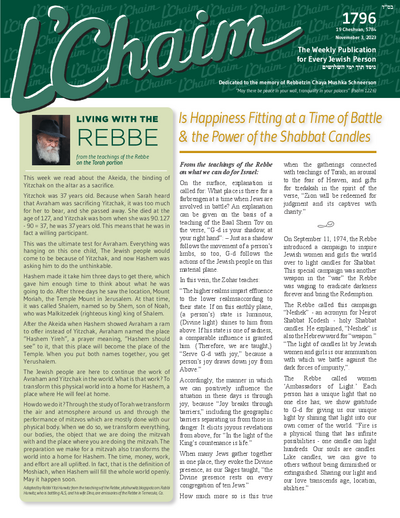
This week we read about the Akeida, the binding of Yitzchak on the altar as a sacrifice.

Yitzchok was 37 years old. Because when Sarah heard that Avraham was sacrificing Yitzchak, it was too much for her to bear, and she passed away. She died at the age of 127, and Yitzchak was born when she was 90. 127 - 90 = 37, he was 37 years old. This means that he was in fact a willing participant.

This was the ultimate test for Avraham. Everything was hanging on this one child, The Jewish people would come to be because of Yitzchak, and now Hashem was asking him to do the unthinkable.

Hashem made it take him three days to get there, which gave him enough time to think about what he was going to do. After three days he saw the location, Mount Moriah, the Temple Mount in Jerusalem. At that time, it was called Shalem, named so by Shem, son of Noah, who was Malkitzedek (righteous king) king of Shalem.

After the Akeida when Hashem showed Avraham a ram to offer instead of Yitzchak, Avraham named the place “Hashem Yireh”, a prayer meaning, “Hashem should see” to it, that this place will become the place of the Temple. When you put both names together, you get Yerushalem.

The Jewish people are here to continue the work of Avraham and Yitzchak in the world. What is that work? To transform this physical world into a home for Hashem, a place where He will feel at home.

How do we do it? Through the study of Torah we transform the air and atmosphere around us and through the performance of mitzvos which are mostly done with our physical body. When we do so, we transform everything, our bodies, the object that we are doing the mitzvah with and the place where you are doing the mitzvah. The preparation we make for a mitzvah also transforms the world into a home for Hashem. The time, money, work, and effort are all uplifted. In fact, that is the definition of Moshiach, when Hashem will fill the whole world openly. May it happen soon.

Adapted by Rabbi Yitzi Hurwitz from the teachings of the Rebbe, yitzihurwitz.blogspot.com. Rabbi Hurwitz, who is battling ALS, and his wife Dina, are emissaries of the Rebbe in Temecula, Ca.

On what we can do for Israel:

On the surface, explanation is called for: What place is there for a farbrengen at a time when Jews are involved in battle? An explanation can be given on the basis of a teaching of the Baal Shem Tov on the verse, “G-d is your shadow, at your right hand”: – Just as a shadow follows the movement of a person’s limbs, so too, G-d follows the actions of the Jewish people on this material plane.

In this vein, the Zohar teaches: “The higher realms impart effluence to the lower realms according to their state. If on this earthly plane, {a person’s} state is luminous, {Divine light} shines to him from above. If his state is one of sadness, a comparable influence is granted him. {Therefore, we are taught,} “Serve G-d with joy,” because a person’s joy draws down joy from Above.”

Accordingly, the manner in which we can positively influence the situation in these days is through joy, because “Joy breaks through barriers,” including the geographic barriers separating us from those in danger. It elicits joyous revelations from above, for “In the light of the King’s countenance is life.”

When many Jews gather together in one place, they evoke the Divine presence, as our Sages taught, “the Divine presence rests on every congregation of ten Jews.”

How much more so is this true when the gatherings connected with teachings of Torah, an arousal to the fear of Heaven, and gifts for tzedakah in the spirit of the verse, “Zion will be redeemed for judgment and its captives with charity.”

The Power of the Shabbat Candles

On September 11, 1974, the Rebbe introduced a campaign to inspire Jewish women and girls the world over to light candles for Shabbat. This special campaign was another weapon in the “war” the Rebbe was waging to eradicate darkness forever and bring the Redemption.

The Rebbe called this campaign “Neshek” - an acronym for Neirot Shabbat Kodesh - holy Shabbat candles. He explained, “Neshek” is also the Hebrew word for “weapon.” “The light of candles lit by Jewish women and girls is our ammunition with which we battle against the dark forces of impurity,”.

The Rebbe called women ‘Ambassadors of Light.’ Each person has a unique light that no one else has; we show gratitude to G-d for giving us our unique light by shining that light into our own corner of the world. “Fire is a physical thing that has infinite possibilities - one candle can light hundreds. Our souls are candles. Like candles, we can give to others without being diminished or extinguished. Sharing our light and our love transcends age, location, abilities.”

PDF Preview