One Must Do Whatever the Host Says
Parsha Pages | October 30, 2023
ה וְאֶקְחָה פַת -לֶחֶם וְסַעֲדוּ לִבְכֶם, אַחַר תַעֲבֹרוּ --כִי -עַל -כֵּן עֲבַרְ תֶם, עַל-עַבְדְכֶם; וַיֹאמְרוּ, כֵּן תַעֲשֶה כַאֲשֶר דִבַרְ תָ.
19,5 And I will fetch a morsel of bread and stay your heart; after that you shall pass on; forasmuch as you came to your servant.' And they said, 'So do, as you have said.'
Pesachim 86b: Rav Huna: One must do whatever his host says [except for 'leave'].
מצא כל מה שיאמר לך בעל הבית עשה חוץ
How do we understand this saying?
- Some delete “except for leave” from the text.
- Maharsha says one must leave, but after this, the host is no longer considered his host.
- One must do any service that is in the house, but one is not required to do any service outside the house because that is not part of Derech Eretz.
- The word צא can imply something that is disgusting (see Yeshiyahu 30,22) that one is exempt if the request involves doing something disgusting.
- מצ"א is roshei taivos for שהארכי צן מ One is exempt if the request involves doing something for the wife of the host since might lead to future concerns.
- מצ"א is roshei taivos for יסור אד צן מ One is exempt if the host requests involves an illegal matter. This would exempt even if not an actual prohibition but perhaps a stringency not to do such.
- A rabbinic degree enacted after the story of Bar Kamza that lead to the destruction of the Bais haMikdash. In that story the host requested that the guest (mistakenly invited) must leave the party. The rabbis present did not object. (see Gittin 55)
- By way of an allusion, HaShem is the host for this world. We are instructed to do all that the host requests except for one thing. If HaShem indicates that after severe sinning one must go out (that Teshuvah is no longer an option), one must not listen, but one must stay and do Teshuvah. (Kaf haChaim)
- Noach was told צא go out from the ark with your wife (resume marital relations that were forbidden on the ark). However, Noach declined to listen to HaShem in this matter even though commanded, since he desired to sanctify himself in matters that were permitted to be done.
- One time the Sefas Emes was a guest and his host wished to honor him. The Sefas Emes refused the honor. The host responded that a guest needs to listen to his host. The Sefas Emes responded that Chaza”l did state that concept but they also said that honor takes one out of this world and this is what is meant by חוץ מצא (except going out of this world).
- In the introduction to the Shulchan Aruch with the notes of the Gr”a, the sons of the Gr”a spoke about their father. They included a story. One time the Gr”a was traveling and stayed by a frum Jew for the night. The host served the Gr”a some food, urging him to eat. As the host left the room the Gr”a vomited the food as he was not able to eat it. The host returned and found the Gr”a had barely touched the food and again urged him to eat. The Gr”a again took one bite and after the host left the room he vomited out the food. This happened a third and fourth time. Finally, his students asked why he continued to take bites of the food which evidently harmed him. The Gr”a replied that he was obligated to do what the host said until he reached the point of his soul leaving his body (the exemption only being up until death). Rabbi David Frankel mentions this story and states the Chazon Ish did not believe it to be true. The Mishneh Berurah (O.Ch.170, 17) that if one is to full to eat or drink more and the host is urging one to eat more, there no obligation to eat more to the detriment of one’s health, and it would not be considered a lack of proper honor to the host if one does not eat more.
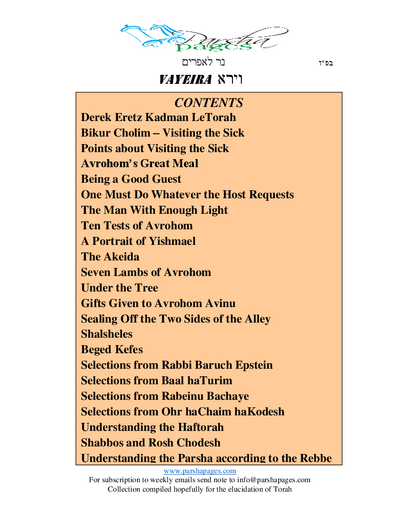
View The Full Article (PDF)
Related Articles

Various Torah Insights on Parshas Vayeira
Parsha Pages • Vayeira

Being a Good Guest or The Halachic Etiquette When Visiting Someone’s House
Parsha Pages • Vayeira

A Yeshivah Bachur Should Have a Davar Torah to Share
Parsha Pages • Vayeira
One Must Do Whatever the Host Says
Parsha Pages • Vayeira

Being a Good Guest or The Halachic Etiquette When Visiting Someone’s House
Parsha Pages • Vayeira