Shabbos and Rosh Chodesh – Which Takes Precedence
Parsha Pages | November 15, 2024
Print This Article
View Original PDF

Shabbos and Rosh Chodesh – Which Takes Precedence

Parsha Pages | June 27, 2025

The Haftorah for Parshas VaYera includes the pasuk (Melachim 2, ch. 4, v. 23) "Madua at ho'leches eilov hayom lo chodesh v'lo Shabbos" – “Why are you going to him (the prophet) it is not the new month nor is it Shabbos”

The Gemara (Brachos 51b, Pesachim 114a, Sukah 54b, and Megilah 29b) states that the principle "tadir v'she'eino tadir tadir kodem," when we have two items, one which is more often than the other, the one that is more often has priority. If so, why didn't the husband of the Shunamite woman mention Shabbos first and say in a different manner that it is not Shabbos nor is it Rosh Chodesh?

1) Since he said that it IS NOT Rosh Chodesh NOR Shabbos - it is more often that the day is NOT Rosh Chodesh than it is NOT Shabbos. (mipi hashmua b'sheim Reb Chaim'ke Soloveitchik z"l Brisk-Kamenitz)

2) Perhaps her personal history of traveling to Elisha was more often for Rosh Chodesh than it was for Shabbos, thus Rosh Chodesh travel for her was more often.

3) The Gemara Rosh HaShana 16b derives from these words that "chayov odom l'hakbil pnei rabbo b'Shabbos u'v'regel - a person is required to visit his teacher on Shabbos and Yom Tov. This deserves clarification. Yom Tov does not seem to be mentioned in our verse, only Rosh Chodesh and Shabbos. Commentators answer that Shabbos means Yom Tov, as we find Pesach referred to as Shabbos in Vayikroh 23:11 and 23:15. Thus Rosh Chodesh comes more often than Yom Tov. However, this seems to not be a proper answer as Rosh Chodesh only came 12 times a year since the ruling of one and two-day Roshei Chodoshim was not yet instituted. There are 18 days of Yom Tov in Eretz Yisroel. If we say that the term Shabbos when used to mean Yom Tov refers specifically to the days that are "mo'eid-chag," i.e. days that have major work restriction, then we have 7 day that are Yom Tov and 12 days that are R.Ch., so Rosh Chodesh is mentioned first. Alternatively, even if there are 18 days of Yom Tov and only 12 days that are Rosh Chodesh, Rosh Chodesh is considered more "tadir," if we understand "tadir" to mean STEADY rather than OFTEN. Yomim Tovim appear at times of the year that are not spread out with equal intervals, while Roshei Chodoshim are.

4) We can say that Shabbos means Yom Tov. If so, he mentioned the holier (Yom Tov) ahead of the less holy (Rosh Chodesh), as per the dictum "kol hamkudosh meichaveiro kodem es chaveiro" ( Z'vachim 89a).

5) The Rada"k says in his father's name that the meaning of these words is "it has not passed a Chodesh nor Shabbos that you haven't seen him, so why go now?" Thus, if it was just after Rosh Chodesh he spoke in order of closeness of her most recent visit.

6) As per the Rada"k just mentioned, perhaps it was just before Rosh Chodesh and Shabbos would take place after Rosh Chodesh. He said to her that it is not Rosh Chodesh, which is just about to come, and she would see him then, nor is it Shabbos, which would come a bit later.

7) Perhaps it was just before Rosh Chodesh and a few days after Rosh Chodesh would be Shabbos. His intention was "wait a few days for Rosh Chodesh or a few more days for Shabbos." (Very similar to the previous answer but without the Rada"k component)

8) We cannot say that he meant "it is not Shabbos so why are you going now." If it were Shabbos she surely wouldn't be going. We see from verse 22 that it was a distance to Elisha, as she asked for a youth and a donkey to travel. Traveling beyond the Shabbos boundary, "t'chum," is prohibited. We must say that his intention is that it is not before Shabbos. If so, he mentioned Rosh Chodesh ahead of a day or so before Shabbos, a perfectly proper order with the rule of "kol hamkudosh meichaveiro kodem es chaveiro" mentioned earlier in answer #4.

9) He mentioned the day that it was easier to get away ahead of the day that it was harder to get away. Rosh Chodesh is a day that women are exempt and even restricted from doing many types of work. On the eve of Shabbos (as per answer #8) women are usually very busy with preparation for Shabbos.

10) The original question raised has no basis. The rule of "tadir v'she'eino tadir tadir kodem" does not apply to the order of items mentioned in one's speech, but rather to prioritizing when doing an action, for example to sacrifice the "tamid" ahead of the "musaf" offering.
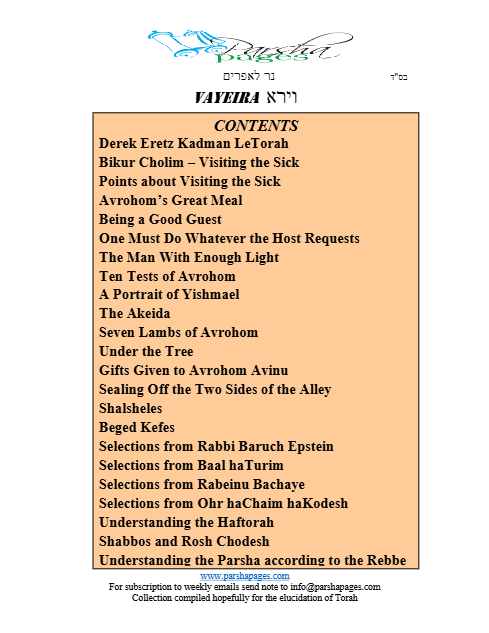
The Haftorah for Parshas VaYera includes the pasuk (Melachim 2, ch. 4, v. 23) "Madua at ho'leches eilov hayom lo chodesh v'lo Shabbos" – “Why are you going to him (the prophet) it is not the new month nor is it Shabbos”

The Gemara (Brachos 51b, Pesachim 114a, Sukah 54b, and Megilah 29b) states that the principle "tadir v'she'eino tadir tadir kodem," when we have two items, one which is more often than the other, the one that is more often has priority. If so, why didn't the husband of the Shunamite woman mention Shabbos first and say in a different manner that it is not Shabbos nor is it Rosh Chodesh?

1) Since he said that it IS NOT Rosh Chodesh NOR Shabbos - it is more often that the day is NOT Rosh Chodesh than it is NOT Shabbos. (mipi hashmua b'sheim Reb Chaim'ke Soloveitchik z"l Brisk-Kamenitz)

2) Perhaps her personal history of traveling to Elisha was more often for Rosh Chodesh than it was for Shabbos, thus Rosh Chodesh travel for her was more often.

3) The Gemara Rosh HaShana 16b derives from these words that "chayov odom l'hakbil pnei rabbo b'Shabbos u'v'regel - a person is required to visit his teacher on Shabbos and Yom Tov. This deserves clarification. Yom Tov does not seem to be mentioned in our verse, only Rosh Chodesh and Shabbos. Commentators answer that Shabbos means Yom Tov, as we find Pesach referred to as Shabbos in Vayikroh 23:11 and 23:15. Thus Rosh Chodesh comes more often than Yom Tov. However, this seems to not be a proper answer as Rosh Chodesh only came 12 times a year since the ruling of one and two-day Roshei Chodoshim was not yet instituted. There are 18 days of Yom Tov in Eretz Yisroel. If we say that the term Shabbos when used to mean Yom Tov refers specifically to the days that are "mo'eid-chag," i.e. days that have major work restriction, then we have 7 day that are Yom Tov and 12 days that are R.Ch., so Rosh Chodesh is mentioned first. Alternatively, even if there are 18 days of Yom Tov and only 12 days that are Rosh Chodesh, Rosh Chodesh is considered more "tadir," if we understand "tadir" to mean STEADY rather than OFTEN. Yomim Tovim appear at times of the year that are not spread out with equal intervals, while Roshei Chodoshim are.

4) We can say that Shabbos means Yom Tov. If so, he mentioned the holier (Yom Tov) ahead of the less holy (Rosh Chodesh), as per the dictum "kol hamkudosh meichaveiro kodem es chaveiro" ( Z'vachim 89a).

5) The Rada"k says in his father's name that the meaning of these words is "it has not passed a Chodesh nor Shabbos that you haven't seen him, so why go now?" Thus, if it was just after Rosh Chodesh he spoke in order of closeness of her most recent visit.

6) As per the Rada"k just mentioned, perhaps it was just before Rosh Chodesh and Shabbos would take place after Rosh Chodesh. He said to her that it is not Rosh Chodesh, which is just about to come, and she would see him then, nor is it Shabbos, which would come a bit later.

7) Perhaps it was just before Rosh Chodesh and a few days after Rosh Chodesh would be Shabbos. His intention was "wait a few days for Rosh Chodesh or a few more days for Shabbos." (Very similar to the previous answer but without the Rada"k component)

8) We cannot say that he meant "it is not Shabbos so why are you going now." If it were Shabbos she surely wouldn't be going. We see from verse 22 that it was a distance to Elisha, as she asked for a youth and a donkey to travel. Traveling beyond the Shabbos boundary, "t'chum," is prohibited. We must say that his intention is that it is not before Shabbos. If so, he mentioned Rosh Chodesh ahead of a day or so before Shabbos, a perfectly proper order with the rule of "kol hamkudosh meichaveiro kodem es chaveiro" mentioned earlier in answer #4.

9) He mentioned the day that it was easier to get away ahead of the day that it was harder to get away. Rosh Chodesh is a day that women are exempt and even restricted from doing many types of work. On the eve of Shabbos (as per answer #8) women are usually very busy with preparation for Shabbos.

10) The original question raised has no basis. The rule of "tadir v'she'eino tadir tadir kodem" does not apply to the order of items mentioned in one's speech, but rather to prioritizing when doing an action, for example to sacrifice the "tamid" ahead of the "musaf" offering.

PDF Preview