To Be a Gadol
According to Chazal, gadol hachnasas orchim yoser mikabalas pnai haShechina - bringing in guests is greater than greeting the presence of Hashem.
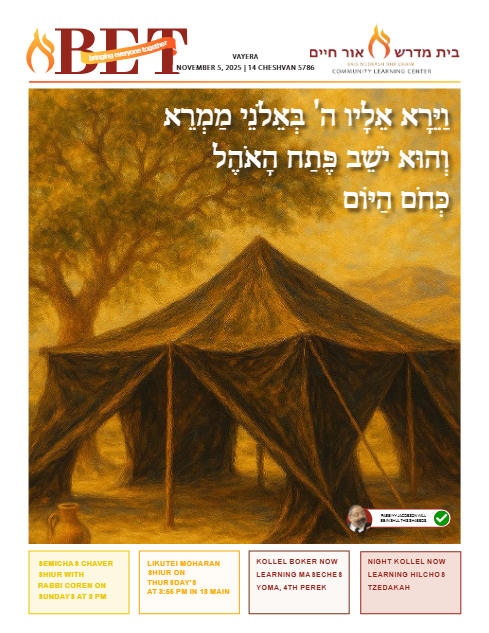
Chazal learned this principle from Avraham Avinu in this week’s parsha. While in the middle of his encounter with Hashem, he seems to put Hashem on hold and instead runs to accommodate the three angels who had arrived at his tent’s door.
At first glance, this sounds very perplexing. Isn’t our ultimate goal to be greeting and connecting to Hashem presence? How is it possible to consider the act of greeting guests to be greater than that of greeting Hashem?
What needs to be defined here is the word that Chazal use – gadol, which can mean great or large. I believe we should define the word as growth or accomplishment, not just greatness. This comes to say that greatness is measured by how much growth and accomplishment results through our actions.
Sefer Melachim describes the woman from the town of Shunam as an ‘isha gedola,’ a big lady. It sounds a bit strange to praise a lady by calling her ‘the big lady,’ and I wouldn’t suggest this for a husband who wants to compliment his wife.
(Someone jokingly told me that in America when you want to tell your wife that she looks good, you say she looks like a million dollars, and in England, you say she looks like a million pounds!)
The Meam Loez explains that the term ‘isha gedola’ refers to a lady who is engaged in chessed and is accomplishing positive things in the world. The greatest positive thing a person can do is kindness, as is emphasized in the hakdama to Sefer Nefesh Hachayim. The greatest kindness you can do for someone is to provide them with more clarity of Hashem, which was indeed the mission of Avraham Avinu.
This definition helps us to understand what went on with Avraham Avinu and his three guests.
Avraham was speaking to Hashem. He was standing in Hashem’s presence just like the Amida in prayer, and a person praying must be stationary and not move. However, when the opportunity came for Avraham to move higher level, i.e., to be greater by helping others, he understood that this is the will of Hashem. Hashem doesn’t want us to stand still in this world; he wants us to accomplish as much as we can. It’s in the next world that we are expected to stand still.
This idea fits well with the eulogy that many give at a levaya. They quote the Gemara in Moed Katan where Rav says Achim hehespeda, which means warm up the people at a levaya.... d’hasam kaimna – for I am standing there.
One explanation to the use of this phrase at a funeral is that Rav was trying to arouse and warm up the people so they would, realize that if they don’t accomplish their mission in this world, then in the next world it’s too late because ‘there I’m just standing....’
This also sheds light on what it means to be ‘gadol.’ At 13 years old, a boy can already be motzi others. He has reached an age when he has an opportunity to help others spiritually. And this is the idea of a gadol b’Yisrael – someone who grabs onto the reigns and helps to lead others, so that the world can continue to move forward under Hashem’s love and guidance.
RABBI DANIEL COREN