Building Peace and Love Among Siblings
Facebuker Shabbos Table Talk | December 07, 2023
Print This Article
View Original PDF

Building Peace and Love Among Siblings

Facebuker Shabbos Table Talk | December 31, 2025

When, finally, one of the patriarchs had sons who were all servants of Hashem, sadly there was not unity among them. There was jealousy and resentment among them, and many of the things that we unfortunately recognize among siblings. Yosef was the favorite son, and the others knew it.

For his part, Yosef did not ingratiate himself to them, because he had a habit of talking negatively about them. While it is entirely possible that Yosef meant it for their benefit, so that Yaakov could guide them, that is not necessarily to bring people closer to Hashem.

Indeed, the Mishna in Pireki Avos adjures us to be from the students of Aharon, “Love peace, pursue peace, love people, and bring them closer to Torah.” Before you can try to correct anyone or help them improve in their service of Hashem, you must love peace and love the people you’re trying to correct.

Had Yosef expressed his love for his brothers first and foremost, and sought to create peace amongst them, rather than jealousy, he would not have spoken about their errors. He probably would not have spoken of his dreams of leadership, as this would also destroy the peace.

But, alas, Yosef was young. In his youthful exuberance to change the world, he decried what he saw as evil, and sought to prove he was correct by intimating that even G-d sided with him, in that he had seen visions of his family bowing to him (no doubt in utter appreciation for his mussar and guidance.)

Had Yosef been a bit older and more experienced, he would have known that the more you criticize someone and cut them down, the more they will defend their actions. The more you tell them how foolishly they’re acting, the more they will hate you and stick to their guns that what they did was right. Instead, the way to bring people closer to Hashem is by building them up as Aharon did. When you show how much you love them and how good you believe them to be, they will find ways to live up to the pedestal you put them on. This is the way of the older and wiser, who have learned from the mistakes of youth.

STORY TIME!

A young man who had left his Yeshiva ways behind him was persuaded to learn with Rabbi Ronnie Greenwald z”l. There was no pressure, but the boy worked in the building next to the school Ronnie ran, and over the course of some conversations, the boy agreed.

When they learned the portion in the Torah, that Yosef brought his sons to see Yaakov, but Yaakov didn’t recognize them, the boy said, “I have an explanation of this episode.” Ronnie encouraged him to share it and the young man said, “Yaakov was old and couldn’t see. This means that he was from a different generation and couldn’t understand what he was looking at in these boys who looked and dressed differently than the people in his generation. But,” said the youth with poignancy, “he drew them close and kissed them and hugged them.

Yaakov understood that he didn’t understand them. But that didn’t diminish his love for them. He hugged and kissed them to show them that he still cared. That’s what you need to do for a generation that’s “different” than you are.”

Ronnie was astounded. He said, “I have to address a group of mental health professionals and I want to share that insight.” With the boy’s glowing permission, Ronnie did. One rabbi called him and said, “It was worth coming all the way from Brazil just to hear that lesson!”

“So why don’t you call him and tell him that?” suggested Ronnie. “Here’s his number.” The rabbi called the young man and complimented him greatly. He said that he would share it too. The next time Ronnie saw the boy, he was shocked to hear, “Ronnie, I think I want to go back to Yeshiva.”

The way to change people is not by trying to change them, but by letting them know that they are worthy of love and respect.
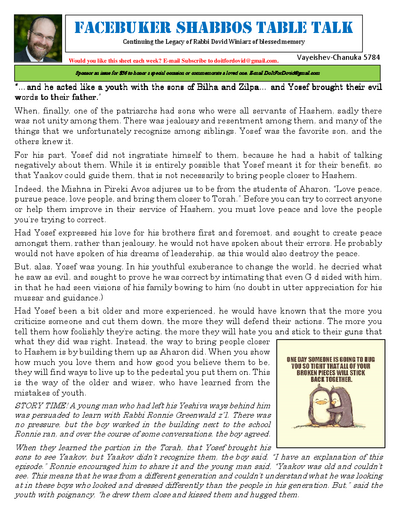
When, finally, one of the patriarchs had sons who were all servants of Hashem, sadly there was not unity among them. There was jealousy and resentment among them, and many of the things that we unfortunately recognize among siblings. Yosef was the favorite son, and the others knew it.

For his part, Yosef did not ingratiate himself to them, because he had a habit of talking negatively about them. While it is entirely possible that Yosef meant it for their benefit, so that Yaakov could guide them, that is not necessarily to bring people closer to Hashem.

Indeed, the Mishna in Pireki Avos adjures us to be from the students of Aharon, “Love peace, pursue peace, love people, and bring them closer to Torah.” Before you can try to correct anyone or help them improve in their service of Hashem, you must love peace and love the people you’re trying to correct.

Had Yosef expressed his love for his brothers first and foremost, and sought to create peace amongst them, rather than jealousy, he would not have spoken about their errors. He probably would not have spoken of his dreams of leadership, as this would also destroy the peace.

But, alas, Yosef was young. In his youthful exuberance to change the world, he decried what he saw as evil, and sought to prove he was correct by intimating that even G-d sided with him, in that he had seen visions of his family bowing to him (no doubt in utter appreciation for his mussar and guidance.)

Had Yosef been a bit older and more experienced, he would have known that the more you criticize someone and cut them down, the more they will defend their actions. The more you tell them how foolishly they’re acting, the more they will hate you and stick to their guns that what they did was right. Instead, the way to bring people closer to Hashem is by building them up as Aharon did. When you show how much you love them and how good you believe them to be, they will find ways to live up to the pedestal you put them on. This is the way of the older and wiser, who have learned from the mistakes of youth.

STORY TIME!

A young man who had left his Yeshiva ways behind him was persuaded to learn with Rabbi Ronnie Greenwald z”l. There was no pressure, but the boy worked in the building next to the school Ronnie ran, and over the course of some conversations, the boy agreed.

When they learned the portion in the Torah, that Yosef brought his sons to see Yaakov, but Yaakov didn’t recognize them, the boy said, “I have an explanation of this episode.” Ronnie encouraged him to share it and the young man said, “Yaakov was old and couldn’t see. This means that he was from a different generation and couldn’t understand what he was looking at in these boys who looked and dressed differently than the people in his generation. But,” said the youth with poignancy, “he drew them close and kissed them and hugged them.

Yaakov understood that he didn’t understand them. But that didn’t diminish his love for them. He hugged and kissed them to show them that he still cared. That’s what you need to do for a generation that’s “different” than you are.”

Ronnie was astounded. He said, “I have to address a group of mental health professionals and I want to share that insight.” With the boy’s glowing permission, Ronnie did. One rabbi called him and said, “It was worth coming all the way from Brazil just to hear that lesson!”

“So why don’t you call him and tell him that?” suggested Ronnie. “Here’s his number.” The rabbi called the young man and complimented him greatly. He said that he would share it too. The next time Ronnie saw the boy, he was shocked to hear, “Ronnie, I think I want to go back to Yeshiva.”

The way to change people is not by trying to change them, but by letting them know that they are worthy of love and respect.

PDF Preview


