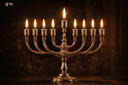
How to Light the Chanukah Lecht
How to Light the Chanukah Lecht
The Baal Shem Tov zt'l (quoted in דרשת יוסף פורת בן ג"שבה) tells a mashal of a student who studied to be a smith. After several years of study and practice, he was an expert and was able to fix everything given to him.
He began working alone. On his first job as a smith, someone gave him a utensil to fix, and he did nothing at all. This is because he never learned how to start a fire from stones. He knew how to be a smith, but he didn't know how to create a fire.
The nimshal is that to serve Hashem, there must be "a fire". Even when you know what you must do, but without the spark of fire, the avodah is incomplete.
This is alluded to in the pasuk (Shir HaShirim 1:11) ה ַכָּסֶף נְק ֻדּוֹת עִם לָּ ךְ נַעֲשֶׂה זָהָב ת ּוֹרֵי. You can know how to make gold utensils and how to be a smith, and you can know how to serve Hashem, but you need the ה ַכָּסֶף נְק ֻדּוֹת, the fire and the spark of excitement, so your avodas Hashem will be done properly.
When a person takes out a piece of meat from the freezer, he has to first let the meat thaw, and then he can put it into a pot on the fire or into a frying pan. You don’t put frozen meat directly into the fire. It has to defrost first. This tells us that if a person wants to feel the heat of hislahavus when he lights Chanukah lecht, he should begin by removing all the cold and frozen habits. This refers to the matters that are distant from kedushah. There are many examples, each person according to his level. But just as excitement for the holy mitzvos can be called fire, excitement for matters we shouldn’t be interested in can be called "frozen." If you want to serve Hashem with hislahavus when lighting the Chanukah lecht, first remove all those matters that make you freeze. Then you can attain the warmth and fire of the Chanukah lecht.
Chazal (Shabbos 21b) say that one should light Chanukah lecht from shekiyah השוק מן רגל שתכלה עד, until there are no more people out in the marketplace. The word רגל can be translated as רגילות, familiarity, routine. We should light the Chanukah lecht and train ourselves that our avodas Hashem should always be with fervor, and with new excitement. We shouldn't be bored with the mitzvos and perform them by rote.
Rebbe Hershel of Riminov zt'l (Be'eros HaMayim, Toldos, Haftarah) explains the pasuk (Malachim 1, 1:1), וְלֹא בַּבְּגָדִים וַיְכַס ֻּהוּ בַּיָּמ ִים בָּא זָקֵן דָּוִד וְהַמֶּלֶ ךְ לוֹ יִחַם, "And the King Dovid was old, advanced in years and they covered him with garments, but he did not become warm", in the following way:
King Dovid represents Melech HaMoshiach, בַּיָּמ ִים בָּא, days have passed, and it is time for Moshiach to come. So, what is preventing him from coming? בַּבְּגָדִים וַיְכַס ֻּהוּ Clothes represent mitzvos (see Zohar Vayichi 226b). The pasuk is saying that Klal Yisrael perform mitzvos, the problem is לו יחם ולא, the mitzvos lack hislahavus, love and warmth. This prevents Moshiach from coming.
Perhaps this is the reason we light Chanukah lecht with lamps of fire. It is to tell us that everything we do for Hashem should be with "fire". This is also hinted in the pasuk (Tehillim 132:17) לִמְשִׁיחִי נֵר עָר ַכְתִּי, "I have prepared a lamp for my anointed." This means Moshiach will come when we perform mitzvos with a fire of hislahavus.
One year, on Chanukah, Reb Chaim Ozer Grodzinski zt'l was in Krakow. He came to a tailor’s home and asked the tailor to fix his jacket.
"I haven’t lit Chanukah lecht yet," the tailor replied.
"I'll wait," Reb Chaim Ozer replied. He thought it would be just a few moments; however, it took much longer than a few moments. Reb Chaim Ozer watched in astonishment and admiration as the tailor, dressed in his Shabbos clothing, sang songs for a half hour near the lecht, with obvious happiness for the mitzvah.
Reb Chaim Ozer said, "Now I understand the reason the city Krakow produced so many great talmidei chachamim over the generations." It is because the mitzvah of Chanukah lecht is mesugal for children talmidei chachamim. As the Gemara (Shabbos 23:) states, חכמים תלמידי בנים ליה הויין בנר הרגיל, “A person who is cautious with lighting the candles, he will merit children talmidei chachamim, as it states, אור ותורה מצוה נר כי.” This will undoubtedly occur when the mitzvah is performed with love and passion.
It is important to prepare oneself for the mitzvos. When one prepares himself for a mitzvah, it will be a far greater mitzvah than a mitzvah performed without preparation. One will receive the "light" and kedushah of the mitzvah and of the yom tov according to the extent he prepared for it. הכנה is gematria יסוד, foundation, because the foundation of a mitzvah is in its preparation. Tzaddikim have said that preparing for a mitzvah is greater than the mitzvah itself. We see this concept from the menorah in the Beis HaMikdash. Anyone can light the menorah, but preparing the menorah can only be performed by kohanim.
Related Articles