Reuven Heard and He Rescued Him from Their Hand
Peninim on the Torah | December 08, 2025
Print This Article
View Original PDF

Reuven Heard and He Rescued Him from Their Hand

Peninim on the Torah | December 10, 2025

וישמע ראובן ויצילהו מידם
Reuven heard, and he rescued him from their hand. (36:21)

Mechiras Yosef is one of the greatest tragedies recorded in the Torah. It was not merely a family quarrel or a dysfunction in the Patriarchal family (as those lacking in Torah and yiraas Shomayim would contend); it was the near dissolution of the future Shivtei Kah, the very foundation stones of Klal Yisrael. What makes the episode (for which we are still paying in the present) more painful is that it was rooted in misconception and misjudgment. The brothers were all noble and devoted to Hashem; yet, they misread Yosef’s character. They saw what they saw, or perhaps what they wanted to see. As a result, his reports to his father concerning their behavior, which he also misread, were viewed by them as antagonistic and harmful to their collective destiny. They saw everything he did through the erroneous lens of suspicion. He looked through the eyes of innocence, lacking the deep perception which comes with age.

Yet, as in all events in history, the hidden hand of Hashen guided the entire process. Hashem wanted this to happen. Had the Shivtei Kah perhaps been on a higher spiritual plane, going down to Egypt, followed by the crucible of slavery, culminating in the miraculous liberation and Splitting of the Red Sea, leading up to the Giving of the Torah, could have occurred through a different venue and vehicle. This is what it was and we do not ask questions of Hashem because we will probably not grasp the answers. The brothers’ error became the vehicle for a larger destiny. Yosef went down to Egypt not as the victim of family strife, but as the forerunner of the Geulah, Redemption. This is how a Torah Jew should view this “tragedy.” This is how it appears to us. In the Heavenly sphere it is far removed from tragedy. It is part of the Divine Plan. The word tragedy has a different meaning in the Heavenly lexicon. What superficially appeared to the uninitiated as a family downfall was actually the precursor of a national ascent. Egypt was part of their destiny because Hashem wanted it to be the ordeal which would prepare and refine Klal Yisrael for Har Sinai and nitzchiyus, eternity.

The tragedy of Mechiras Yosef, like the rest of the Torah, can only be understood through the lens of the Torah as interpreted by able and spiritually refined commentators. The pain of fraternal misunderstanding and family strife, which led to a descent into a miserable exile, contained the seeds of consolation: the knowledge that nothing just happens. There is a Divine choreography to which we are not privy, but in which we have faith. Truly, even the gravest miscalculations are woven into the Divine Plan for Redemption.

Appearances can be deceiving, but if one delves beneath the surface, there is so much he can learn about what he is missing. I remember forty years ago taking a group of eighth graders to New York for a gedolim tour in conjunction with visiting a matzoh bakery and other religious venues. I record the date by design, because what has become acceptable and taken for granted, forty years ago in Cleveland was a novelty. One of the high points of the trip was to visit the Lower East Side and hopefully meet Horav Moshe Feinstein, zl.

We were told that the gadol ha’dor was not up to receiving visitors. However, at 8:30 the next morning he was being driven by his grandson to a medical appointment. If we were standing in the hall when he came off the elevator, we could give shalom aleichem and hopefully receive a brachah. I, for one, never having met Rav Moshe, was hyper-excited and I attempted to infuse my students concerning the unparalleled z’chus and good fortune of sharing in this experience.

Bright and early the next morning, having davened with the earliest minyan in Brooklyn, we stood in the hallway of the large apartment building which was home to many Jewish people, most of whom were senior citizens, the younger families opting to live in Brooklyn. We stood there looking at the elevator going up and going down, checking for the floor on which Rav Moshe’s apartment was located. Finally, we saw the light go on – the elevator was descending. I was beyond nervous. My students could not understand my reaction. One day, when they grew older, they would perhaps understand. Finally, the elevator door stopped on the ground floor, the doors opened, and out poured a group of elderly ladies and a few elderly men, all dressed in their street clothes about to go shopping. They each turned to the “inhabitant” of the elevator and waved, “Bye, Rabbi,” “We hope you have a good day, Rabbi,” “Good luck with your doctor’s appointment, Rabbi!” Then the gadol ha’dor came out, small in physical build, but a giant in Torah, and he waved back to each and every one of the people. It was worth everything to see this incredible lesson in humility and respect for a human being. Not all the elevator passengers were Jewish, but Rav Moshe acknowledged each one. My students, however, were not yet ready to perceive the experience the way I did. Appearances can be deceiving.
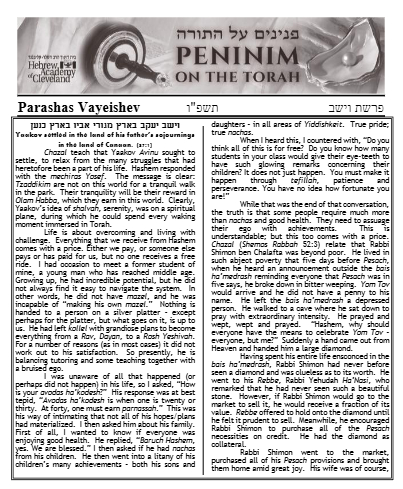
וישמע ראובן ויצילהו מידם
Reuven heard, and he rescued him from their hand. (36:21)

Mechiras Yosef is one of the greatest tragedies recorded in the Torah. It was not merely a family quarrel or a dysfunction in the Patriarchal family (as those lacking in Torah and yiraas Shomayim would contend); it was the near dissolution of the future Shivtei Kah, the very foundation stones of Klal Yisrael. What makes the episode (for which we are still paying in the present) more painful is that it was rooted in misconception and misjudgment. The brothers were all noble and devoted to Hashem; yet, they misread Yosef’s character. They saw what they saw, or perhaps what they wanted to see. As a result, his reports to his father concerning their behavior, which he also misread, were viewed by them as antagonistic and harmful to their collective destiny. They saw everything he did through the erroneous lens of suspicion. He looked through the eyes of innocence, lacking the deep perception which comes with age.

Yet, as in all events in history, the hidden hand of Hashen guided the entire process. Hashem wanted this to happen. Had the Shivtei Kah perhaps been on a higher spiritual plane, going down to Egypt, followed by the crucible of slavery, culminating in the miraculous liberation and Splitting of the Red Sea, leading up to the Giving of the Torah, could have occurred through a different venue and vehicle. This is what it was and we do not ask questions of Hashem because we will probably not grasp the answers. The brothers’ error became the vehicle for a larger destiny. Yosef went down to Egypt not as the victim of family strife, but as the forerunner of the Geulah, Redemption. This is how a Torah Jew should view this “tragedy.” This is how it appears to us. In the Heavenly sphere it is far removed from tragedy. It is part of the Divine Plan. The word tragedy has a different meaning in the Heavenly lexicon. What superficially appeared to the uninitiated as a family downfall was actually the precursor of a national ascent. Egypt was part of their destiny because Hashem wanted it to be the ordeal which would prepare and refine Klal Yisrael for Har Sinai and nitzchiyus, eternity.

The tragedy of Mechiras Yosef, like the rest of the Torah, can only be understood through the lens of the Torah as interpreted by able and spiritually refined commentators. The pain of fraternal misunderstanding and family strife, which led to a descent into a miserable exile, contained the seeds of consolation: the knowledge that nothing just happens. There is a Divine choreography to which we are not privy, but in which we have faith. Truly, even the gravest miscalculations are woven into the Divine Plan for Redemption.

Appearances can be deceiving, but if one delves beneath the surface, there is so much he can learn about what he is missing. I remember forty years ago taking a group of eighth graders to New York for a gedolim tour in conjunction with visiting a matzoh bakery and other religious venues. I record the date by design, because what has become acceptable and taken for granted, forty years ago in Cleveland was a novelty. One of the high points of the trip was to visit the Lower East Side and hopefully meet Horav Moshe Feinstein, zl.

We were told that the gadol ha’dor was not up to receiving visitors. However, at 8:30 the next morning he was being driven by his grandson to a medical appointment. If we were standing in the hall when he came off the elevator, we could give shalom aleichem and hopefully receive a brachah. I, for one, never having met Rav Moshe, was hyper-excited and I attempted to infuse my students concerning the unparalleled z’chus and good fortune of sharing in this experience.

Bright and early the next morning, having davened with the earliest minyan in Brooklyn, we stood in the hallway of the large apartment building which was home to many Jewish people, most of whom were senior citizens, the younger families opting to live in Brooklyn. We stood there looking at the elevator going up and going down, checking for the floor on which Rav Moshe’s apartment was located. Finally, we saw the light go on – the elevator was descending. I was beyond nervous. My students could not understand my reaction. One day, when they grew older, they would perhaps understand. Finally, the elevator door stopped on the ground floor, the doors opened, and out poured a group of elderly ladies and a few elderly men, all dressed in their street clothes about to go shopping. They each turned to the “inhabitant” of the elevator and waved, “Bye, Rabbi,” “We hope you have a good day, Rabbi,” “Good luck with your doctor’s appointment, Rabbi!” Then the gadol ha’dor came out, small in physical build, but a giant in Torah, and he waved back to each and every one of the people. It was worth everything to see this incredible lesson in humility and respect for a human being. Not all the elevator passengers were Jewish, but Rav Moshe acknowledged each one. My students, however, were not yet ready to perceive the experience the way I did. Appearances can be deceiving.

PDF Preview