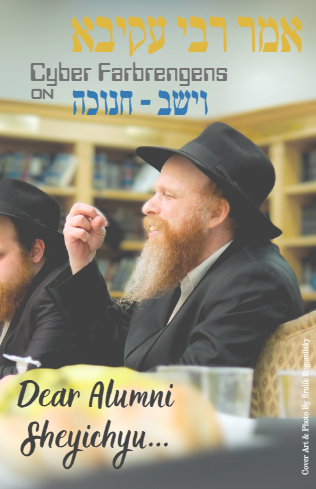
The Krechtz of a Rebbe
Dear Alumni Sheyichyu!
Sholom U’Brocho!
A Freilichen Chanuka!
Mazel Tov to Rabbi and Mrs. Avi Minkowitz on the birth of their daughter. Mazel Tov to Rabbi and Mrs. Shmully Goldstein on the birth of their son. Mazel Tov to Rabbi and Mrs. Shmully Weinberg on the birth of their daughter. May they bring him up lTOveCHuMAA”T mitoch harchovo, and to be true chayolim/os! (If anyone is aware of any mazel tov’s that I omitted please let me know).
Thank you as always for the feedback, it is much appreciated.
The following story is in the Rebbe’s Reshimos, and was also retold by the Rebbe by a farbrengen:
When the Rebbe Rashab and his older brother, the RAZA (R’ Zalman Aharon) were children, they were once playing together. Now, today, when children want to play, they have it very easy. They have phones and computers and toys and gadgets to keep them busy for ages. But 2 children in Lubavitch, and the sons of the Lubavitcher Rebbe, what could they play?
No, not cops and robbers, they played Rebbe and chosid. The RaZA played the Rebbe, and the Rebbe Rashab played the chosid who was coming for help. In fact, he had an actual question that was disturbing him: On a Shabbos, not long before, the Rashab had cracked open nuts and eaten them. Afterwards he learned that the Alter Rebbe, in his siddur, prohibits this behaviour. At the time the Rashab was so overwrought about the incident that he cried over it. Now, in their “game”, he asked for a “tikkun” - something to do to rectify his inadvertent sin.
The RaZA (who obviously knew how to play the part of Rebbe quite well) instructed the “chosid” to daven the tefilah of “Lechu Neranenah” (on Friday night) from a siddur, and – in general – to be more careful about davening from a siddur.
Apparently the Rebbetzin, the mother of the boys overheard the exchange, and she subsequently asked the Rashab why he wasn’t carrying out the instructions that he was given.
“Because he is not a Rebbe”, was the child’s answer. And he explained: “A Rebbe, before he gives a response, has to give a krechtz (a sigh). And he (the RaZA) answered me without giving a krechtz. It’s not the brocho of the Rebbe that helps, but the krechtz!”
[On a subsequent occasion, the RaZA suggested to the Rashab: “Let’s play Rebbe and chosid; - I’ll be the Rebbe, and you will be my gabay”. The Rebbe Rashab, however, refused, saying: “You will never be a Rebbe, and I will never be a gabay!”]
Surely in the “Complete Handbook For Rebbes” it states very clearly that before giving an answer or brocho, there always must be an audible krechtz. Undoubtedly that is one of the important lessons taught in Rebbe school, or in the Rebbe 101 course.
Which raises the question: Why do we seem to see otherwise with our Rebbe? On so many occasions the Rebbe’s responses seemed not to follow this protocol, but, rather, to do the complete opposite. Why didn’t the Rebbe follow the rule in the above story that was quoted from his own reshimos?
Examples of the Rebbe's Approach
Here are two examples amongst many in which the Rebbe doesn’t seem to follow the above “rule”:
A young man was once going by the Rebbe, and he asked for a brocho, explaining that the doctors had discovered a tumor and his condition was very serious.
“Where did they discover it?” the Rebbe asked. The young man picked up his shirt and pointed to his stomach. The Rebbe bent over slightly and peered at the area where the man was pointing, and remarked “I don’t see anything”.
That was it! No krechtz, no commiserating, nothing! Just, “I don’t see it” and it’s over, it’s no longer there (obviously after the Rebbe said he doesn’t see anything, no one else was able to find anything there either).
Or, another story:
Two women, sisters, once went by the Rebbe. They were crying, as one informed the Rebbe that the doctors had found a growth, looleinu, by her sister. The Rebbe smiled and replied something. The women were certain that the Rebbe hadn’t heard them properly. They had, after all, been to other tzaddikim (for a brocho for this problem), and all had reacted with the appropriate measure of solemnity. This was, after all, not the type of news that should elicit a smile, of all things! So the woman repeated her news (and request for a brocho) more loudly. But the Rebbe’s smile only became broader, as he replied: “I heard what you said. You said they found something. Nu, they found it, so now they’ll lose it.”
Once again, seemingly ignoring the proper ‘Rebbe protocol’.
Understanding the Rebbe's Conduct
What does this mean? Why did the Rebbe’s conduct seem to be in contradistinction of other tzaddikim (who all graduated from reputable Rebbe schools)?
I think the answer can be found in the Chanuka maamar that the Rebbe edited in 5752 (that was printed in sefer hamaamorim meluket vov, and which was originally said in 5726).
There the Rebbe explains that there are different manners in which a tzaddik can “veto” and overrule a Heavenly decree. One way is described in the Gemoro (Moed Koton 16B) on the Possuk צדיק מושל ביראת אלוקים - that the Tzaddik has control – מושל - to the extent of being able to reverse and undo a decree that was made by HKBH. In that case, there is a “conflict”, a struggle so to speak, between the Heavenly decree and the (Divinely given) powers of the tzaddik, and the tzaddik’s powers need to overcome and defeat the decree. (For those who want a specific address, for their contact list, this is when the hamshocho of the tzaddik is from the level of “Arich” or chitzoniyus of Keser).
A higher level is (what the gemoro describes in Bava Metzia 85A) that for certain Tzaddikim Hashem says “Even if I made a decree, I will annul it for the sake of this tzaddik”. In this case there isn’t really a “conflict” between the tzaddik and HKBH, because HKBH Himself is the one who annuls the decree (rather than the tzaddik needing to overrule Him). It is because of the tzaddik that Hashem Himself changes the plans. (This is when the hamshocho is from the level of “Atik”, or pnimiyus of Kesser). But, even in this case, there was originally a decree and it has to be overturned.
The highest level, however, is (what is described in Yerushalmi) that through the tzaddik it comes to light that there is no negative decree to begin with, thus there is nothing that needs to be overturned or vetoed. (This is the case with a tzaddik who draws down from the level of the pnimiyus of Atik, or ס"א א"ש ברדל).
Because this tzaddik is connected with the essence of G-dliness, which is the essence of everything in creation, it becomes revealed through his avoda the inherent G-dliness in everything, as a result of which it becomes clear that there isn’t really any (negative) decree in the first place (compare this (partly) to the avoda of R’ Zushe, which is explained elsewhere, who said that he doesn’t see anything negative in the first place).
The Light of Chanuka
This is the idea of Chanuka (as explained in the maamarim in detail): In Chassidus we are taught that the Chanuka menorah is different from the menorah that was in the Beis Hamikdash in that it is placed outside and lit at night, because it represents the Transcendent Light of Hashem (a.k.a. ס"א אש למעלה מהשתלשלות) that can illuminate even the darkness.
But the obvious question is: the lights of the Beis Hamikdash also illuminated the darkness (although the Menorah was lit in the afternoon, it burned מערב עד בוקר - throughout the night), and also illuminated the “outside” (as Chazal teach us that the windows in the Beis Hamikdash were narrow on the inside and wide on the outside because משם אורה יוצא לכל העולם), so what is the uniqueness of the Chanuka lights?
The answer is, the lights of the Beis Hamikdash are comparable to the first 2 types of Tzaddikim, a light that’s inside or kindled during the day is at odds with the “darkness” and the “reshus horabim”. Thus there is a conflict between this light and the darkness, and the way it illuminates the darkness is by “fighting” with it; - overpowering the darkness and banishing it so that it can be replaced with light.
On Chanuka we place the lights in the darkness (by lighting them after nightfall) and outside to begin with. Like the third type of tzaddik described above, they are the lights that uncover and reveal that the darkness itself is really light, that when we look deep enough we can discover how the reshus horabim – beneath its’ external coverings – is really Elokus!
(Of course, the above is an over-over-simplication. But if I can get any of you to sit down and learn the maamar (and since it’s a hemshech of the Yud Tes Kislev maamar in the same sefer, you’ll need to learn them both) then it will have been worth all the effort!)
The 3rd approach of the tzaddikim (and the lights of Chanuka) is mainly connected with the era of Moshiach (because that – after all – is what Moshiach is all about: the revelation of pnimiyus Atik in the world, as a result of which it will be clearly visible how the entire world and all that is within it is really G-dliness). This is also the special connection that the holiday of Chanuka has with Moshiach (as understood from many maamorei Chazal).
And this – apparently – was often the approach of the Rebbe in annulling decrees and giving brochos. Understandably, with the third approach there is no place for the krechtz. The krechtz is there when there is something negative, at some point at least, which needs to be corrected.
But, when the tzaddik reveals the essence of G-dliness in the world, thus revealing that the negative never existed to begin with, then the brocho is as outlined above, in a way – in the literal sense – that reveals that there isn’t any problem to start with (“I don’t see anything”), and therefore no conflict whatsoever to correct it.
So let’s get into the spirit of Chanuka: Through learning chassidus for ourselves, and spreading the lights of chanuka – through our mivtzoim – to the world around us, we will lift the veil and be able to glimpse beneath the surface and superficial coverings, and see the true essence of the entire universe.
This is, after all, the way the Rebbe dealt with us and gave us brochos and yeshuos in such abundance (and let’s not forget the specific directive of the Rebbe to use out the time of Chanuka to relate – not just the miracles of Chanuka themselves, but – pirsumei nisa of all of the many miracles that the Eibishter performed for each and every one of us through the Rebbeim). That has to surely be reflected in our Avodas Hashem (which is the main goal of everything).
And this will bring us one – and hopefully the final – step closer to the ultimate lights of Moshiach, when it will be revealed the pnimiyus Atik in the entire world וְנִגְלָה כְּבוֹד ה'
NOW MAMOSH!
L’chaim! May the lights of every person’s Chanuka, both in the literal sense and in its’ various aspects of avodas Hashem, join together to be an unstoppable force that will immediately burn away the last trace of Golus and replace it with the realization that beneath the surface everything is really geulah, and we only need to open up our eyes and see it with the immediate revelation of Moshiach Tzidkeinu – the ultimate shliach - TUMYM!!!
Rabbi Akiva Wagner
לזכות 'ר שלום מרדכי הלוי בן, רבקה לגאולה וישועה קרובה ושלימה י"תומ ממש – ובפרט בכח ט"ה יוש להנסים והנפלאות והישועות בימים ההם בזמן הזה שנזכרים ונעשים - ג"ב טוהנוהנ