The Secret of the Birth of Peretz and Zerach and the Foundations of Kingship in Israel
Parsha B'Iyun | December 12, 2025
Print This Article
View Original PDF

The Secret of the Birth of Peretz and Zerach and the Foundations of Kingship in Israel

Parsha B'Iyun | December 31, 2025

At the time when it seems that everything is dark and there is no hope, from there the light will emerge!

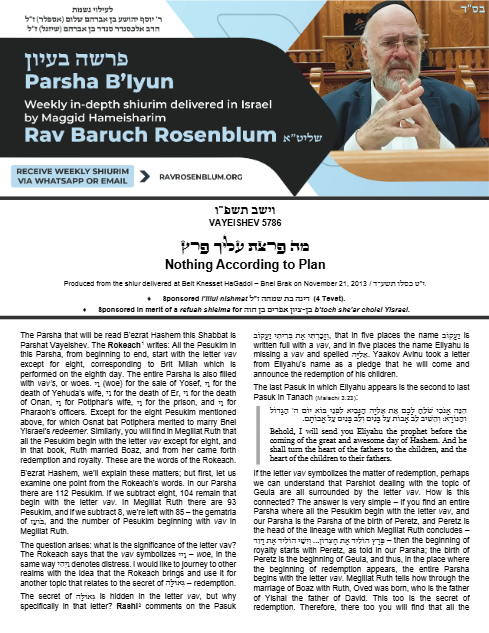
If so, Rabbotai, we can begin with the yesod that we want to expand upon. We opened at the beginning of the shiur and said that the Parsha from beginning to end is all vav’s, except for eight Pesukim that don't have a vav. We found another place – Megillat Ruth, which from beginning to end is all vav’s. 85 Pesukim that equal Boaz, and another eight Pesukim that don't begin with the letter vav. In total, 93 Pesukim.

The question arises – what is the sod here? The secret is, the creation of the light of Mashiach. The light of Mashiach, we said, begins with vav. Why? Because the letter vav was taken as a pledge from Eliyahu HaNavi, that he will return to usher in the Geula.

Rabbotai, I want to focus on one point and expand on it, B'ezrat Hashem. What I will say now is mostly taken from the wonderful sefer Niflaot MiTorat Hashem Yitbarach (Essay 39), which was written 150 years ago in Warsaw by a great Jew named R' Tzvi Hirsch Shlez. He presents a remarkable insight in this Parsha that elevates the entire story of Yehuda and Tamar. B’ezrat Hashem, we will gain much from it and, toward the end of the shiur, connect it to the days of Chanukah and to the Chashmonaim’s mistake regarding the true dynasty of kingship that emerged from Yehuda and Tamar.

The Journey of Yehuda and Tamar

The sefer asks: Why did Yehuda choose to go specifically there, what did he have to look for there?! There are, Baruch Hashem, so many places in Eretz Yisrael; so why specifically there?

And it was told to Tamar, saying, Behold your father-in-law goes up to Timnah to shear his sheep. And she put off her widow's garments from her, and covered herself with a veil, and wrapped herself, and sat in Petach Einayim, which is on the way to Timnah; for she saw that Shelah was grown, and she was not given to him as a wife.

A second question he asks: When Tamar saw that she was not given to Shelah, she decided to take action and went down to a place called Derech Timnatah and sat at Petach Einayim – translated as a crossroads. Which crossroads? Why did she go to sit on the road to Timnah? This is a road where Plishtim sit! And why did Yehuda also go specifically to Timnah, to a place where Plishtim are found? Are there no other places?!

The Mystery of the Twins

To understand the yesod of these matters, let us bring another wonderful question that he asks. Throughout the entire Torah we find many pairs of twins. With Cain and Hevel, twin sisters were born; with each of the tribes, a twin sister was born. The Torah doesn't deal with their birth or with the pregnancy, no one stuck out a hand, no one grabbed a foot, nothing. Baruch Hashem, they were all born in natural births, dozens of twin births and everything was perfectly fine. The Torah only deals with two pairs of twins: Yaakov and Eisav; Peretz and Zerach.

Rabbotai, says R' Tzvi Hirsch Shlez in his sefer – let us contemplate. Rivka Imeinu feels that her children are jumping in her womb. She walks by idolatry, Eisav jumps. She walks by a shul, Yaakov jumps. She asks, “What is this? What’s going on here?” She’s told, “Don't worry, you have two nations in your womb, one will go to idolatry, and one will go to the yeshiva. Everything is perfectly fine.” Twice in the Torah is the term twins referenced. One instance is written with missing letters – וְהִנֵּה תוֹמִם בְּבִטְנָהּ – missing an alef and yud, and the second instance is written in full – וְהִנֵּה תְאוֹמִים בְּבִטְנָֽהּ. Rashi explains that the first instance, in reference to Yaakov and Eisav, is written missing letters because one was wicked, whereas the second case involved two righteous sons.

The Ba’al HaTurim writes, תוֹמִם, missing yud and alef, which equals 11, corresponds to the 11 tribes she was worthy to bear. The Midrash states (Bereishit Rabbah, 63:6) that Rivka brought Yaakov into the world; he was the first tribe, and she was supposed to give birth to another 11 tribes. But what did Eisav do? Chazal say, when he emerged from his mother's womb, he cut her cords so that she would not give birth again.

In this week's Parsha, the word תְאוֹמִים is written in full, and B'ezrat Hashem we will try to understand why it is written in full here, while in Parshat Toldot it is written missing letters.

The Grasping of the Heel

The sefer Niflaot MiTorat Hashem Yitbarach continues with a wonderful idea. With the birth of Yaakov and Eisav, the Torah tells us: know that when Eisav emerged, the midwife witnessed a phenomenon; Yaakov Avinu was holding onto Eisav's foot. What did he want? Why did he grasp the foot?

Rashi quotes a Midrash Aggadah that expounds it according to its plain meaning: He was rightfully holding onto him to delay him. Yaakov was the first to be conceived, and Eisav only afterwards. But this is like a tube with a narrow opening, where the first stone inserted will come out last, and the second stone inserted will come out first. Thus Eisav, who was formed last, came out first, and Yaakov, who was formed first, came out last. Yaakov came to delay him so that he would be first in birth and take the birthright by right.

Yaakov held his foot because he was expressing protest. “I was formed first and therefore deserve to be the firstborn! I lost the birthright because of you!” Hakadosh Baruch Hu said, “If you expressed the pain, you will receive the reward!” What reward? “In the end you will acquire the birthright, and it will be yours.”

And why did he hold his heel? Rashi says it is a sign that this one is not sufficient to complete his kingdom until this one rises and takes it from him. “Eight kings will come from you before I become king, but after your eight kings are finished, my kingdom begins." The Torah states in last week's Parsha: וְאֵלֶּה הַמְּלָכִים אֲשֶׁר מָלְכוּ בְּאֶרֶץ אֱדוֹם לִפְנֵי מְלָךְ מֶלֶךְ לִבְנֵי יִשְׂרָאֵל – And these are the kings who reigned in the land of Edom before any king reigned over Bnei Yisrael. How many kings reigned? Eight kings!

R' Tzvi Hirsch Shlez says, in Parshat Vayeishev, the Torah deals with the heel of Yaakov Avinu. Which heel? What is the significance of Yaakov’s heel? In Parshat Vayishlach, the Torah discusses the eight kings who reigned in Edom before any king reigned over Bnei Yisrael. And then the first king of Israel arrives here in Parshat Vayeishev. Who is it? David HaMelech who descended from Peretz. Since he descends from him, this is where the kingdom of David begins.

וְאֵלֶּה תּוֹלְדוֹת פָּרֶץ פֶּרֶץ הוֹלִיד אֶת חֶצְרוֹן: וְחֶצְרוֹן הוֹלִיד אֶת רָם וְרָם הוֹלִיד אֶת עַמִּינָדָב: וְעַמִּינָדָב הוֹלִיד אֶת נַחְשׁוֹן וְנַחְשׁוֹן הוֹלִיד אֶת שַׂלְמָה: וְשַׂלְמוֹן הוֹלִיד אֶת בֹּעַז וּבֹעַז הוֹלִיד אֶת עוֹבֵד: וְעֹבֵד הוֹלִיד אֶת יִשַׁי וְיִשַׁי הוֹלִיד אֶת דָּוִד:

From Yaakov Avinu until יִשַׁי הוֹלִיד אֶת דָּוִד you have eleven names; 11 names from Yaakov Avinu until David HaMelech. Yaakov Avinu holds onto Eisav's heel, and Rashi says the missing yud and alef (11) signify Yaakov saying, "I will be king, but you will reign before me, for eight kings reigned in Edom before a king reigned over Israel." Who is the first king? David HaMelech. And what is the distance from Yaakov Avinu holding Eisav's heel until the moment David HaMelech arrives? 11 generations. Therefore, it's written here as תוֹמִם.

Here in our Parsha, this is the beginning of the formation of Peretz, who is the beginning of the dynasty of David HaMelech. In Megillat Ruth, the Pasuk doesn't begin from Yaakov or from Yehuda, but from Peretz, because from him begins the kingship, a kingship that is completed 11 generations later.

The Unusual Birth of Peretz and Zerach

These are the words of R' Tzvi Hirsch Shlez, and now Rabbotai, let's delve a bit deeper. The Torah in Parshat Toldot speaks at great length about the birth of Eisav and Yaakov. In our Parsha too, there is an unusual birth of twins. What's unusual about it?

While she was in labor, one of them put out a hand, and the midwife tied a crimson thread on that hand, to signify: This one came out first.

One child put out a hand, and the midwife took and tied a scarlet thread on his hand, saying, “This one came out first."

R' Shlez asks: Tell me, have you ever seen such a birth? Why are you rushing to tie a thread on his hand, he hasn't even come out yet and you're already tying it and marking him as the first of two? What's the rush?! First of all, who told you he came out first?! He only put out a hand! Also, you don't even know if there are twins, and you're already putting a label on him? Wait until he comes out!

The Ohr HaChaim Hakadosh explains that the midwife was moved by a moment of Divine inspiration and tied a scarlet thread on the baby’s hand without realizing its deeper meaning. Her intention was to mark him as the firstborn, but the sign itself hinted to the opposite – that he was actually second. Thus, the Pasuk’s wording of לֵאמֹר זֶה יָצָא רִאשׁוֹנָה – saying, this one came out first; reflecting it was only her statement, and not the true order. He adds that it would otherwise make no sense for her to label or write a note declaring, “This one came out first.”

But just then it drew back its hand, and out came its brother; and she said, “What a breach you have made for yourself!” So he was named Peretz. Afterward his brother came out, on whose hand was the crimson thread; he was named Zerach.

It's not clear what is going on here. Rabbotai, let's go back to the birth story of Yaakov and Eisav. We already said before, using the analogy of two stones placed in a tube, that whoever was formed first comes out second and whoever entered second comes out first. If Zerach put out his hand, when was he formed? Second. So, who should come out first? Zerach. If Zerach was supposed to come out first, how did Peretz then come out first?!

Let's return again to Parshat Toldot. If it's written here that Zerach put out his hand first, it means he's first to exit and second to be formed. Therefore, who was first to be formed? Peretz! If Peretz was first to be formed, why does the midwife tie Zerach? He would come out first anyway, why are you tying him with scarlet and declaring “This one came out first”? Do you have another option? After all, why did Yaakov grasp Eisav's heel? He said to him, “Sir, you think you're the firstborn? You're not. I'm the firstborn! You're coming out first because you were formed second. In reality I can't kill you or delay you, because this is the natural order. But I protest! And therefore, I'm holding your foot.”

Niflaot MiTorat Hashem Yitbarach, and the Ohr HaChaim HaKadosh, say something amazing here. Something happened in our Parsha that never occurred in history and never will again. Peretz was created first and came out first; Zerach was created second and came out second. Usually, whoever puts out a hand comes out first.

So, why did the midwife tie scarlet on Zerach's hand? She didn't know what she was doing, divine inspiration flickered within her. But after five minutes she realized what she had done, because Peretz who was formed first grabbed Zerach and said to him, “Come here buddy, you're not coming out first!” Peretz then came out first! The midwife cried out and said: "מַה פָּרַצְתָּ עָלֶיךָ פָּרֶץ?! I've never seen this in my life, that a child who's positioned more internally comes out first!" Zerach put out his hand and the midwife tied scarlet on it. Why did he put out his hand? Did he want to hitchhike?! Rabbotai,

The Symbolism of Peretz and Zerach

it's absolutely wondrous what R' Shlez explains about this whole story. Pay attention – his chidush and insight is sweeter than honey!

He relies on many foundations. We need to know one thing first – the name given to him, Peretz, symbolizes the breakthrough of Melech HaMashiach. It's not just random that they cry out “מַה פָּרַצְתָּ עָלֶיךָ פָּרֶץ” – there are names that Hakadosh Baruch Hu gives through His Nevi’im that express a person's role. We said earlier that Bat-Shua has no name, and we only know her father's name. It's very interesting that in the sefer of Divrei HaYamim, when David HaMelech's genealogy is brought, it states:

And these were born to him in Jerusalem: Shimaa, and Shovav, and Nathan, and Shlomo, four, to Bat-Shua the daughter of Ammiel.

The question is asked, which Bat Shua? Their mother was Batsheva! Why are you calling her Bat Shua?! R’ Shlez says, Yehuda's Bat Shua there, and Batsheva here; they are the same soul that returned again. Chazal say that Batsheva was destined for David HaMelech from the six days of Creation. From the six days of Creation and from when Yehuda took Bat Shua.

Rabbotai, let us begin to explain these matters in a most wonderful way. The story of the birth of Peretz and Zerach comes to tell us one thing. The Torah describes how the kingship in Eretz Yisrael will look after the kings who will rule in Edom finish their reign. The Torah, at the end of Parshat Vayishlach, enumerates the kings who reigned in the land of Edom before any king reigned over Bnei Yisrael. Then, in Parshat Vayeshev, the formation of the kings in Eretz Yisrael begins. And who are these kings? The first was Shaul and the last was David.

Originally, Hakadosh Baruch Hu wanted the first king to be David HaMelech. When Hakadosh Baruch Hu showed Adam HaRishon all the souls that would exist in the world, He showed him the soul of David HaMelech, and Adam saw that it had no time to live at all – he was supposed to live only three hours. Adam HaRishon asked, "The first king will live only three hours?" "Yes. Those are the hours he has!" "Can I donate hours to him?" "Yes." Adam then gave David seventy years from his life.

If so, Rabbotai, we can understand his words. Know that our Parsha hints at kingship in Israel. Which kingship? Let’s read six lines from the words of the Ramban on the Parsha:

There is a mystic principle in connection with the name of these children, Peretz and Zerach. Thus, they said: “He was called Zerach (shining) on account of the sun which always shines, and Peretz (breaking) on account of the moon which is sometimes visible and sometimes dismantled (invisible) and sometimes whole (visible). Now was not Peretz the firstborn, and yet the sun is greater than the moon? This presents no difficulty, for it does indeed say, And he [Zerach] put out his hand, and it is further written, And afterwards came out his brother.” Now according to their opinion, the moon is associated with the name Peretz on account of the kingdom of the House of David. Peretz and Zerach were born twins since the moon functions by means of the sun. Thus, Peretz is the twin of Zerach who gives forth the hand, while he is the firstborn by virtue of the power of the Supreme One, as is said, I also appoint him first-born. This is the purport of the saying of the Sages with respect to the Sanctification of the Moon: “David King of Israel lives and exists.”

(How does this fit together? Whoever wants can look in Rabbeinu Bachya to find the most wonderful things.)

The Connection of Yehuda and Binyamin

Let us approach the point that relates to us. The sefer Niflaot MiTorat Hashem comes and says, know that indeed something will appear to you that seemingly doesn't fit. But I want to tell you that Zerach who put out his hand corresponds to the kingship of Shaul which is called by the name hand. The next kingship called Peretz is the kingship of David, as it is said דָּוִד מֶלֶךְ יִשְׂרָאֵל חַי וְקַיָּם.

How can you say that Yehuda, the father of Peretz and Zerach, is connected to Binyamin? Can you connect Binyamin to Yehuda?! This doesn't fit together. R’ Shlez says – I want to present a yesod that seemingly doesn't fit; but we find that Yehuda is connected to Binyamin everywhere. Therefore, I have reason to connect this matter, that Peretz and Zerach are Yehuda and Binyamin. Why? Because the kingship of Shaul was very short. The Torah says in Parshat Vayechi: בִּנְיָמִין זְאֵב יִטְרָף בַּבֹּקֶר יֹאכַל עַד וְלָעֶרֶב יְחַלֵּק שָׁלָל – Binyamin is a wolf that tears; in the morning he devours prey, and in the evening he divides the spoil. And regarding Shaul, it says that he stood at the beginning of the dawn and rising of Israel. It emerges that the entire kingship of Binyamin and Shaul is a kingship of בֹּקֶר – morning. At the beginning of the existence of Klal Yisrael, he had a little. He extended his hand, referring to the kingship of Binyamin which is the kingship of morning when the sun rises. The rising sun is Zerach, who has the red thread on his hand, which expresses the kingship of Binyamin.

Megillat Esther states: מָרְדֳּכַי בֶּן יָאִיר בֶּן שִׁמְעִי בֶּן קִישׁ אִישׁ יְמִינִי – Mordechai the son of Yair, the son of Shimi, the son of Kish, a Benjaminite. The Gemara states (Megillah 12b) that his father was from Binyamin and his mother from Yehuda.

It emerges that his kingship is also connected together. If you see with Mordechai that his kingship is also connected to Yehuda, and Shaul was from his family, as he was the son of Kish, then Shaul also belongs to the family of Yehuda. If so, it emerges that Zerach refers to Shaul.

If these are the facts, let's continue and understand the idea. Everywhere you see that Yehuda is connected with Binyamin. Where do we find this? When the brothers go down to Egypt, Yosef tells the brothers to bring Binyamin, otherwise they won't receive food. Who takes responsibility for Binyamin? Yehuda. Why do you take responsibility for him? The brothers brought you down from your greatness! It is because Yehuda and Binyamin are connected together.

Rabbotai, in sefer Melachim, the kingdom of Israel was divided into two. Who went with Yehuda and who went with all the rest? Chazal say, ten tribes went with Yeravam ben Nevat, and two went with Rechavam ben Shlomo. Who there they? Yehuda and Binyamin.

Rabbotai, look to Yehonatan and David. Yehonatan from Binyamin and David from Yehuda. Yehonatan comes to him and says, "I'm giving you the kingship!” Why? "Because my kingship is only of the hand, you take the kingship."

With regards to the placement of the Beit Hamikdash amongst the tribal portions, the Gemara states (Megillah 26a): And what was in the portion of Binyamin? The Hall and the Sanctuary and the Holy of Holies. And a strip extended from the portion of Yehuda and entered into the portion of Binyamin, and on it the altar was built.

Peretz corresponds to Yehuda. Zerach corresponds to Binyamin.

Rav Shlez says in his sefer – pay attention, I have collected for you a series of sources where Shaul's name is mentioned, and wherever Shaul appears, the word hand is mentioned together with him.

וַיַּשְׁכֵּם שְׁמוּאֵל לִקְרַאת שָׁאוּל בַּבֹּקֶר וַיֻּגַּד לִשְׁמוּאֵל לֵאמֹר בָּא הַגִּלְגָּל וְהִנֵּה שָׁם

וַיִּסֹּב וַיַּעֲבֹר וַיֵּרֶד הַגַּרְמֶלָה וְהִנֵּה מַצִּיב לוֹ

וַיֹּאמֶר אֵלָיו אַל־תִּירָא כִּי לֹא תִמְצָאֲךָ שָׁאוּל אָבִי וְאַתָּה תִּמְלֹךְ עַל יִשְׂרָאֵל וְאָנֹכִי אֶהְיֶה־לְמִשְׁנֶה וְגַם־שָׁאוּל אָבִי יֹדֵעַ כֵּן׃

לַמְנַצֵּחַ לְעֶבֶד ה' לְדָוִד אֲשֶׁר דִּבֶּר לַה' אֶת דִּבְרֵי הַשִּׁירָה הַזֹּאת בְּיוֹם הִצִּיל ה' אוֹתוֹ מִכַּף כָּל אֹיְבָיו וּמִכַּף שָׁאוּל.

If so, Zerach represents the kingdom of Shaul. But why did he put out his hand first? It is because David's kingdom is the permanent kingdom, and everywhere Binyamin and Yehuda go together. If so, Binyamin must always assist Yehuda, for he is the true king, he is Peretz, and he, Binyamin, is only a hand. And why is Binyamin's hand needed? The answer is very simple. The Midrash states (Devarim Rabbah, 5:10):

עַל שְׁלשָׁה דְבָרִים נִצְטַוּוּ יִשְׂרָאֵל בִּכְנִיסָתָן לָאָרֶץ, וְאֵלּוּ הֵן: לִמְחוֹת זִכְרוֹ שֶׁל עֲמָלֵק, וּלְמַנּוֹת לָהֶם מֶלֶךְ, וְלִבְנוֹת לָהֶם בֵּית הַמִּקְדָּשׁ.

Israel was commanded three things upon entering the Land, and these are they: to erase the memory of Amalek, to appoint for themselves a king, and to build for themselves the Beit Hamikdash.

David was not yet ready for kingship. Bnei Yisrael come to Shmuel and say to him: “Behold, you have grown old and your sons have not walked in your ways; now appoint for us a king to judge us like all the nations.” Hakadosh Baruch Hu says to Shmuel, “Please, appoint a king.” Who is that king? Shaul ben Kish. And what does Shaul do? Shaul was commanded to destroy the seed of Amalek.

Why specifically was Shaul commanded to do this? Chazal say in the Gemara (Bava Batra 123b), the seed of Eisav is delivered (i.e., defeated) only into the hand of the seed of Yosef. The Midrash (Bereishit Rabbah, 73:7) further states the principle: מָסוֹרֶת הִיא שֶׁאֵין עֵשָׂו נוֹפֵל אֶלָּא בְּיַד בָּנֶיהָ שֶׁל רָחֵל – It is a tradition that Eisav falls only by the hand of the children of Rachel.

Come and see, when Moshe Rabbeinu goes to fight against Amalek, whom does he place at the front? Yehoshua bin Nun. And why? Because Yehoshua belongs to Ephraim and Ephraim belongs to Yosef – so he goes out to fight. When they go to destroy Agag, who goes out to war? Shaul. To whom does he belong? To Binyamin. Both Yosef and Binyamin belong to Rachel. It follows that in order to destroy Amalek one must use the power of Binyamin or Yosef.

If so, to enable David HaMelech to establish the Beit Hamikdash, the seed of Amalek must be destroyed, therefore first the kingdom of Shaul from Binyamin is needed, as he can destroy the seed of Amalek. What is his role? R’ Shlez says this is what is written: כִּי יָד עַל כֵּס יָ-הּ מִלְחָמָה לה' בַּעֲמָלֵק מִדֹּר דֹּר
At the time when it seems that everything is dark and there is no hope, from there the light will emerge!

If so, Rabbotai, we can begin with the yesod that we want to expand upon. We opened at the beginning of the shiur and said that the Parsha from beginning to end is all vav’s, except for eight Pesukim that don't have a vav. We found another place – Megillat Ruth, which from beginning to end is all vav’s. 85 Pesukim that equal Boaz, and another eight Pesukim that don't begin with the letter vav. In total, 93 Pesukim.

The question arises – what is the sod here? The secret is, the creation of the light of Mashiach. The light of Mashiach, we said, begins with vav. Why? Because the letter vav was taken as a pledge from Eliyahu HaNavi, that he will return to usher in the Geula.

Rabbotai, I want to focus on one point and expand on it, B'ezrat Hashem. What I will say now is mostly taken from the wonderful sefer Niflaot MiTorat Hashem Yitbarach (Essay 39), which was written 150 years ago in Warsaw by a great Jew named R' Tzvi Hirsch Shlez. He presents a remarkable insight in this Parsha that elevates the entire story of Yehuda and Tamar. B’ezrat Hashem, we will gain much from it and, toward the end of the shiur, connect it to the days of Chanukah and to the Chashmonaim’s mistake regarding the true dynasty of kingship that emerged from Yehuda and Tamar.

The Journey of Yehuda and Tamar

The sefer asks: Why did Yehuda choose to go specifically there, what did he have to look for there?! There are, Baruch Hashem, so many places in Eretz Yisrael; so why specifically there?

And it was told to Tamar, saying, Behold your father-in-law goes up to Timnah to shear his sheep. And she put off her widow's garments from her, and covered herself with a veil, and wrapped herself, and sat in Petach Einayim, which is on the way to Timnah; for she saw that Shelah was grown, and she was not given to him as a wife.

A second question he asks: When Tamar saw that she was not given to Shelah, she decided to take action and went down to a place called Derech Timnatah and sat at Petach Einayim – translated as a crossroads. Which crossroads? Why did she go to sit on the road to Timnah? This is a road where Plishtim sit! And why did Yehuda also go specifically to Timnah, to a place where Plishtim are found? Are there no other places?!

The Mystery of the Twins

To understand the yesod of these matters, let us bring another wonderful question that he asks. Throughout the entire Torah we find many pairs of twins. With Cain and Hevel, twin sisters were born; with each of the tribes, a twin sister was born. The Torah doesn't deal with their birth or with the pregnancy, no one stuck out a hand, no one grabbed a foot, nothing. Baruch Hashem, they were all born in natural births, dozens of twin births and everything was perfectly fine. The Torah only deals with two pairs of twins: Yaakov and Eisav; Peretz and Zerach.

Rabbotai, says R' Tzvi Hirsch Shlez in his sefer – let us contemplate. Rivka Imeinu feels that her children are jumping in her womb. She walks by idolatry, Eisav jumps. She walks by a shul, Yaakov jumps. She asks, “What is this? What’s going on here?” She’s told, “Don't worry, you have two nations in your womb, one will go to idolatry, and one will go to the yeshiva. Everything is perfectly fine.” Twice in the Torah is the term twins referenced. One instance is written with missing letters – וְהִנֵּה תוֹמִם בְּבִטְנָהּ – missing an alef and yud, and the second instance is written in full – וְהִנֵּה תְאוֹמִים בְּבִטְנָֽהּ. Rashi explains that the first instance, in reference to Yaakov and Eisav, is written missing letters because one was wicked, whereas the second case involved two righteous sons.

The Ba’al HaTurim writes, תוֹמִם, missing yud and alef, which equals 11, corresponds to the 11 tribes she was worthy to bear. The Midrash states (Bereishit Rabbah, 63:6) that Rivka brought Yaakov into the world; he was the first tribe, and she was supposed to give birth to another 11 tribes. But what did Eisav do? Chazal say, when he emerged from his mother's womb, he cut her cords so that she would not give birth again.

In this week's Parsha, the word תְאוֹמִים is written in full, and B'ezrat Hashem we will try to understand why it is written in full here, while in Parshat Toldot it is written missing letters.

The Grasping of the Heel

The sefer Niflaot MiTorat Hashem Yitbarach continues with a wonderful idea. With the birth of Yaakov and Eisav, the Torah tells us: know that when Eisav emerged, the midwife witnessed a phenomenon; Yaakov Avinu was holding onto Eisav's foot. What did he want? Why did he grasp the foot?

Rashi quotes a Midrash Aggadah that expounds it according to its plain meaning: He was rightfully holding onto him to delay him. Yaakov was the first to be conceived, and Eisav only afterwards. But this is like a tube with a narrow opening, where the first stone inserted will come out last, and the second stone inserted will come out first. Thus Eisav, who was formed last, came out first, and Yaakov, who was formed first, came out last. Yaakov came to delay him so that he would be first in birth and take the birthright by right.

Yaakov held his foot because he was expressing protest. “I was formed first and therefore deserve to be the firstborn! I lost the birthright because of you!” Hakadosh Baruch Hu said, “If you expressed the pain, you will receive the reward!” What reward? “In the end you will acquire the birthright, and it will be yours.”

And why did he hold his heel? Rashi says it is a sign that this one is not sufficient to complete his kingdom until this one rises and takes it from him. “Eight kings will come from you before I become king, but after your eight kings are finished, my kingdom begins." The Torah states in last week's Parsha: וְאֵלֶּה הַמְּלָכִים אֲשֶׁר מָלְכוּ בְּאֶרֶץ אֱדוֹם לִפְנֵי מְלָךְ מֶלֶךְ לִבְנֵי יִשְׂרָאֵל – And these are the kings who reigned in the land of Edom before any king reigned over Bnei Yisrael. How many kings reigned? Eight kings!

R' Tzvi Hirsch Shlez says, in Parshat Vayeishev, the Torah deals with the heel of Yaakov Avinu. Which heel? What is the significance of Yaakov’s heel? In Parshat Vayishlach, the Torah discusses the eight kings who reigned in Edom before any king reigned over Bnei Yisrael. And then the first king of Israel arrives here in Parshat Vayeishev. Who is it? David HaMelech who descended from Peretz. Since he descends from him, this is where the kingdom of David begins.

וְאֵלֶּה תּוֹלְדוֹת פָּרֶץ פֶּרֶץ הוֹלִיד אֶת חֶצְרוֹן: וְחֶצְרוֹן הוֹלִיד אֶת רָם וְרָם הוֹלִיד אֶת עַמִּינָדָב: וְעַמִּינָדָב הוֹלִיד אֶת נַחְשׁוֹן וְנַחְשׁוֹן הוֹלִיד אֶת שַׂלְמָה: וְשַׂלְמוֹן הוֹלִיד אֶת בֹּעַז וּבֹעַז הוֹלִיד אֶת עוֹבֵד: וְעֹבֵד הוֹלִיד אֶת יִשַׁי וְיִשַׁי הוֹלִיד אֶת דָּוִד:

From Yaakov Avinu until יִשַׁי הוֹלִיד אֶת דָּוִד you have eleven names; 11 names from Yaakov Avinu until David HaMelech. Yaakov Avinu holds onto Eisav's heel, and Rashi says the missing yud and alef (11) signify Yaakov saying, "I will be king, but you will reign before me, for eight kings reigned in Edom before a king reigned over Israel." Who is the first king? David HaMelech. And what is the distance from Yaakov Avinu holding Eisav's heel until the moment David HaMelech arrives? 11 generations. Therefore, it's written here as תוֹמִם.

Here in our Parsha, this is the beginning of the formation of Peretz, who is the beginning of the dynasty of David HaMelech. In Megillat Ruth, the Pasuk doesn't begin from Yaakov or from Yehuda, but from Peretz, because from him begins the kingship, a kingship that is completed 11 generations later.

The Unusual Birth of Peretz and Zerach

These are the words of R' Tzvi Hirsch Shlez, and now Rabbotai, let's delve a bit deeper. The Torah in Parshat Toldot speaks at great length about the birth of Eisav and Yaakov. In our Parsha too, there is an unusual birth of twins. What's unusual about it?

While she was in labor, one of them put out a hand, and the midwife tied a crimson thread on that hand, to signify: This one came out first.

One child put out a hand, and the midwife took and tied a scarlet thread on his hand, saying, “This one came out first."

R' Shlez asks: Tell me, have you ever seen such a birth? Why are you rushing to tie a thread on his hand, he hasn't even come out yet and you're already tying it and marking him as the first of two? What's the rush?! First of all, who told you he came out first?! He only put out a hand! Also, you don't even know if there are twins, and you're already putting a label on him? Wait until he comes out!

The Ohr HaChaim Hakadosh explains that the midwife was moved by a moment of Divine inspiration and tied a scarlet thread on the baby’s hand without realizing its deeper meaning. Her intention was to mark him as the firstborn, but the sign itself hinted to the opposite – that he was actually second. Thus, the Pasuk’s wording of לֵאמֹר זֶה יָצָא רִאשׁוֹנָה – saying, this one came out first; reflecting it was only her statement, and not the true order. He adds that it would otherwise make no sense for her to label or write a note declaring, “This one came out first.”

But just then it drew back its hand, and out came its brother; and she said, “What a breach you have made for yourself!” So he was named Peretz. Afterward his brother came out, on whose hand was the crimson thread; he was named Zerach.

It's not clear what is going on here. Rabbotai, let's go back to the birth story of Yaakov and Eisav. We already said before, using the analogy of two stones placed in a tube, that whoever was formed first comes out second and whoever entered second comes out first. If Zerach put out his hand, when was he formed? Second. So, who should come out first? Zerach. If Zerach was supposed to come out first, how did Peretz then come out first?!

Let's return again to Parshat Toldot. If it's written here that Zerach put out his hand first, it means he's first to exit and second to be formed. Therefore, who was first to be formed? Peretz! If Peretz was first to be formed, why does the midwife tie Zerach? He would come out first anyway, why are you tying him with scarlet and declaring “This one came out first”? Do you have another option? After all, why did Yaakov grasp Eisav's heel? He said to him, “Sir, you think you're the firstborn? You're not. I'm the firstborn! You're coming out first because you were formed second. In reality I can't kill you or delay you, because this is the natural order. But I protest! And therefore, I'm holding your foot.”

Niflaot MiTorat Hashem Yitbarach, and the Ohr HaChaim HaKadosh, say something amazing here. Something happened in our Parsha that never occurred in history and never will again. Peretz was created first and came out first; Zerach was created second and came out second. Usually, whoever puts out a hand comes out first.

So, why did the midwife tie scarlet on Zerach's hand? She didn't know what she was doing, divine inspiration flickered within her. But after five minutes she realized what she had done, because Peretz who was formed first grabbed Zerach and said to him, “Come here buddy, you're not coming out first!” Peretz then came out first! The midwife cried out and said: "מַה פָּרַצְתָּ עָלֶיךָ פָּרֶץ?! I've never seen this in my life, that a child who's positioned more internally comes out first!" Zerach put out his hand and the midwife tied scarlet on it. Why did he put out his hand? Did he want to hitchhike?! Rabbotai,

The Symbolism of Peretz and Zerach

it's absolutely wondrous what R' Shlez explains about this whole story. Pay attention – his chidush and insight is sweeter than honey!

He relies on many foundations. We need to know one thing first – the name given to him, Peretz, symbolizes the breakthrough of Melech HaMashiach. It's not just random that they cry out “מַה פָּרַצְתָּ עָלֶיךָ פָּרֶץ” – there are names that Hakadosh Baruch Hu gives through His Nevi’im that express a person's role. We said earlier that Bat-Shua has no name, and we only know her father's name. It's very interesting that in the sefer of Divrei HaYamim, when David HaMelech's genealogy is brought, it states:

And these were born to him in Jerusalem: Shimaa, and Shovav, and Nathan, and Shlomo, four, to Bat-Shua the daughter of Ammiel.

The question is asked, which Bat Shua? Their mother was Batsheva! Why are you calling her Bat Shua?! R’ Shlez says, Yehuda's Bat Shua there, and Batsheva here; they are the same soul that returned again. Chazal say that Batsheva was destined for David HaMelech from the six days of Creation. From the six days of Creation and from when Yehuda took Bat Shua.

Rabbotai, let us begin to explain these matters in a most wonderful way. The story of the birth of Peretz and Zerach comes to tell us one thing. The Torah describes how the kingship in Eretz Yisrael will look after the kings who will rule in Edom finish their reign. The Torah, at the end of Parshat Vayishlach, enumerates the kings who reigned in the land of Edom before any king reigned over Bnei Yisrael. Then, in Parshat Vayeshev, the formation of the kings in Eretz Yisrael begins. And who are these kings? The first was Shaul and the last was David.

Originally, Hakadosh Baruch Hu wanted the first king to be David HaMelech. When Hakadosh Baruch Hu showed Adam HaRishon all the souls that would exist in the world, He showed him the soul of David HaMelech, and Adam saw that it had no time to live at all – he was supposed to live only three hours. Adam HaRishon asked, "The first king will live only three hours?" "Yes. Those are the hours he has!" "Can I donate hours to him?" "Yes." Adam then gave David seventy years from his life.

If so, Rabbotai, we can understand his words. Know that our Parsha hints at kingship in Israel. Which kingship? Let’s read six lines from the words of the Ramban on the Parsha:

There is a mystic principle in connection with the name of these children, Peretz and Zerach. Thus, they said: “He was called Zerach (shining) on account of the sun which always shines, and Peretz (breaking) on account of the moon which is sometimes visible and sometimes dismantled (invisible) and sometimes whole (visible). Now was not Peretz the firstborn, and yet the sun is greater than the moon? This presents no difficulty, for it does indeed say, And he [Zerach] put out his hand, and it is further written, And afterwards came out his brother.” Now according to their opinion, the moon is associated with the name Peretz on account of the kingdom of the House of David. Peretz and Zerach were born twins since the moon functions by means of the sun. Thus, Peretz is the twin of Zerach who gives forth the hand, while he is the firstborn by virtue of the power of the Supreme One, as is said, I also appoint him first-born. This is the purport of the saying of the Sages with respect to the Sanctification of the Moon: “David King of Israel lives and exists.”

(How does this fit together? Whoever wants can look in Rabbeinu Bachya to find the most wonderful things.)

The Connection of Yehuda and Binyamin

Let us approach the point that relates to us. The sefer Niflaot MiTorat Hashem comes and says, know that indeed something will appear to you that seemingly doesn't fit. But I want to tell you that Zerach who put out his hand corresponds to the kingship of Shaul which is called by the name hand. The next kingship called Peretz is the kingship of David, as it is said דָּוִד מֶלֶךְ יִשְׂרָאֵל חַי וְקַיָּם.

How can you say that Yehuda, the father of Peretz and Zerach, is connected to Binyamin? Can you connect Binyamin to Yehuda?! This doesn't fit together. R’ Shlez says – I want to present a yesod that seemingly doesn't fit; but we find that Yehuda is connected to Binyamin everywhere. Therefore, I have reason to connect this matter, that Peretz and Zerach are Yehuda and Binyamin. Why? Because the kingship of Shaul was very short. The Torah says in Parshat Vayechi: בִּנְיָמִין זְאֵב יִטְרָף בַּבֹּקֶר יֹאכַל עַד וְלָעֶרֶב יְחַלֵּק שָׁלָל – Binyamin is a wolf that tears; in the morning he devours prey, and in the evening he divides the spoil. And regarding Shaul, it says that he stood at the beginning of the dawn and rising of Israel. It emerges that the entire kingship of Binyamin and Shaul is a kingship of בֹּקֶר – morning. At the beginning of the existence of Klal Yisrael, he had a little. He extended his hand, referring to the kingship of Binyamin which is the kingship of morning when the sun rises. The rising sun is Zerach, who has the red thread on his hand, which expresses the kingship of Binyamin.

Megillat Esther states: מָרְדֳּכַי בֶּן יָאִיר בֶּן שִׁמְעִי בֶּן קִישׁ אִישׁ יְמִינִי – Mordechai the son of Yair, the son of Shimi, the son of Kish, a Benjaminite. The Gemara states (Megillah 12b) that his father was from Binyamin and his mother from Yehuda.

It emerges that his kingship is also connected together. If you see with Mordechai that his kingship is also connected to Yehuda, and Shaul was from his family, as he was the son of Kish, then Shaul also belongs to the family of Yehuda. If so, it emerges that Zerach refers to Shaul.

If these are the facts, let's continue and understand the idea. Everywhere you see that Yehuda is connected with Binyamin. Where do we find this? When the brothers go down to Egypt, Yosef tells the brothers to bring Binyamin, otherwise they won't receive food. Who takes responsibility for Binyamin? Yehuda. Why do you take responsibility for him? The brothers brought you down from your greatness! It is because Yehuda and Binyamin are connected together.

Rabbotai, in sefer Melachim, the kingdom of Israel was divided into two. Who went with Yehuda and who went with all the rest? Chazal say, ten tribes went with Yeravam ben Nevat, and two went with Rechavam ben Shlomo. Who there they? Yehuda and Binyamin.

Rabbotai, look to Yehonatan and David. Yehonatan from Binyamin and David from Yehuda. Yehonatan comes to him and says, "I'm giving you the kingship!” Why? "Because my kingship is only of the hand, you take the kingship."

With regards to the placement of the Beit Hamikdash amongst the tribal portions, the Gemara states (Megillah 26a): And what was in the portion of Binyamin? The Hall and the Sanctuary and the Holy of Holies. And a strip extended from the portion of Yehuda and entered into the portion of Binyamin, and on it the altar was built.

Peretz corresponds to Yehuda. Zerach corresponds to Binyamin.

Rav Shlez says in his sefer – pay attention, I have collected for you a series of sources where Shaul's name is mentioned, and wherever Shaul appears, the word hand is mentioned together with him.

וַיַּשְׁכֵּם שְׁמוּאֵל לִקְרַאת שָׁאוּל בַּבֹּקֶר וַיֻּגַּד לִשְׁמוּאֵל לֵאמֹר בָּא הַגִּלְגָּל וְהִנֵּה שָׁם

וַיִּסֹּב וַיַּעֲבֹר וַיֵּרֶד הַגַּרְמֶלָה וְהִנֵּה מַצִּיב לוֹ

וַיֹּאמֶר אֵלָיו אַל־תִּירָא כִּי לֹא תִמְצָאֲךָ שָׁאוּל אָבִי וְאַתָּה תִּמְלֹךְ עַל יִשְׂרָאֵל וְאָנֹכִי אֶהְיֶה־לְמִשְׁנֶה וְגַם־שָׁאוּל אָבִי יֹדֵעַ כֵּן׃

לַמְנַצֵּחַ לְעֶבֶד ה' לְדָוִד אֲשֶׁר דִּבֶּר לַה' אֶת דִּבְרֵי הַשִּׁירָה הַזֹּאת בְּיוֹם הִצִּיל ה' אוֹתוֹ מִכַּף כָּל אֹיְבָיו וּמִכַּף שָׁאוּל.

If so, Zerach represents the kingdom of Shaul. But why did he put out his hand first? It is because David's kingdom is the permanent kingdom, and everywhere Binyamin and Yehuda go together. If so, Binyamin must always assist Yehuda, for he is the true king, he is Peretz, and he, Binyamin, is only a hand. And why is Binyamin's hand needed? The answer is very simple. The Midrash states (Devarim Rabbah, 5:10):

עַל שְׁלשָׁה דְבָרִים נִצְטַוּוּ יִשְׂרָאֵל בִּכְנִיסָתָן לָאָרֶץ, וְאֵלּוּ הֵן: לִמְחוֹת זִכְרוֹ שֶׁל עֲמָלֵק, וּלְמַנּוֹת לָהֶם מֶלֶךְ, וְלִבְנוֹת לָהֶם בֵּית הַמִּקְדָּשׁ.

Israel was commanded three things upon entering the Land, and these are they: to erase the memory of Amalek, to appoint for themselves a king, and to build for themselves the Beit Hamikdash.

David was not yet ready for kingship. Bnei Yisrael come to Shmuel and say to him: “Behold, you have grown old and your sons have not walked in your ways; now appoint for us a king to judge us like all the nations.” Hakadosh Baruch Hu says to Shmuel, “Please, appoint a king.” Who is that king? Shaul ben Kish. And what does Shaul do? Shaul was commanded to destroy the seed of Amalek.

Why specifically was Shaul commanded to do this? Chazal say in the Gemara (Bava Batra 123b), the seed of Eisav is delivered (i.e., defeated) only into the hand of the seed of Yosef. The Midrash (Bereishit Rabbah, 73:7) further states the principle: מָסוֹרֶת הִיא שֶׁאֵין עֵשָׂו נוֹפֵל אֶלָּא בְּיַד בָּנֶיהָ שֶׁל רָחֵל – It is a tradition that Eisav falls only by the hand of the children of Rachel.

Come and see, when Moshe Rabbeinu goes to fight against Amalek, whom does he place at the front? Yehoshua bin Nun. And why? Because Yehoshua belongs to Ephraim and Ephraim belongs to Yosef – so he goes out to fight. When they go to destroy Agag, who goes out to war? Shaul. To whom does he belong? To Binyamin. Both Yosef and Binyamin belong to Rachel. It follows that in order to destroy Amalek one must use the power of Binyamin or Yosef.

If so, to enable David HaMelech to establish the Beit Hamikdash, the seed of Amalek must be destroyed, therefore first the kingdom of Shaul from Binyamin is needed, as he can destroy the seed of Amalek. What is his role? R’ Shlez says this is what is written: כִּי יָד עַל כֵּס יָ-הּ מִלְחָמָה לה' בַּעֲמָלֵק מִדֹּר דֹּר

PDF Preview