The Wonderful Fourth Leg
Parsha Topic
The Wonderful Fourth Leg
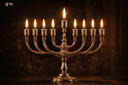
The Chanukah lights are an exceptionally precious mitzvah, as the Rambam states in Hilchos Chanukah 4:12. But out of all the mitzvos, why was this said only about Chanukah?
The same question can be asked about miracles. The dreidel that children play with on Chanukah bears letters signifying the Chanukah miracle, calling it nes gadol, a “great miracle.” There were really two miracles on Chanukah: defeating the Greeks, and the oil that burned eight days. In the blessing of She’asah Nissim, we mention only the miracle of the oil. However, there are other times of year when very great miracles took place for our forefathers, miracles that seem much greater than that of the oil. Yet, we don’t recite She’asah Nissim over them. Why?
The miracle of the oil lasted eight days. But it happened only once in history! Whereas the Menorah experienced a regular, daily miracle. The westernmost lamp of the Menorah, the one adjacent to the Kodesh Kodoshim, would be kindled first, and it always extinguished last, even though all the lamps were allotted the same amount of oil. This miracle took place for more than a thousand years. It, too, is a miracle of the Menorah’s oil lasting longer than naturally possible. Yet, we make no special remembrance of this miracle, although we make a big remembrance over the Chanukah miracle of the oil. Why is only the latter a “big miracle”?
Let us put Chanukah in perspective. Objects of furniture, such as tables and chairs, typically stand on four legs. An object standing on four legs has a stable base. Yet, the Jewish people ostensibly has only three legs, which are the three regalim, the three festivals of Pesach, Shavu’os and Sukkos. Where is the fourth leg?
The Arizal says it is Chanukah. The Gemara states that the Chanukah lights need to burn until people go home in the evening, literally, “until the leg is no longer in the marketplace.” The Arizal says that the word regel, “leg,” alludes to the fact that Chanukah is the fourth leg of the Jewish people, without which there is no stability.
The significance of the other three regalim is quite clear. Pesach is when we left Egypt and became Hashem’s people, which granted us eternal freedom. Shavu’os is when we received the Torah, and Sukkos is the time of deveikus between Hashem and His people.
What is the special message of the Chanukah miracle?
It teaches us how to deal with darkness. How to conduct ourselves in the darkness of galus. The greatest thing you can do for someone is not to tell him to ignore his troubles and forget about them, but rather to give him the tools to deal with them.
All the other holidays are Mikraei Kodesh. They are times of kedushah. But Chanukah takes place on mundane weekdays, which we are permitted to perform all manners of work. Chanukah is unique in this. It is a mo’ed that occurs on ordinary weekdays. How is this possible? What granted it the quality of a mo’ed?
It was the mesirus nefesh of the Chashmona’im. Mesirus nefesh means going above human nature. It means giving up one’s soul for kiddush Hashem. This transcends the normal human outlook. The wondrous mesirus nefesh of the Chashmona’im did away with the Greek kingdom. The Chanukah miracle taught us that we can live a life of kedushah even within the course of natural life, on mundane weekdays.
Why is this called a “great miracle”?
First we need to understand the following point. We know that the Jewish people is different from all the nations of the earth. What makes it different? Is it that we proclaim G-d’s existence, that He created the world? No, this is not a uniquely Jewish idea. The nations of the world know about the Creator. It even says on the American dollar bill in Whom they trust.
It is a matter of common sense to believe in G-d; only fools don’t.
Judaism is all about personal connection to Hashem. It is one thing to believe that G-d exists somewhere up there in the heavens or on some abstract metaphysical plane, but it is something else altogether to develop a deep, personal connection with Him through tefilah and berachos and Torah learning. This is being a Jew.
Hashem loves us greatly. Our intimate relationship with Him is described in many places as that of husband and wife. The two keruvim that were on the Aron of Beis Hamikdash symbolized this intense love, which was expressed at Har Sinai, where Hashem spoke to us “face to face,” a revelation that is described in Shir Hashirim as “May He kiss me with the kisses of His mouth.” Kissing on the mouth, as opposed to kissing on the hand, is by nature a mutual expression of love. If you kiss someone’s hand, he may or may not return the kiss, but a kiss on the mouth is by nature reciprocal.
Let’s imagine that a very wealthy bridegroom says to his beloved bride, who comes from a poor but respectable background, that after their marriage, she will come to live with him in a magnificent mansion replete with an army of servants who will serve her like a queen. She responds that she prefers him to join her in her humble home.
Which will express greater love: if the husband insists that she come to his mansion, or if he agrees to go and live with her in her humble home? Clearly, the latter is a greater expression of love.
This explains the difference between Chanukah and the other holidays. On the three regalim, Hashem raises us up to Him, He invites us to approach His holy abode. On Shabbos, too, we are invited to partake of a banquet with Hashem, so to speak. It is Hashem’s se’udah: דא היא סעודתא דעתיקא קדישא.
This is a miracle, but it is not a “great miracle.”
Chanukah is a “great miracle.” The Jewish people were enveloped in deep darkness. Not only did the Greeks rule over them, but many Jews were misyavnim, they followed the Greek ways. Thus they lived in great “poverty.” Nevertheless, the core of the Jewish people remained faithful to Hashem, so He made for them a “great miracle” in the midst of all the darkness. He was with us in our time of distress. This miracle was not just the fact that the Menorah burned for eight days; it was the “kiss” that Hashem gave us, it was His special closeness to us in all our darkness and poverty.
In our great darkness, Hashem showed us special affection and treated us as His precious beloved ones. The other holidays celebrate the greatness of Hashem as demonstrated by the miracles of Yetzi’as Mitzrayim and so forth. Chanukah celebrates Hashem’s special affection for the Jewish people. He came to us in our darkness and poverty. This was expressed by the miracle of the Menorah burning eight days.
On Chanukah we received a “kiss” from Hashem like we never received on the three regalim. Instead of Hashem bringing us up to Him, on Chanukah He came down to us. All He asked is for us to return the kiss, and that is what the Chashmona’im did: ואחר כן באו בניך לדביר ביתך ופינו את היכלך וטהרו את מקדשך והדליקו נרות בחצרות קדשך – “Afterward, Your children entered the hall of Your house and cleared out Your palace and purified Your Temple and kindled lights in Your sacred courtyards.”
Our generation is shrouded in a darkness like never before. On the other hand, Hashem shows us tremendous affection. So many yeshivos and Torah schools and other blessed institutions have been established. All Hashem asks is that we should return the kiss, and give Him a place in our lives and our homes.
Hashem shows His love to us at all times. We, in return, should purify our homes from all the impurities of the street. In this merit, may we see miracles and wonders that will lead us to the Ge’ulah Sheleimah.