When Its Dark Outside
Why Chanukah lights differ from Temple and Shabbos candles: A lesson on illuminating the darkness beyond our homes
EXCERPT FROM A CHANUKAH MESSAGE BY RABBI MENACHEM M. SCHNEERSON LUBAVITCHER RABBI א״טילש
By the Grace of G-d
23rd of Kislev, 5713
Brooklyn 13, N.Y.
Sholom u’Brocho:
... With the approach of Chanukah, I extend to you herewith my sincere wishes for a happy and inspiring Chanukah.
The message of Chanukah is important and timely to all Jews, but even more so to Jews, living in surroundings with comparatively little Jewish vitality and activity. It is precisely in such circumstances that Chanukah offers many a useful lesson. One such lesson I wish to make the subject of this message.
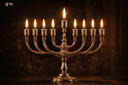
It is noteworthy that the Chanukah lights must be kindled after sunset, when it is dark outside, unlike the lights that were kindled in the Beth Hamikdosh much earlier, or the Sabbath lights kindled on Friday before sunset. There is another difference: the Beth Hamikdosh – and the Sabbath – lights have their place indoors, while the place of the Chanukah lights is at the entrance to the home (when Jews lived freely in their land, the place was the outside entrance). Finally, there is yet another distinction: in the former two cases the lights remain the same, while the Chanukah lights are increased every night.
The lesson which seems to be indicated by the Chanukah lights is that besides lighting up the home (Sabbath lights) and the synagogue and Yeshiva (substituting for the Sanctuary of old), the Jew has the additional responsibility of lighting up the ‘outside’, the whole environment. Moreover, when conditions are unfavorable (it is “dark” outside), it is then not enough to make a light and maintain it, though it is also an achievement in view of the darkness; but it is necessary to steadily increase the lights, through steadily growing efforts to spread the light of Torah and Mitzvoth, to illuminate not only one’s home, but the whole environment as well. ...