Yosefs Business
Toras Avigdor | December 17, 2024
Print This Article
View Original PDF

Yosefs Business

Toras Avigdor | June 27, 2025

Yosef’s Business

Everyone remembers the story of וַיָּבֵא יוֹסֵף אֶת דִּבָּתָם רָעָה אֶל אֲבִיהֶם, how Yosef, whenever he saw anything in his brothers’ behavior that he felt was wrong, he brought it to his father’s attention. Now, I don't know if all the reports that he brought were always factual. It could be that sometimes it only looked like they were doing something that wasn't proper and actually he suspected them wrongly; it could be. The brothers were righteous people after all.

But that’s not our subject now. What’s important for us is that Yosef felt some sort of responsibility and he went and told his father everything. He didn’t say, “It’s none of my business.”

That, after all, would have been the more prudent thing to do. It was a dangerous adventure, what Yosef was doing. Actually, we see that it almost cost him his life; the brothers wanted to get rid of him because of that. And Yosef was no fool; he knew that he wasn’t increasing his favor in the eyes of his brothers. And nevertheless he didn’t hold back and he continued to bring דִּבָּתָם רָעָה אֶל אֲבִיהֶם. He did what was commanded by his conscience. He made it his business.

Now, don’t think it was immaturity, a little brother who was a babbler, a tattletale. No; you should never project your own faults, your own immature attitudes, on a great person like Yosef Hatzaddik. Yosef was a responsible person, very responsible and very thoughtful.

The Chanukah Attitude

And so you have to say that there was a certain middah, a certain attitude of making it his own business, of feeling that it was his business. And that brings us to the heroes of Chanukah, the Chashmonaim and all the loyal Jews of that generation.

In the Al Hanissim of Chanukah we say to Hashem as follows: עֵת צָרָתָם לָהֶם בָּעֲמַדְתָּ – We thank You for standing up for our ancestors at their time of trouble, אֶת רִיבָם רַבְתָּ – you stood up for their quarrel, אֶת דִּינָם דַּנְתָּ – and You judged their case. It means, You took up for them. You stepped in and fought their fight.

It’s a beautiful tefillah of gratitude that we say all eight days of Chanukah, but we're going to see now that the language seems to be wrong. Because actually, it wasn’t “their fight”; it wasn't “their quarrel” that they were fighting. And we’ll explain that.

Everybody knows that there's a big difference between Chanukah and Purim. On Purim our enemies were making war on the Am Yisroel as a people; they wanted to destroy our bodies, לַהֲרֹג לְאַבֵּד אֶת כָּל הַיְּהוּדִים. On Chanukah, however, there was no such intention. Antiochus wasn’t a Hitler. He didn’t want to exterminate them; all he wanted was to destroy the Torah. We say that in the Al Hanissim: It was לְהַשְׁכִּיחָם תּוֹרָתֶךָ; it was only to make them forget the Torah.

Fighting Hashem’s Fight

And so when Matisyahu and the Jews rose up in revolt to uphold the Torah it wasn’t “their fight” at all – it was Hashem’s fight that they were battling. Because if they had been willing to yield His Torah and accept the Greek way of life then there wouldn't have been any battles. They would have been like all the nations around the Mediterranean who all adopted the Greek ways and lived in peace. Alexander the Great had conquered them, so they accepted his ways.

The Egyptians had Greek ways now. The Syrians had Greek ways now. All over Asia Minor everybody had adopted the ways of the conquerors. They didn't put up any fight and they lived peacefully. And the Jews could have done the same thing; they could have lived in peace. But the Am Yisroel rose up anyhow; they rose like lions – not to defend themselves, but to defend the Toras Hashem. The whole battle, the whole campaign, all those years that they sacrificed their lives and everything else was only for Hashem.

And so we see, that there’s a concept of us taking on something that’s not our business, and making it our business. That’s what Yosef Hatzaddik was doing when he was bearing reports to his father. He cared so deeply about the conduct of his brothers, that he inserted himself, he took it personally, and that is our subject for tonight.
Yosef’s Business

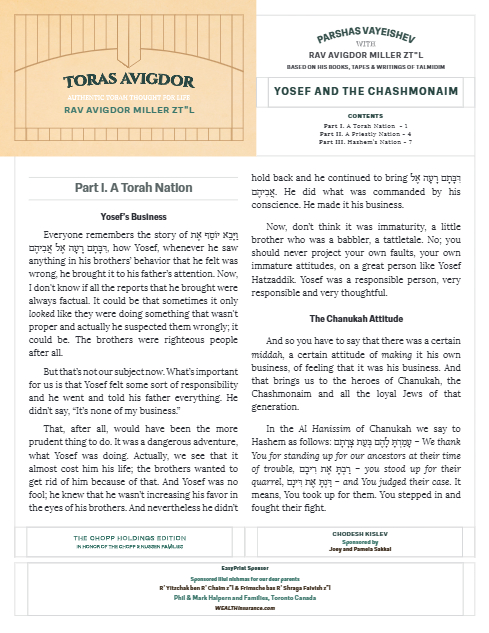
Everyone remembers the story of וַיָּבֵא יוֹסֵף אֶת דִּבָּתָם רָעָה אֶל אֲבִיהֶם, how Yosef, whenever he saw anything in his brothers’ behavior that he felt was wrong, he brought it to his father’s attention. Now, I don't know if all the reports that he brought were always factual. It could be that sometimes it only looked like they were doing something that wasn't proper and actually he suspected them wrongly; it could be. The brothers were righteous people after all.

But that’s not our subject now. What’s important for us is that Yosef felt some sort of responsibility and he went and told his father everything. He didn’t say, “It’s none of my business.”

That, after all, would have been the more prudent thing to do. It was a dangerous adventure, what Yosef was doing. Actually, we see that it almost cost him his life; the brothers wanted to get rid of him because of that. And Yosef was no fool; he knew that he wasn’t increasing his favor in the eyes of his brothers. And nevertheless he didn’t hold back and he continued to bring דִּבָּתָם רָעָה אֶל אֲבִיהֶם. He did what was commanded by his conscience. He made it his business.

Now, don’t think it was immaturity, a little brother who was a babbler, a tattletale. No; you should never project your own faults, your own immature attitudes, on a great person like Yosef Hatzaddik. Yosef was a responsible person, very responsible and very thoughtful.

The Chanukah Attitude

And so you have to say that there was a certain middah, a certain attitude of making it his own business, of feeling that it was his business. And that brings us to the heroes of Chanukah, the Chashmonaim and all the loyal Jews of that generation.

In the Al Hanissim of Chanukah we say to Hashem as follows: עֵת צָרָתָם לָהֶם בָּעֲמַדְתָּ – We thank You for standing up for our ancestors at their time of trouble, אֶת רִיבָם רַבְתָּ – you stood up for their quarrel, אֶת דִּינָם דַּנְתָּ – and You judged their case. It means, You took up for them. You stepped in and fought their fight.

It’s a beautiful tefillah of gratitude that we say all eight days of Chanukah, but we're going to see now that the language seems to be wrong. Because actually, it wasn’t “their fight”; it wasn't “their quarrel” that they were fighting. And we’ll explain that.

Everybody knows that there's a big difference between Chanukah and Purim. On Purim our enemies were making war on the Am Yisroel as a people; they wanted to destroy our bodies, לַהֲרֹג לְאַבֵּד אֶת כָּל הַיְּהוּדִים. On Chanukah, however, there was no such intention. Antiochus wasn’t a Hitler. He didn’t want to exterminate them; all he wanted was to destroy the Torah. We say that in the Al Hanissim: It was לְהַשְׁכִּיחָם תּוֹרָתֶךָ; it was only to make them forget the Torah.

Fighting Hashem’s Fight

And so when Matisyahu and the Jews rose up in revolt to uphold the Torah it wasn’t “their fight” at all – it was Hashem’s fight that they were battling. Because if they had been willing to yield His Torah and accept the Greek way of life then there wouldn't have been any battles. They would have been like all the nations around the Mediterranean who all adopted the Greek ways and lived in peace. Alexander the Great had conquered them, so they accepted his ways.

The Egyptians had Greek ways now. The Syrians had Greek ways now. All over Asia Minor everybody had adopted the ways of the conquerors. They didn't put up any fight and they lived peacefully. And the Jews could have done the same thing; they could have lived in peace. But the Am Yisroel rose up anyhow; they rose like lions – not to defend themselves, but to defend the Toras Hashem. The whole battle, the whole campaign, all those years that they sacrificed their lives and everything else was only for Hashem.

And so we see, that there’s a concept of us taking on something that’s not our business, and making it our business. That’s what Yosef Hatzaddik was doing when he was bearing reports to his father. He cared so deeply about the conduct of his brothers, that he inserted himself, he took it personally, and that is our subject for tonight.

PDF Preview