He Who Does Not Place His Trust in Hashem is Forsaken by Him
Zera Shimshon | November 26, 2025
Print This Article
View Original PDF

He Who Does Not Place His Trust in Hashem is Forsaken by Him

Zera Shimshon | December 07, 2025

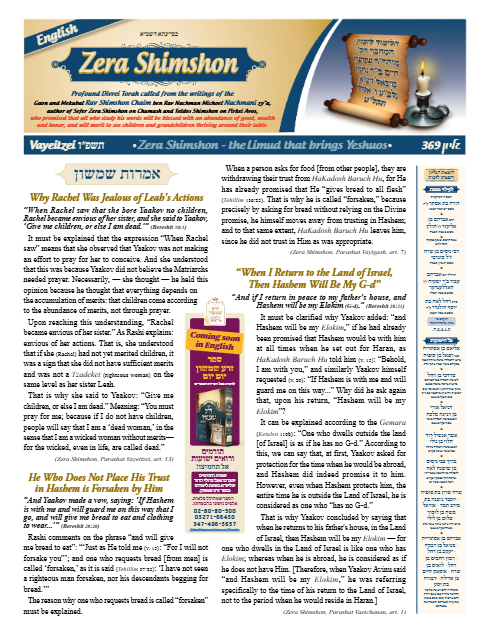
“And Yaakov made a vow, saying: ‘If Hashem is with me and will guard me on this way that I go, and will give me bread to eat and clothing to wear...’” (Bereshit 28:20)

Rashi comments on the phrase “and will give me bread to eat”: “‘Just as He told me (v. 15): “For I will not forsake you”’; and one who requests bread [from men] is called ‘forsaken,’ as it is said (Tehillim 37:25): ‘I have not seen a righteous man forsaken, nor his descendants begging for bread.’”

The reason why one who requests bread is called “forsaken” must be explained.

When a person asks for food [from other people], they are withdrawing their trust from HaKadosh Baruch Hu, for He has already promised that He “gives bread to all flesh” (Tehillim 136:25). That is why he is called “forsaken,” because precisely by asking for bread without relying on the Divine promise, he himself moves away from trusting in Hashem; and to that same extent, HaKadosh Baruch Hu leaves him, since he did not trust in Him as was appropriate.

Zera Shimshon, Parashat Vayigash, art. 7
“And Yaakov made a vow, saying: ‘If Hashem is with me and will guard me on this way that I go, and will give me bread to eat and clothing to wear...’” (Bereshit 28:20)

Rashi comments on the phrase “and will give me bread to eat”: “‘Just as He told me (v. 15): “For I will not forsake you”’; and one who requests bread [from men] is called ‘forsaken,’ as it is said (Tehillim 37:25): ‘I have not seen a righteous man forsaken, nor his descendants begging for bread.’”

The reason why one who requests bread is called “forsaken” must be explained.

When a person asks for food [from other people], they are withdrawing their trust from HaKadosh Baruch Hu, for He has already promised that He “gives bread to all flesh” (Tehillim 136:25). That is why he is called “forsaken,” because precisely by asking for bread without relying on the Divine promise, he himself moves away from trusting in Hashem; and to that same extent, HaKadosh Baruch Hu leaves him, since he did not trust in Him as was appropriate.

Zera Shimshon, Parashat Vayigash, art. 7

PDF Preview


