How Does Something Like This Happen
Hashgacha Pratis | November 24, 2023
Print This Article
View Original PDF

How Does Something Like This Happen

Hashgacha Pratis | December 31, 2025

There is a wonderful midrash in Devarim Rabbah (1:12): Rabi Levi bar Chama says that if, regarding someone who worships idols, it says (Tehillim 115-135), “Those who make [idols] will be [as powerless] as the idols, [and the same for] all who trust in them,” then how much more will one who serves Hakadosh Baruch Hu be like Him. How do we know this? Because the navi says (Yirmeyahu 17:7), “Blessed is the man who trusts in Hashem.”

In the perek of Tehillim from Hallel (recited on those days when we say the complete Hallel), Dovid Hamelech fulfills the mitzvah of mocking avodah zarah. He describes the idols – the handiwork of mankind – and mocks them in seven different ways: Their mouths don’t speak; their eyes don’t see; their ears don’t hear; their legs don’t move even a millimeter; their hands don’t feel; their noses cannot smell; and from their throats, not a syllable will emerge. Afterward, Dovid Hamelech curses whoever made these idols and all who trust in them, saying that they should be just like the idols. Klal Yisrael continues to curse them every time we recite Tehillim or complete Hallel: “Those who made them shall be like them....”

The midrash teaches that from this curse we learn the opposite: Whoever trusts in Hashem will be like Him. How is it possible to say that a person will be like Hakadosh Baruch Hu? Perhaps the idea is that one who trusts in Hashem will reach the level of a righteous man, who decrees and Hakadosh Baruch Hu fulfills. Whoever trusts in Hashem and believes in the foundations of emunah – that only Hashem does everything and that no one can take anything from him or give him anything without the will of the Creator – is calm and serene. He is focused on his avodas Hashem and does not fear other people at all, and he can reach very high madreigos.

Whoever trusts in the Creator of all worlds is himself blessed. Radak explains the words “...and Hashem will be his Protector” (Yirmeyahu, ibid.) as implying that he does not fear any evil. He is taken care of. He has a secure place to go, where he will be protected. How wonderful that is! How do we merit this brachah that is bestowed on the one who trusts in Hashem?

The Sfas Emes explained (Eikev 5652): “Trust in Him at all times” (Tehillim 62:9). We need bitachon during times of tzarah, but the main challenge of maintaining bitachon is during times of serenity.

A person has pain; he doesn’t feel well; someone is stuck at home and doesn’t find his zivug; or there is a chassan and a kallah, but it is so difficult at home with all the expenses...it’s nice that he trusts in Hashem, believing that Hashem will help him and save him. But it’s most important to have bitachon during times of serenity, when all is rosy: There are no debts to the bank or the gemachim, the children are healthy, the mechanchim praise them excessively, the neighbors are wonderful, the house is redone, there is cash at home, the weather is wonderful – hot when appropriate, cold when expected, and there is cold seltzer and watermelon for dessert – the trick is to feel specifically at that time that one is completely dependent on Hashem, to feel that “I am alone and poor” – on my own I am powerless. It wasn’t me, with my wisdom, who brought all this wealth and happiness to myself. These are not my skills and strengths. “Remember that it is Hashem Who gives one the ability to do mighty deeds.” The Targum explains that He is the One Who gave you the skill to make good investments. Remember that the idea that brought about your success came only from the Creator of the world.

During times of nisayon and pain – may they never come – there will then be strength to cope. The person with strong bitachon won’t lose his equilibrium when someone does something he doesn’t like.

You might see a very respectable Yid, who sits at the mizrach wall, who davens beautifully and learns diligently, who buys arbaah minim for a four-digit sum; but suddenly, when someone insults him, or pushes him, or causes some item of his to fall down, or the gabbai doesn’t give him the aliyah he wanted...he bursts out with offensive words and tones that are literally shameful. How does something like this happen? And the simple people standing around him are shocked and ask themselves, Where is his honor? How did all his Torah wisdom disappear in an instant? He was always such a respected Yid.... This is due only to the fact that he did not invest time and energy into learning the subject of bitachon.

A Yid for whom bitachon is a way of life doesn’t lose it when someone hurts him. When others apologize to him, he doesn’t even understand why they are apologizing, since everything was decreed by the Creator yisbarach. He doesn’t hold a grudge against anyone, all sorts of circumstances and worries don’t faze him, and he is not pained over things that happened to him, since he is strong in his belief that Hashem alone does everything for the good. As a result, he copes well with his difficulties, and his life is happy and blessed. Blessed is the man who trusts in Hashem!

Excerpt from shiur 327 in Shaar Habitachon.

To listen to the shiur, press 4 after selecting a language, or dial directly 02-301-1904
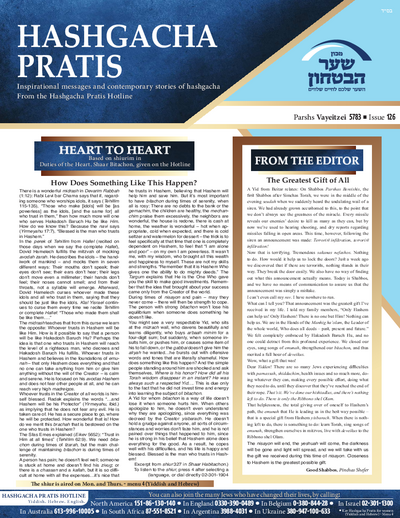
There is a wonderful midrash in Devarim Rabbah (1:12): Rabi Levi bar Chama says that if, regarding someone who worships idols, it says (Tehillim 115-135), “Those who make [idols] will be [as powerless] as the idols, [and the same for] all who trust in them,” then how much more will one who serves Hakadosh Baruch Hu be like Him. How do we know this? Because the navi says (Yirmeyahu 17:7), “Blessed is the man who trusts in Hashem.”

In the perek of Tehillim from Hallel (recited on those days when we say the complete Hallel), Dovid Hamelech fulfills the mitzvah of mocking avodah zarah. He describes the idols – the handiwork of mankind – and mocks them in seven different ways: Their mouths don’t speak; their eyes don’t see; their ears don’t hear; their legs don’t move even a millimeter; their hands don’t feel; their noses cannot smell; and from their throats, not a syllable will emerge. Afterward, Dovid Hamelech curses whoever made these idols and all who trust in them, saying that they should be just like the idols. Klal Yisrael continues to curse them every time we recite Tehillim or complete Hallel: “Those who made them shall be like them....”

The midrash teaches that from this curse we learn the opposite: Whoever trusts in Hashem will be like Him. How is it possible to say that a person will be like Hakadosh Baruch Hu? Perhaps the idea is that one who trusts in Hashem will reach the level of a righteous man, who decrees and Hakadosh Baruch Hu fulfills. Whoever trusts in Hashem and believes in the foundations of emunah – that only Hashem does everything and that no one can take anything from him or give him anything without the will of the Creator – is calm and serene. He is focused on his avodas Hashem and does not fear other people at all, and he can reach very high madreigos.

Whoever trusts in the Creator of all worlds is himself blessed. Radak explains the words “...and Hashem will be his Protector” (Yirmeyahu, ibid.) as implying that he does not fear any evil. He is taken care of. He has a secure place to go, where he will be protected. How wonderful that is! How do we merit this brachah that is bestowed on the one who trusts in Hashem?

The Sfas Emes explained (Eikev 5652): “Trust in Him at all times” (Tehillim 62:9). We need bitachon during times of tzarah, but the main challenge of maintaining bitachon is during times of serenity.

A person has pain; he doesn’t feel well; someone is stuck at home and doesn’t find his zivug; or there is a chassan and a kallah, but it is so difficult at home with all the expenses...it’s nice that he trusts in Hashem, believing that Hashem will help him and save him. But it’s most important to have bitachon during times of serenity, when all is rosy: There are no debts to the bank or the gemachim, the children are healthy, the mechanchim praise them excessively, the neighbors are wonderful, the house is redone, there is cash at home, the weather is wonderful – hot when appropriate, cold when expected, and there is cold seltzer and watermelon for dessert – the trick is to feel specifically at that time that one is completely dependent on Hashem, to feel that “I am alone and poor” – on my own I am powerless. It wasn’t me, with my wisdom, who brought all this wealth and happiness to myself. These are not my skills and strengths. “Remember that it is Hashem Who gives one the ability to do mighty deeds.” The Targum explains that He is the One Who gave you the skill to make good investments. Remember that the idea that brought about your success came only from the Creator of the world.

During times of nisayon and pain – may they never come – there will then be strength to cope. The person with strong bitachon won’t lose his equilibrium when someone does something he doesn’t like.

You might see a very respectable Yid, who sits at the mizrach wall, who davens beautifully and learns diligently, who buys arbaah minim for a four-digit sum; but suddenly, when someone insults him, or pushes him, or causes some item of his to fall down, or the gabbai doesn’t give him the aliyah he wanted...he bursts out with offensive words and tones that are literally shameful. How does something like this happen? And the simple people standing around him are shocked and ask themselves, Where is his honor? How did all his Torah wisdom disappear in an instant? He was always such a respected Yid.... This is due only to the fact that he did not invest time and energy into learning the subject of bitachon.

A Yid for whom bitachon is a way of life doesn’t lose it when someone hurts him. When others apologize to him, he doesn’t even understand why they are apologizing, since everything was decreed by the Creator yisbarach. He doesn’t hold a grudge against anyone, all sorts of circumstances and worries don’t faze him, and he is not pained over things that happened to him, since he is strong in his belief that Hashem alone does everything for the good. As a result, he copes well with his difficulties, and his life is happy and blessed. Blessed is the man who trusts in Hashem!

Excerpt from shiur 327 in Shaar Habitachon.

To listen to the shiur, press 4 after selecting a language, or dial directly 02-301-1904

PDF Preview