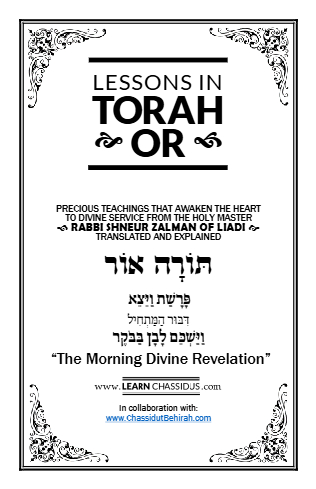
The Morning Divine Revelation
Lessons in Likutay Torah | December 04, 2024
Print This Article
View Original PDF

The Morning Divine Revelation

Lessons in Likutay Torah | June 27, 2025

In Parshas Vayeitzei the Torah describes how Yaakov took his family and escaped from Lavan’s household. When Lavan found out he chased after them, until he caught up with them at place later to be called Gilad. Lavan originally planned to harm Yaakov, but Hashem appeared to Lavan in a dream and warned him not to harm Yaakov in any way. After arguing with Lavan, they decided to make a peace agreement to not hurt each other. Before Lavan went back to his home, he woke up early in the morning, he kissed his four daughters, who were all married to Yaakov, and his eleven grandchildren, and blessed them with success.

In this maamar, the Alter Rebbe will explain the mystical meaning for the Torah’s description of how Lavan kissed and blessed his children and grandchildren.

Short Introduction

In this maamar, the Alter Rebbe will describe four levels of mercy from Hashem.

  • Lavan-Loven HaElyon/The Whiteness of Above: The “Infinite Worlds” where Hashem’s Infinite Light shines unobstructed, in the level above Atzilus. At that level, Hashem’s mercies are unlimited.
  • Atzilus: This is the level of the Forefathers, Avraham, Yitzchok, and Yaakov. At this level, Yaakov can awaken Hashem’s unlimited mercy to be expressed into the 10 Sefiros of Atzilus.
  • Briah: This is the level of Shevatim/Tribes, the 12 sons of Yaakov. They can awaken Hashem’s mercy to descend from Atzilus into the created worlds of Beriah, Yetzira, and Asiya.
  • Physical aspect of Asiya: Is where we live. We can awaken Hashem’s mercy to come down into the physical world. Because we are derived from the Shevatim of Beriah, and from the forefathers Avraham, Yitzchok, and Yaakov of Atzilus, we are also able to connect to the unlimited mercies of Hashem in the “Infinite Worlds” above Atzilus, and bring down all the way to our physical world.

The commentary to this maamar will be based primarily on the Mittler Rebbe’s explanation of this maamar in Toras Chayim Bereishis, page 175d (aka p. 350).

Back to the maamar

(Chapter 1)

“And Lavan woke up early in the morning, and he kissed his [grand]sons and his daughters [and granddaughter], and he blessed them, and then Lavan went on his way and returned to his home town.” (Bereishis 32:1)

For a slightly different approach to explain the maamar, see Or HaTorah of the Tzemach Tzemech, Bereishis, vol. 5, page 869a (1737).

The Seven Attributes and Their Descent

Now, it is written (Divrei Hayamim I, 29:11): “To You Hashem is the greatness, the might, the splendor, the victory, and the majesty, for all on heaven and earth is Yours; to You Hashem is the kingship, for You are exalted supreme over all rulers.”

This verse is part of King David’s praise of Hashem in his speech to the entire Jewish people at the end of his life, when he appoints his son Shlomo to be king after him. He thanks Hashem for giving him kingship over the Jewish people, and victory over the enemies of the Jewish people.

In the teachings of Kabbalah, the seven attributes mentioned in this verse are the seven Sefiros of Atzilus that relate to how Hashem conducts the world:

  1. Greatness = Chesed/Kindness
  2. Might = Gevura/Severity
  3. Splendor = Tiferes/Beauty
  4. Victory = Netzach
  5. Majesty = Hod
  6. For all on heaven and earth = Yesod/Foundation
  7. Kingship = Malchus

Now, these attributes in Atzilus exist on different levels. The essential nature of these attributes is too lofty to be able to descend into the created worlds. Only an extension and expression of these attributes can directly contact the creations. This is possible when the first five attributes, Chesed-Hod, come down through Yesod into Malchus. As they exist in Malchus they can come into the created worlds.

These attributes are written in the feminine grammatical format, i.e., גְּדוּלָּּה with a ה instead of גָּדוֹל etc., since this verse is describing the attributes as they are receiving from the Infinite Light of Hashem.

The Letter ה and Divine Expansion

The Mittler Rebbe explains in Toras Chayim (Bereishis, 175d):

The idea of the letter ה is expansion and spreading out. This represents how the attributes of Atzilus extend and spread downward to flow into the created worlds. This is the more external aspect of the Chesed and Gevura, as they come into Malchus and into the worlds. At this level, these aspects are only receiving a limited aspect from the essence of these attributes. It is from this extension of the attributes as they come into Malchus that the created beings can perceive Hashem’s greatness and might. (The essence of Chesed and Gevura before they extend downward into Malchus are called גָּדוֹל וְגִּבּוֹר without a ה. At that level these attributes are “giving,” as opposed to the how they extend into Malchus, where they are “feminine” and “receiving.”)

For, there is no possibility of perceiving the greatness of the actual Infinite Light of Hashem, since “where you find His greatness is actually where you find His humility.” (Megila 31a)

The actual greatness of Hashem cannot be fathomed in any way. Similarly, the essence of the attributes of Kindness and Severity of Atzilus are too lofty to be directly perceived by the creations. Only as these attributes extend into Malchus can they serve as the source of perceivable Kindness and Severity in the creations. Where some finds Hashem’s greatness, meaning he is able to perceive something of Hashem’s attributes, this is Hashem’s humility, i.e., it is only a limited expression of Hashem’s attributes that came down to a level where created beings can perceive it.

Avraham and the Attribute of Greatness

Now this “הָּלְּדַגֲאַו” attribute of Hashem’s greatness perceivable to creations, is the aspect of Avraham,

Avraham’s mission was to reveal Hashem’s greatness and kindness to the creations, which he accomplished to a great extant in his lifetime by teaching the whole world about Hashem.

As it is written (Bereishis 12:2): “And I [Hashem] will make your name ‘גדלה-the amplifier,’”

Hashem named Avraham as the one to make Hashem’s presence known in the world, and to amplify people’s awareness of Hashem.

This is why we first praise Hashem in the Amida prayer saying that He is the “G-d of Avraham,” before describing Him as “הַגָּדוֹל-The Great,”

Toras Chayim: In order to describe Hashem as “הַגָּדוֹל-The Great” with a letter ה, implying a greatness that is known to us, we first need to refer to how Hashem is the ultimate Source of all Greatness, the “G-d of Avraham,” i.e., the source of all kindness and greatness that would later be revealed through the attribute of Avraham.

This is the praise of Hashem: His humility is so great, that He can bring down some of His greatness to a level that we can understand.

If his true greatness cannot be fathomed, then how are we praising Hashem for that limited expression of his greatness that doesn’t reflect His true greatness at all?

The answer is that we are praising Hashem for His great humility, that He descends to our level so that we can appreciate His greatness according to our capacity.

Meaning, that His Infinite Light is drawn down and extends to the point that it can even dwell and be revealed in the aspect of “Avraham, My friend who loves Me,” (see Yeshaya 41:8)

Hashem’s Kindness was able to descend and limit itself to the point of investing in Avraham’s attribute of Kindness, and furthermore, into Avraham himself as he was a human in the world. Even though Hashem’s essential attribute of Kindness is unlimited and infinite, nonetheless, Hashem contracted and limited some of His Kindness so that it should be invested and manifest in the soul of Avraham in this world. This is why Hashem called Avraham “My friend who loves Me,” since he ‘belonged’ to Hashem, in the sense that Hashem’s Kindness and love was manifest and invested in him.

The Forefathers as the Merkavah

Now, it says (Bereishis Rabbah 47:6) “the forefathers are the ‘Merkavah-Chariot’ of Hashem’s attributes,” since all of their days they were on the level of total selfless transparency to Divinity.

A chariot has no will or desire independent of the one riding it. So too, the forefathers, Avraham, Yitzchok and Yaakov, were selfless vehicles for Divine expression.

Because of this, they merited to have manifest in them the ‘Shechina-Divine Presence’ i.e., an actual revelation of Hashem’s Infintie Light, so that Hashem’s Infinite Light and His attributes were revealed in their souls, in the aspects of “Avraham, who loves Me,” and “the fear of Hashem of Yitzchok,”

The fact that Hashem describes how Avraham loved Him and how Yitzchok feared Him was to show that Avraham was a vehicle of expression of Hashem’s love and kindness, and therefore had a Divine level of love of Hashem, and Yitzchok was a vehicle of expression of Hashem’s attribute of Severity, and therefore had a Divine level of fear of Hashem. Similary, Yaakov was a vehicle of expression of Hashem’s attribute of Mercy.

These are the actual attributes of Hashem’s own greatness (kindness) and severity, as they descend downward through them, i.e., the souls of the forefathers, so that Hashem’s Infinite Light should be openly revealed in the souls of all the Jewish People.

The revelation referred to here is not that the awareness of Hashem should just be expressed in a Jew’s fleeting thoughts, since “all Jews are believers, the children of believers,”

Since every Jew inherits a Divine soul, he or she naturally believes in Hashem, without needing any proof. However, this natural belief in Hashem can exist on a subconscious level, without affecting one’s daily conduct. This is why a Jewish thief may pray to Hashem to succeed in stealing, since he naturally believes in Hashem, but his thoughts about Hashem don’t affect his conduct to stop him from stealing. This type of fleeting thoughts about Hashem resulting from our natural (subconscious) connection to Him is not called an “actual revelation” of Hashem’s Infinite Light into the souls of the Jewish People.

Since, a person’s thoughts are in his control to turn it in whatever direction he desires, and whatever he desires he can choose to concentrate the thoughts of his heart upon, and sometimes he turns them one way, i.e., to think about Hashem, and sometimes the other way, i.e., to think only about material matters.

Mere inborn belief in Hashem’s existence will produce occasional fleeting thought about Hashem, that the person may sometimes choose to concentrate upon and sometimes not. This is not true revelation of Hashem.

Rather, true revelation of Hashem means that the person’s desire and will are firmly established in their focus on connecting to Hashem, and this is accomplished through “Daas-intimate knowledge” and recognition of Hashem that is experienced so strongly that it is as if the person “sees” the truth of Hashem’s existence.

As our Sages say regarding Avraham our forefather (Nedarim 32a) that “He recognized his Creator,”

The Rambam (Hilchos Avoda Zara, 1:3) explains that Avraham came to the full recognition of the true existence of Hashem. This recognition was so real and powerful to Avraham that he was willing to give up his life to publicize this knowledge and truth. It is this type of recognition of Hashem that is called “seeing” the truth of Hashem. When a Jew comes to recognize the truth of Hashem’s existence in a similar manner, that it becomes absolutely real to him even in his or her physical life, that is called “a true revelation of the Infinite Light of Hashem” in his or her soul.

However, the flow of this revelation of the awareness of Hashem on the level of the forefathers themselves – which is the level of ‘Merkava-Chariot’ of Hashem from the aspect of the world of Atzilus, where “He [Hashem’s Infinite Light] and His Sefiros/Attributes are completely united,” – not every soul is able to handle that level of revelation.

Rather, for this revelation to be drawn down and descend into the levels of Beriah, Yetzira, and Asiya, where the souls of the general Jewish population are derived, this is possible only through the intermediary level of the souls of the ‘שְׁבָּטִּים-Shevatim/(Tribes),’ i.e., the souls of the 12 sons of Yaakov.

Since the word “שֵׁבֶט-Sheivet/(Tribe)” comes from the expression which means to “draw forth,” as in the term for a shooting star, “כּוֹכְבָּא-a star דְשָׁבִּיט-that is drawn out.”

Also, it (the word “שֵׁבֶט-Sheivet/(Tribe)”) comes from the expression which means a wooden staff derived from the branch or bough of great tree,

The tree branch, which is then used as walking staff, is an extension of the trunk of the tree. The trunk of the tree is drawn out and extends through its branches. We see that the idea of the Shevatim is to serve as an extension of the “trunk of the Tree,” which is the level of the forefathers, Avraham, Yitzchok, and Yaakov. Their souls serve to bring down and extend into a lower level the revelation of Hashem manifest in the souls of the forefathers.

Since they (the Shevatim) are the level of the ‘Merkava-Chariot’ to Hashem’s revelation in the aspect of Malchus of Atzilus as it descends into the created worlds, which is known as “the World of Revelation,”

Malchus of Atzilus has two aspects: The inner aspect of Malchus is how it exists in the realm of Atzilus itself. The outer aspect of Malchus is how it descends to create and enliven the worlds of Beriah, Yetzira, and Asiya. At that level, it is referred to as “the World of Revelation,” since it is the source of revelation to all the created worlds. The Shevatim were a ‘Merkava-Chariot’ to that level, i.e., this revelation completely permeated their being, and they served Hashem selflessly based on the awareness of Him from that revelation.

This level is also referred to, by way of analogy, as the Mikvah in the first Beis Hamikdash called “‘The Sea’ that stands upon 12 cow statues.” (See Melachim I, 7:23-25)

King Shlomo built a large round mikvah for Kohanim in the first Beis Hamikdash, which he called “The Sea.” This represented the level of Malchus of Atzilus, since Malchus is also like the sea. It receives the flow of Light and Life-force from the higher Sefiros and uses that to give life to the creations. This is like how the sea gathers water from all the rivers, which then turn back into cloud vapor to provide rain for the land. King Shlomo placed this mikvah on top of twelve metal cows, with three cows facing each of the four directions. This represented the four camps of the angels: Michael, Gavriel, Refael, and Uriel.

These “12 cow statues” represent the 12 Shevatim, which correspond to the four angels of the ‘Merkava-Chariot’ of the World of Beriah, each one with a different “face,” these faces are “the face of a man, the face of the face of a lion... the face of an ox... and the face of an eagle,” (Yechezkal 1:10), and each of these four angels is comprised of the three attributes of the forefathers, Love, Fear, and Mercy, equaling 12 aspects, one for each Sheivet.

The prophet Yechezkal was in Exile right before the destruction of the Beis Hamikdash. He had a prophetic vision of Hashem coming in “a stormy wind... and raging fire.” He then perceived four angels who were Hashem’s emissaries to carry out different tasks. These angels were called “חַיּוֹת-wild animals.” These angels are known as the “Merkavah-Chariot” of Hashem’s Divine Presence. Just like the King travels around in a chariot on various missions, Hashem accomplishes different things using these angels and the angels under them in spiritual level.

These four angels each had four faces: 1- A man; 2- A lion; 3- An ox; 4- An eagle. Even though they all had these four faces, they were each facing a different direction with their “main face,” so that each one had an emphasis on one of the four faces, even though they also had the other three faces, which were less pronounced than the main one.

These four angels, each facing one direction, are represented in the four groups of cows under ‘The Sea’ mikvah, three cows facing each direction.

The reason why each group has three is because each of the four angels has three aspects to it, Love, Fear, and Mercy, corresponding to those attributes of Atzilus, which were manifest in the forefathers, Avraham, Yitzchok, and Yaakov.

This group of four angels known as the ‘Merkavah-Chariot’ of Beria is the same general level as that of the souls of the 12 Shevatim.

Both the Merkava angels and the souls of the Shevatim serve as an intermediary level through which the flow of Light and Life passing through Malchus of Atzilus must go through in order to become limited enough to descend to the other creations (through the angels), or to the souls of the general population of the Jewish people (through the souls of the Shevatim).

From this level, the souls of the Shevatim, there is drawn down the flow of Hashem’s revelation in the souls of the general population of the Jewish people.

Since every Jewish soul can handle the level of the revelation of Hashem coming from the Shevatim.

And this is what the prophet said about the exile (and it will be fixed...)
In Parshas Vayeitzei the Torah describes how Yaakov took his family and escaped from Lavan’s household. When Lavan found out he chased after them, until he caught up with them at place later to be called Gilad. Lavan originally planned to harm Yaakov, but Hashem appeared to Lavan in a dream and warned him not to harm Yaakov in any way. After arguing with Lavan, they decided to make a peace agreement to not hurt each other. Before Lavan went back to his home, he woke up early in the morning, he kissed his four daughters, who were all married to Yaakov, and his eleven grandchildren, and blessed them with success.

In this maamar, the Alter Rebbe will explain the mystical meaning for the Torah’s description of how Lavan kissed and blessed his children and grandchildren.

Short Introduction

In this maamar, the Alter Rebbe will describe four levels of mercy from Hashem.

  • Lavan-Loven HaElyon/The Whiteness of Above: The “Infinite Worlds” where Hashem’s Infinite Light shines unobstructed, in the level above Atzilus. At that level, Hashem’s mercies are unlimited.
  • Atzilus: This is the level of the Forefathers, Avraham, Yitzchok, and Yaakov. At this level, Yaakov can awaken Hashem’s unlimited mercy to be expressed into the 10 Sefiros of Atzilus.
  • Briah: This is the level of Shevatim/Tribes, the 12 sons of Yaakov. They can awaken Hashem’s mercy to descend from Atzilus into the created worlds of Beriah, Yetzira, and Asiya.
  • Physical aspect of Asiya: Is where we live. We can awaken Hashem’s mercy to come down into the physical world. Because we are derived from the Shevatim of Beriah, and from the forefathers Avraham, Yitzchok, and Yaakov of Atzilus, we are also able to connect to the unlimited mercies of Hashem in the “Infinite Worlds” above Atzilus, and bring down all the way to our physical world.

The commentary to this maamar will be based primarily on the Mittler Rebbe’s explanation of this maamar in Toras Chayim Bereishis, page 175d (aka p. 350).

Back to the maamar

(Chapter 1)

“And Lavan woke up early in the morning, and he kissed his [grand]sons and his daughters [and granddaughter], and he blessed them, and then Lavan went on his way and returned to his home town.” (Bereishis 32:1)

For a slightly different approach to explain the maamar, see Or HaTorah of the Tzemach Tzemech, Bereishis, vol. 5, page 869a (1737).

The Seven Attributes and Their Descent

Now, it is written (Divrei Hayamim I, 29:11): “To You Hashem is the greatness, the might, the splendor, the victory, and the majesty, for all on heaven and earth is Yours; to You Hashem is the kingship, for You are exalted supreme over all rulers.”

This verse is part of King David’s praise of Hashem in his speech to the entire Jewish people at the end of his life, when he appoints his son Shlomo to be king after him. He thanks Hashem for giving him kingship over the Jewish people, and victory over the enemies of the Jewish people.

In the teachings of Kabbalah, the seven attributes mentioned in this verse are the seven Sefiros of Atzilus that relate to how Hashem conducts the world:

  1. Greatness = Chesed/Kindness
  2. Might = Gevura/Severity
  3. Splendor = Tiferes/Beauty
  4. Victory = Netzach
  5. Majesty = Hod
  6. For all on heaven and earth = Yesod/Foundation
  7. Kingship = Malchus

Now, these attributes in Atzilus exist on different levels. The essential nature of these attributes is too lofty to be able to descend into the created worlds. Only an extension and expression of these attributes can directly contact the creations. This is possible when the first five attributes, Chesed-Hod, come down through Yesod into Malchus. As they exist in Malchus they can come into the created worlds.

These attributes are written in the feminine grammatical format, i.e., גְּדוּלָּּה with a ה instead of גָּדוֹל etc., since this verse is describing the attributes as they are receiving from the Infinite Light of Hashem.

The Letter ה and Divine Expansion

The Mittler Rebbe explains in Toras Chayim (Bereishis, 175d):

The idea of the letter ה is expansion and spreading out. This represents how the attributes of Atzilus extend and spread downward to flow into the created worlds. This is the more external aspect of the Chesed and Gevura, as they come into Malchus and into the worlds. At this level, these aspects are only receiving a limited aspect from the essence of these attributes. It is from this extension of the attributes as they come into Malchus that the created beings can perceive Hashem’s greatness and might. (The essence of Chesed and Gevura before they extend downward into Malchus are called גָּדוֹל וְגִּבּוֹר without a ה. At that level these attributes are “giving,” as opposed to the how they extend into Malchus, where they are “feminine” and “receiving.”)

For, there is no possibility of perceiving the greatness of the actual Infinite Light of Hashem, since “where you find His greatness is actually where you find His humility.” (Megila 31a)

The actual greatness of Hashem cannot be fathomed in any way. Similarly, the essence of the attributes of Kindness and Severity of Atzilus are too lofty to be directly perceived by the creations. Only as these attributes extend into Malchus can they serve as the source of perceivable Kindness and Severity in the creations. Where some finds Hashem’s greatness, meaning he is able to perceive something of Hashem’s attributes, this is Hashem’s humility, i.e., it is only a limited expression of Hashem’s attributes that came down to a level where created beings can perceive it.

Avraham and the Attribute of Greatness

Now this “הָּלְּדַגֲאַו” attribute of Hashem’s greatness perceivable to creations, is the aspect of Avraham,

Avraham’s mission was to reveal Hashem’s greatness and kindness to the creations, which he accomplished to a great extant in his lifetime by teaching the whole world about Hashem.

As it is written (Bereishis 12:2): “And I [Hashem] will make your name ‘גדלה-the amplifier,’”

Hashem named Avraham as the one to make Hashem’s presence known in the world, and to amplify people’s awareness of Hashem.

This is why we first praise Hashem in the Amida prayer saying that He is the “G-d of Avraham,” before describing Him as “הַגָּדוֹל-The Great,”

Toras Chayim: In order to describe Hashem as “הַגָּדוֹל-The Great” with a letter ה, implying a greatness that is known to us, we first need to refer to how Hashem is the ultimate Source of all Greatness, the “G-d of Avraham,” i.e., the source of all kindness and greatness that would later be revealed through the attribute of Avraham.

This is the praise of Hashem: His humility is so great, that He can bring down some of His greatness to a level that we can understand.

If his true greatness cannot be fathomed, then how are we praising Hashem for that limited expression of his greatness that doesn’t reflect His true greatness at all?

The answer is that we are praising Hashem for His great humility, that He descends to our level so that we can appreciate His greatness according to our capacity.

Meaning, that His Infinite Light is drawn down and extends to the point that it can even dwell and be revealed in the aspect of “Avraham, My friend who loves Me,” (see Yeshaya 41:8)

Hashem’s Kindness was able to descend and limit itself to the point of investing in Avraham’s attribute of Kindness, and furthermore, into Avraham himself as he was a human in the world. Even though Hashem’s essential attribute of Kindness is unlimited and infinite, nonetheless, Hashem contracted and limited some of His Kindness so that it should be invested and manifest in the soul of Avraham in this world. This is why Hashem called Avraham “My friend who loves Me,” since he ‘belonged’ to Hashem, in the sense that Hashem’s Kindness and love was manifest and invested in him.

The Forefathers as the Merkavah

Now, it says (Bereishis Rabbah 47:6) “the forefathers are the ‘Merkavah-Chariot’ of Hashem’s attributes,” since all of their days they were on the level of total selfless transparency to Divinity.

A chariot has no will or desire independent of the one riding it. So too, the forefathers, Avraham, Yitzchok and Yaakov, were selfless vehicles for Divine expression.

Because of this, they merited to have manifest in them the ‘Shechina-Divine Presence’ i.e., an actual revelation of Hashem’s Infintie Light, so that Hashem’s Infinite Light and His attributes were revealed in their souls, in the aspects of “Avraham, who loves Me,” and “the fear of Hashem of Yitzchok,”

The fact that Hashem describes how Avraham loved Him and how Yitzchok feared Him was to show that Avraham was a vehicle of expression of Hashem’s love and kindness, and therefore had a Divine level of love of Hashem, and Yitzchok was a vehicle of expression of Hashem’s attribute of Severity, and therefore had a Divine level of fear of Hashem. Similary, Yaakov was a vehicle of expression of Hashem’s attribute of Mercy.

These are the actual attributes of Hashem’s own greatness (kindness) and severity, as they descend downward through them, i.e., the souls of the forefathers, so that Hashem’s Infinite Light should be openly revealed in the souls of all the Jewish People.

The revelation referred to here is not that the awareness of Hashem should just be expressed in a Jew’s fleeting thoughts, since “all Jews are believers, the children of believers,”

Since every Jew inherits a Divine soul, he or she naturally believes in Hashem, without needing any proof. However, this natural belief in Hashem can exist on a subconscious level, without affecting one’s daily conduct. This is why a Jewish thief may pray to Hashem to succeed in stealing, since he naturally believes in Hashem, but his thoughts about Hashem don’t affect his conduct to stop him from stealing. This type of fleeting thoughts about Hashem resulting from our natural (subconscious) connection to Him is not called an “actual revelation” of Hashem’s Infinite Light into the souls of the Jewish People.

Since, a person’s thoughts are in his control to turn it in whatever direction he desires, and whatever he desires he can choose to concentrate the thoughts of his heart upon, and sometimes he turns them one way, i.e., to think about Hashem, and sometimes the other way, i.e., to think only about material matters.

Mere inborn belief in Hashem’s existence will produce occasional fleeting thought about Hashem, that the person may sometimes choose to concentrate upon and sometimes not. This is not true revelation of Hashem.

Rather, true revelation of Hashem means that the person’s desire and will are firmly established in their focus on connecting to Hashem, and this is accomplished through “Daas-intimate knowledge” and recognition of Hashem that is experienced so strongly that it is as if the person “sees” the truth of Hashem’s existence.

As our Sages say regarding Avraham our forefather (Nedarim 32a) that “He recognized his Creator,”

The Rambam (Hilchos Avoda Zara, 1:3) explains that Avraham came to the full recognition of the true existence of Hashem. This recognition was so real and powerful to Avraham that he was willing to give up his life to publicize this knowledge and truth. It is this type of recognition of Hashem that is called “seeing” the truth of Hashem. When a Jew comes to recognize the truth of Hashem’s existence in a similar manner, that it becomes absolutely real to him even in his or her physical life, that is called “a true revelation of the Infinite Light of Hashem” in his or her soul.

However, the flow of this revelation of the awareness of Hashem on the level of the forefathers themselves – which is the level of ‘Merkava-Chariot’ of Hashem from the aspect of the world of Atzilus, where “He [Hashem’s Infinite Light] and His Sefiros/Attributes are completely united,” – not every soul is able to handle that level of revelation.

Rather, for this revelation to be drawn down and descend into the levels of Beriah, Yetzira, and Asiya, where the souls of the general Jewish population are derived, this is possible only through the intermediary level of the souls of the ‘שְׁבָּטִּים-Shevatim/(Tribes),’ i.e., the souls of the 12 sons of Yaakov.

Since the word “שֵׁבֶט-Sheivet/(Tribe)” comes from the expression which means to “draw forth,” as in the term for a shooting star, “כּוֹכְבָּא-a star דְשָׁבִּיט-that is drawn out.”

Also, it (the word “שֵׁבֶט-Sheivet/(Tribe)”) comes from the expression which means a wooden staff derived from the branch or bough of great tree,

The tree branch, which is then used as walking staff, is an extension of the trunk of the tree. The trunk of the tree is drawn out and extends through its branches. We see that the idea of the Shevatim is to serve as an extension of the “trunk of the Tree,” which is the level of the forefathers, Avraham, Yitzchok, and Yaakov. Their souls serve to bring down and extend into a lower level the revelation of Hashem manifest in the souls of the forefathers.

Since they (the Shevatim) are the level of the ‘Merkava-Chariot’ to Hashem’s revelation in the aspect of Malchus of Atzilus as it descends into the created worlds, which is known as “the World of Revelation,”

Malchus of Atzilus has two aspects: The inner aspect of Malchus is how it exists in the realm of Atzilus itself. The outer aspect of Malchus is how it descends to create and enliven the worlds of Beriah, Yetzira, and Asiya. At that level, it is referred to as “the World of Revelation,” since it is the source of revelation to all the created worlds. The Shevatim were a ‘Merkava-Chariot’ to that level, i.e., this revelation completely permeated their being, and they served Hashem selflessly based on the awareness of Him from that revelation.

This level is also referred to, by way of analogy, as the Mikvah in the first Beis Hamikdash called “‘The Sea’ that stands upon 12 cow statues.” (See Melachim I, 7:23-25)

King Shlomo built a large round mikvah for Kohanim in the first Beis Hamikdash, which he called “The Sea.” This represented the level of Malchus of Atzilus, since Malchus is also like the sea. It receives the flow of Light and Life-force from the higher Sefiros and uses that to give life to the creations. This is like how the sea gathers water from all the rivers, which then turn back into cloud vapor to provide rain for the land. King Shlomo placed this mikvah on top of twelve metal cows, with three cows facing each of the four directions. This represented the four camps of the angels: Michael, Gavriel, Refael, and Uriel.

These “12 cow statues” represent the 12 Shevatim, which correspond to the four angels of the ‘Merkava-Chariot’ of the World of Beriah, each one with a different “face,” these faces are “the face of a man, the face of the face of a lion... the face of an ox... and the face of an eagle,” (Yechezkal 1:10), and each of these four angels is comprised of the three attributes of the forefathers, Love, Fear, and Mercy, equaling 12 aspects, one for each Sheivet.

The prophet Yechezkal was in Exile right before the destruction of the Beis Hamikdash. He had a prophetic vision of Hashem coming in “a stormy wind... and raging fire.” He then perceived four angels who were Hashem’s emissaries to carry out different tasks. These angels were called “חַיּוֹת-wild animals.” These angels are known as the “Merkavah-Chariot” of Hashem’s Divine Presence. Just like the King travels around in a chariot on various missions, Hashem accomplishes different things using these angels and the angels under them in spiritual level.

These four angels each had four faces: 1- A man; 2- A lion; 3- An ox; 4- An eagle. Even though they all had these four faces, they were each facing a different direction with their “main face,” so that each one had an emphasis on one of the four faces, even though they also had the other three faces, which were less pronounced than the main one.

These four angels, each facing one direction, are represented in the four groups of cows under ‘The Sea’ mikvah, three cows facing each direction.

The reason why each group has three is because each of the four angels has three aspects to it, Love, Fear, and Mercy, corresponding to those attributes of Atzilus, which were manifest in the forefathers, Avraham, Yitzchok, and Yaakov.

This group of four angels known as the ‘Merkavah-Chariot’ of Beria is the same general level as that of the souls of the 12 Shevatim.

Both the Merkava angels and the souls of the Shevatim serve as an intermediary level through which the flow of Light and Life passing through Malchus of Atzilus must go through in order to become limited enough to descend to the other creations (through the angels), or to the souls of the general population of the Jewish people (through the souls of the Shevatim).

From this level, the souls of the Shevatim, there is drawn down the flow of Hashem’s revelation in the souls of the general population of the Jewish people.

Since every Jewish soul can handle the level of the revelation of Hashem coming from the Shevatim.

And this is what the prophet said about the exile (and it will be fixed...)

PDF Preview