The Reason for Not Taking Two Sisters
Torah Papers | November 24, 2023
Print This Article
View Original PDF

The Reason for Not Taking Two Sisters

Torah Papers | December 31, 2025

When the Torah was given to us on Har Sinai, it contained a set of rules, i.e., mitzvot, to follow. Some came with reasons, others came with hints at the benefits, and many came with no additional commentary whatsoever. Regardless, we follow what we were told to do. We don’t pay attention to the reasons, when listed, in that they are not factors for our execution of a command versus ignoring it. The reasons given are not the reasons we perform those mitzvot.

As an example, the Torah says a king should not have many wives because they will steer his heart away. Shlomo HaMelech thought about that reasoning, determined he’d be able to keep his focus, and decided to ignore the rule (by taking many wives). We know the result – he both disobeyed the mitzvah and lost his focus.

We don’t use the reasons in our deliberations – if it says not to, we don’t. Period. In our case related to Yaakov and two sisters, the Torah says not to take a wife and her sister, and then provides a reason. We can learn from the reason, but that isn’t why we observe the rule. The Pasuk could have ended with ָ חּל ֹא תִ ק, and we’d know what to avoid. But an extra word was added – לִצְ רֹר, as a rival, with distress caused. The Ramban explains this to mean there would be sinah – hatred would develop between the two sisters. The Chatam Sofer, Ktav Sofer, and Rav Yaakov Kamenetsky all say this means not to marry sisters when you know there will be rivalry and distress. While today that reason is moot with regards to our following of the commandment, Yaakov kept the Torah before Matan Torah, when it was different. If the reason was not applicable, then neither was the commandment.

Why is the reason for not taking two sisters (i.e., rivalry and distress) not applicable in the case of Rachel and Leah? Yaakov reasoned that Leah receiving the simanim from Rachel and being offered the chance to start building Bnei Yisrael, was a sign of pure ahava – love, between them. Therefore, the potential for לִ צְ רֹר did not apply, and Yaakov could marry both sisters.

Rav Avigdor Nebenzahl asks, if Leah entering is already considered bringing in tzarah, why is Bilhah needed and why are multiple acts required before Rachel took on the status of Sarah Imeinu? He answers, the act of bringing in tzarah is only after being married. Sarah brought in Hagar after already being married to Avraham, but when Rachel gave the simanim to Leah, they were both unmarried at the time, and the fear or risk of לִצְ רֹר was not yet in effect since Leah was not injected into an existing relationship. Even though Rachel called it by that name in the Midrash, according to the Torah it did not qualify. Therefore, Bilhah was the solution, as she was introduced after Rachel was married to Yaakov.

The last remaining question is why the introduction of Bilhah didn’t do the trick right away? If that helped Sarah, and Avraham was able to daven for her as a result, why did it not help Rachel? The answer is found in Esh Tamid. There are many righteous people who fall right after reaching a high. They will do something truly G-dly and jaw-dropping, but it’s only a single act. A one-time shot; a one-hit-wonder. Many find the ability to rise to that level but then immediately backtrack. He brings an example from the Mishna (Menachot 13:10), where two sons of Kohen Gadol Shimon HaTzaddik were in line to succeed him – Shimi, the elder, and Chonio, the more knowledgeable. While the father specified Chonio should succeed him, the younger son deferred to his older brother. He quickly regretted his gracious act though and set his brother up for a failure in the Avodah that rendered him ineligible to continue serving as Kohen Gadol. He could not reverse his earlier benevolent act, so he performed a counter act to bring his brother down. Shemen Rosh says, people can do amazing things for one another, but jealousy has a way of sneaking in and reversing it all, causing them to regret their original act and take an alternate path forward.

Rachel brought Leah into the household, and then Bilhah, and then after seeing four sons born to her sister, she cried out to Hakadosh Baruch Hu. Maybe Rachel was now angry and regretted her earlier acts? Maybe she now wished she had exposed Leah and married Yaakov at that initial wedding so she could be his first wife and the mother of the shevatim that produced kehuna, malchut, and limud Torah? To find out, Hakadosh Baruch Hu issued her a test!

Dudaim were found in the field, and their segulah for childbirth was exactly what Rachel needed. There was only one problem – her sister Leah objected to sharing and lashed out at Rachel. At this point, Rachel had full right to respond with equal force, “I am the one who brought you the simanim and set you up in this household!” We would then know she regretted her earlier acts. But what did she do? She stayed silent. She maintained the honor and dignity of her sister, just as she did when handing over the simanim. It was not a one-time act. Thirteen years later, it was proved to be a permanent character trait.

The Alsheich HaKadosh says, Hakadosh Baruch Hu is קוֹרֵ א דּוֹרוֹת מֵרֹאשׁ – He announces the generations from the beginning. He knew that only through the power of Imeinu Rachel could Bnei Yisrael be redeemed, and these tests were the seeds of redemption being planted! From these tests would sprout the character traits that bring us to redemption! Through שׁ ְ תִ יקָה וּצְנִיעוּת – the altruistic silence and modesty exemplified by Rachel Imeinu, and the uncompromising care given to a sibling, we will see our redemption.

ְָתֵךִּי יֵשׁ שָׂכָר לִפְעֻל ...ו ְ י ֵ שְׁתּ ִ קְ וָ ה לְ אַ חֲ רִ י תֵ ך ...וְשׁ ָ בוּ בָנִים לִגְבוּלָם׃
For there is a reward for your labor... And there is hope for your future... Your children shall return to their country.
Two acts – silence and modesty – were the ingredients of her future and our redemption. Rachel’s silence led to her sister giving birth to a fifth son, named Yissachar (שָׂ כָר → יִשָּׂ שכָר), who would carry forward Torah and its study throughout all generations of Rachel’s children. Her modesty, and the selfless handing over of simanim in a manner that maintained her sister’s dignity, was rewarded with hope. The future redemption of those very same children would be her prize.

When a brother or sister, a genuine yid, sees the success of another which they helped bring about, they are happy for them. They do not look in the mirror to compare their lot. They do not contemplate what they gave up or could have had. It is genuine love and unity from the heart. Rachel demonstrated this and was therefore ready not only to be blessed with children but to be the Mother of all Bnei Yisrael, and in her merit and because of her tears, Bnei Yisrael will be brought back to their land. May we be zocheh during this month of light and miracles to see the Kohanim returning to their Avodah and lighting the Menorah once again in the Beit Hamikdash, sheyibaneh bimheira b’yameinu. ◊
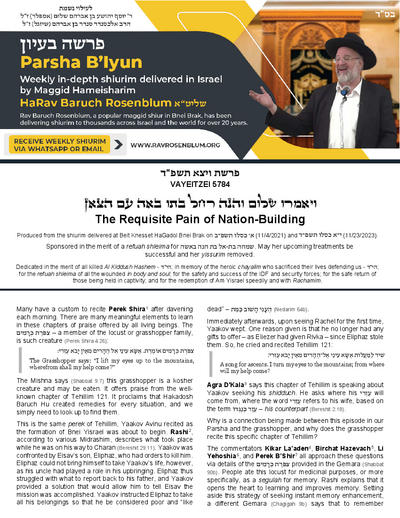

When the Torah was given to us on Har Sinai, it contained a set of rules, i.e., mitzvot, to follow. Some came with reasons, others came with hints at the benefits, and many came with no additional commentary whatsoever. Regardless, we follow what we were told to do. We don’t pay attention to the reasons, when listed, in that they are not factors for our execution of a command versus ignoring it. The reasons given are not the reasons we perform those mitzvot.

As an example, the Torah says a king should not have many wives because they will steer his heart away. Shlomo HaMelech thought about that reasoning, determined he’d be able to keep his focus, and decided to ignore the rule (by taking many wives). We know the result – he both disobeyed the mitzvah and lost his focus.

We don’t use the reasons in our deliberations – if it says not to, we don’t. Period. In our case related to Yaakov and two sisters, the Torah says not to take a wife and her sister, and then provides a reason. We can learn from the reason, but that isn’t why we observe the rule. The Pasuk could have ended with ָ חּל ֹא תִ ק, and we’d know what to avoid. But an extra word was added – לִצְ רֹר, as a rival, with distress caused. The Ramban explains this to mean there would be sinah – hatred would develop between the two sisters. The Chatam Sofer, Ktav Sofer, and Rav Yaakov Kamenetsky all say this means not to marry sisters when you know there will be rivalry and distress. While today that reason is moot with regards to our following of the commandment, Yaakov kept the Torah before Matan Torah, when it was different. If the reason was not applicable, then neither was the commandment.

Why is the reason for not taking two sisters (i.e., rivalry and distress) not applicable in the case of Rachel and Leah? Yaakov reasoned that Leah receiving the simanim from Rachel and being offered the chance to start building Bnei Yisrael, was a sign of pure ahava – love, between them. Therefore, the potential for לִ צְ רֹר did not apply, and Yaakov could marry both sisters.

Rav Avigdor Nebenzahl asks, if Leah entering is already considered bringing in tzarah, why is Bilhah needed and why are multiple acts required before Rachel took on the status of Sarah Imeinu? He answers, the act of bringing in tzarah is only after being married. Sarah brought in Hagar after already being married to Avraham, but when Rachel gave the simanim to Leah, they were both unmarried at the time, and the fear or risk of לִצְ רֹר was not yet in effect since Leah was not injected into an existing relationship. Even though Rachel called it by that name in the Midrash, according to the Torah it did not qualify. Therefore, Bilhah was the solution, as she was introduced after Rachel was married to Yaakov.

The last remaining question is why the introduction of Bilhah didn’t do the trick right away? If that helped Sarah, and Avraham was able to daven for her as a result, why did it not help Rachel? The answer is found in Esh Tamid. There are many righteous people who fall right after reaching a high. They will do something truly G-dly and jaw-dropping, but it’s only a single act. A one-time shot; a one-hit-wonder. Many find the ability to rise to that level but then immediately backtrack. He brings an example from the Mishna (Menachot 13:10), where two sons of Kohen Gadol Shimon HaTzaddik were in line to succeed him – Shimi, the elder, and Chonio, the more knowledgeable. While the father specified Chonio should succeed him, the younger son deferred to his older brother. He quickly regretted his gracious act though and set his brother up for a failure in the Avodah that rendered him ineligible to continue serving as Kohen Gadol. He could not reverse his earlier benevolent act, so he performed a counter act to bring his brother down. Shemen Rosh says, people can do amazing things for one another, but jealousy has a way of sneaking in and reversing it all, causing them to regret their original act and take an alternate path forward.

Rachel brought Leah into the household, and then Bilhah, and then after seeing four sons born to her sister, she cried out to Hakadosh Baruch Hu. Maybe Rachel was now angry and regretted her earlier acts? Maybe she now wished she had exposed Leah and married Yaakov at that initial wedding so she could be his first wife and the mother of the shevatim that produced kehuna, malchut, and limud Torah? To find out, Hakadosh Baruch Hu issued her a test!

Dudaim were found in the field, and their segulah for childbirth was exactly what Rachel needed. There was only one problem – her sister Leah objected to sharing and lashed out at Rachel. At this point, Rachel had full right to respond with equal force, “I am the one who brought you the simanim and set you up in this household!” We would then know she regretted her earlier acts. But what did she do? She stayed silent. She maintained the honor and dignity of her sister, just as she did when handing over the simanim. It was not a one-time act. Thirteen years later, it was proved to be a permanent character trait.

The Alsheich HaKadosh says, Hakadosh Baruch Hu is קוֹרֵ א דּוֹרוֹת מֵרֹאשׁ – He announces the generations from the beginning. He knew that only through the power of Imeinu Rachel could Bnei Yisrael be redeemed, and these tests were the seeds of redemption being planted! From these tests would sprout the character traits that bring us to redemption! Through שׁ ְ תִ יקָה וּצְנִיעוּת – the altruistic silence and modesty exemplified by Rachel Imeinu, and the uncompromising care given to a sibling, we will see our redemption.

ְָתֵךִּי יֵשׁ שָׂכָר לִפְעֻל ...ו ְ י ֵ שְׁתּ ִ קְ וָ ה לְ אַ חֲ רִ י תֵ ך ...וְשׁ ָ בוּ בָנִים לִגְבוּלָם׃
For there is a reward for your labor... And there is hope for your future... Your children shall return to their country.
Two acts – silence and modesty – were the ingredients of her future and our redemption. Rachel’s silence led to her sister giving birth to a fifth son, named Yissachar (שָׂ כָר → יִשָּׂ שכָר), who would carry forward Torah and its study throughout all generations of Rachel’s children. Her modesty, and the selfless handing over of simanim in a manner that maintained her sister’s dignity, was rewarded with hope. The future redemption of those very same children would be her prize.

When a brother or sister, a genuine yid, sees the success of another which they helped bring about, they are happy for them. They do not look in the mirror to compare their lot. They do not contemplate what they gave up or could have had. It is genuine love and unity from the heart. Rachel demonstrated this and was therefore ready not only to be blessed with children but to be the Mother of all Bnei Yisrael, and in her merit and because of her tears, Bnei Yisrael will be brought back to their land. May we be zocheh during this month of light and miracles to see the Kohanim returning to their Avodah and lighting the Menorah once again in the Beit Hamikdash, sheyibaneh bimheira b’yameinu. ◊

PDF Preview