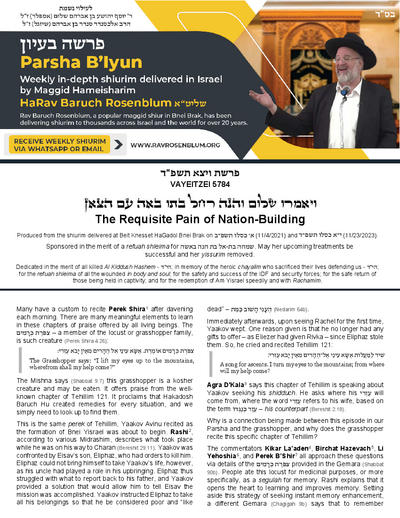
The Requisite Pain of Nation-Building
Many have a custom to recite Perek Shira after davening each morning. There are many meaningful elements to learn in these chapters of praise offered by all living beings. The צִפֹּרֶת כְּרָמִים – a member of the locust or grasshopper family, is such creature (Perek Shira 4:26):
צִפֹּרֶת כְּרָמִים אוֹמֶרֶת. אֶשָּׂא עֵינַי אֵל הֶהָרִים מֵאַיִן יָבֹא עֶזְרִי:
The Grasshopper says: “I lift my eyes up to the mountains, wherefrom shall my help come?”
The Mishna says (Shabbat 9:7) this grasshopper is a kosher creature and may be eaten. It offers praise from the well-known chapter of Tehillim 121. It proclaims that Hakadosh Baruch Hu created remedies for every situation, and we simply need to look up to find them.
This is the same perek of Tehillim, Yaakov Avinu recited as the formation of Bnei Yisrael was about to begin. Rashi, according to various Midrashim, describes what took place while he was on his way to Charan (Bereshit 29:11). Yaakov was confronted by Eisav’s son, Eliphaz, who had orders to kill him. Eliphaz could not bring himself to take Yaakov’s life, however, as his uncle had played a role in his upbringing. Eliphaz thus struggled with what to report back to his father, and Yaakov provided a solution that would allow him to tell Eisav the mission was accomplished. Yaakov instructed Eliphaz to take all his belongings so that he be considered poor and “like dead” – הֶעָנִי חָשׁוּב כַּמֵּת (Nedarim 64b).
Immediately afterwards, upon seeing Rachel for the first time, Yaakov wept. One reason given is that he no longer had any gifts to offer – as Eliezer had given Rivka – since Eliphaz stole them. So, he cried and recited Tehillim 121:
שִׁיר לַמַּעֲלוֹת אֶשָּׂא עֵינַי אֶל־הֶהָרִים מֵאַיִן יָבֹא עֶזְרִי׃
A song for ascents. I turn my eyes to the mountains; from where will my help come?
Agra D'Kala says this chapter of Tehillim is speaking about Yaakov seeking his shidduch. He asks where his עֶזְרִי will come from, where the word עֶזְרִי refers to his wife, based on the term עֵזֶר כְּנֶגְדּוֹ – his counterpart (Bereshit 2:18).
Why is a connection being made between this episode in our Parsha and the grasshopper, and why does the grasshopper recite this specific chapter of Tehillim?
The commentators Kikar La’aden, Birchat Hazevach, Li Yehoshia, and Perek B’Shir all approach these questions via details of the צִפֹּרֶת כְּרָמִים provided in the Gemara (Shabbat 90b). People ate this locust for medicinal purposes, or more specifically, as a segulah for memory. Rashi explains that it opens the heart to learning and improves memory. Setting aside this strategy of seeking instant memory enhancement, a different Gemara (Chagigah 9b) says that to remember something, one must learn it 101 times. The Vilna Gaon comments on a phrase describing people bringing their learning to heaven: אַשְׁרֵי מִי שֶׁבָּא לְכָאן וְתַלְמוּדוֹ בְּיָדוֹ – Praiseworthy is the one who arrives here with his studies in hand (Pesachim 50a). He says, לְכָאן has a numerical value of 101. When reaching heaven, every person is given a shtender and 180 days to talk, without interruption. There is no Q&A allowed, no lunch breaks taken, and they can talk almost endlessly about anything learned in the world below. But beware, their audience includes the Rambam, Rabbi Yochanan, Rabbi Akiva, and many other well-learned individuals, so they had better be prepared! The Vilna Gaon says learning something that 101st time leads to the required preparedness.
According to the Perek Shira commentators brought earlier, the צִפֹּרֶת כְּרָמִים is bothered by people taking shortcuts. Rather than learning, and re-learning a topic the requisite 101 times, they learn it once and rely on a meal of grasshoppers to benefit from instantaneous retention. The grasshopper cries out, “Ribbono Shel Olam, they eat me as a shortcut to get out of learning! מֵאַיִן יָבֹא עֶזְרִי – Where shall my help come from? Ask them to instead learn 101 times!” A connection is made between the word מֵאַיִן – and its numerical value of 101 – to the Gemara discussing learning a topic 101 times.
I saw a discussion in Derushei Yom Yom on the well-known Mishna speaking about Tu B’Av (Taanit 4:8):
לֹא הָיוּ יָמִים טוֹבִים לְיִשְׂרָאֵל כַּחֲמִשָּׁה עָשָׂר בְּאָב וּכְיוֹם הַכִּפּוּרִים, שֶׁבָּהֶן בְּנוֹת יְרוּשָׁלַיִם יוֹצְאוֹת בִּכְלֵי לָבָן... וְחוֹלוֹת בַּכְּרָמִים. וּמֶה הָיוּ אוֹמְרוֹת, בָּחוּר, שָׂא נָא עֵינֶיך וּרְאֵה, מָה אַתָּה בוֹרֵר לָך. אַל תִּתֵּן עֵינֶיך בַנּוֹי, תֵּן עֵינֶיך בַמִּשְׁפָּחָה.
There were no days as joyous for the Jewish people as the fifteenth of Av and as Yom Kippur, as on them the daughters of Jerusalem would go out in white clothes… and dance in the vineyards. And what would they say? Young man, please lift up your eyes and see what you choose for yourself for a wife. Do not set your eyes toward beauty, but set your eyes toward a good family.
Derushei Yom Yom asks, it is understandable to see Yom Kippur referred to as a Yom Tov, given mechilat avonot (atonement) being achieved on that day. But why is Tu B’Av called a Yom Tov – a Good Day? The reasons for marking that day, whether those provided in the above Mishna, or additional reasons suggested in the Gemara, are all positive events but do they truly qualify as a Yom Tov? Additionally, why do the girls go out to the vineyards and not to olive gardens, apple orchards, or wheat fields?
He answers, on this day, the girls go out to find their shidduchim. מָצָא אִשָּׁה מָצָא טוֹב – He who finds a wife has found goodness (Mishlei 18:22) … לֹא־טוֹב הֱיוֹת הָאָדָם לְבַדּוֹ – It is not good for the man to be alone (Bereshit 2:18). These days bring goodness and are therefore referred to a Good Days! And why do they head to the כְּרָמִים – the vineyards? Because that is where the צִפֹּרֶת כְּרָמִים lives, and her song is all about finding shidduchim. It was first sung by Yaakov when he sought his shidduch. We also tell the boys שָׂא נָא עֵינֶיך. Ayin has a numerical value of 130, and two have a value of 260. If we add the numerical value of Tov (17) we reach a total of 277, the same as עֶזֶר. The girl says, “Look in both eyes and see the good in us being together.” This is a genuine Yom Tov!
We’ll shift gears to Yaakov’s wedding day and the events leading up to it, to uncover an incredible chiddush. At the start of our Parsha, Yaakov takes אֲבָנִים – stones, and places them around his head. Yaakov, in fact, has several stories involving stones, something the other Avot do not have. What is their significance?
Rav Shlomo Kluger presents a chiddush (Chachmat HaTorah, Vayeitzei; Kehillat Yaakov, Chanukah). In the Haftarah read on Chanukah, there’s also a pasuk related to a stone (Zecharia 3:9):
כִּי הִנֵּה הָאֶבֶן אֲשֶׁר נָתַתִּי לִפְנֵי יְהוֹשֻׁעַ עַל־אֶבֶן אַחַת שִׁבְעָה עֵינָיִם
For behold the stone that I have laid before Yehoshua; upon one stone are seven facets…
What is this stone’s significance? Many commentators explain this stone to be the foundation stone of a future Beit Hamikdash. If we look at the stones Yaakov put around his head, in the morning they united into a single stone, and there, too, we are pointed to the cornerstone of the Beit Hamikdash.
וַיִּקַּח מֵאַבְנֵי הַמָּקוֹם וַיָּשֶׂם מְרַאֲשֹׁתָיו – He took some of the stones of that place, and arranged them around his head (Bereshit 28:11). How many stones did Yaakov take? The Midrash (Bereshit Rabbah 68) provides three answers – twelve, three, and two – with explanations for each.
According to Rabbi Yehuda, the twelve stones represent Yaakov’s awareness that twelve tribes were originally intended to descend from Adam and Chava, and then from Yitzchak and Rivka. These plans, however, were derailed when Cain killed Hevel, and Eisav damaged the womb of his mother. Yakov wished to know whether the twelve tribes would now emerge from him, so he took twelve stones and placed them around his head – if they united, it would serve as confirmation.
According to Rabbi Nechemia, Yaakov took three stones, recognizing that Avraham and Yitzchak merited to have the Shechina rest upon them. He wished to know if he would merit similar, so he took three stones and placed them around his head – if they united, it would serve as confirmation.
The final opinion presented by the Midrash, in the name of Rabbanan, is that Yaakov placed two stones around his head. He saw how both Avraham and Yitzchak had two sons, one of which turned out to be פְּסֹלֶת – waste. He wished to know if he, too, would have פְּסֹלֶת in his offspring. If the stones around his head united, it would signal his children’s righteousness.
Rav Shlomo Kluger asks, why did Yakov perform these tests using stones? The simple answer is that he was in a barren area and stones were the only item available. But there must be more significance in these actions and in Yaakov’s connection to אֲבָנִים. Rav Kluger suggests the term אֶבֶן represents a woman. In Pharoah’s homicidal command to the מְיַלְּדוֹת הָעִבְרִיּוֹת – the Hebrew midwives, we see the words וּרְאִיתֶן עַל הָאָבְנָיִם – When you deliver the Hebrew women, look at the birthstool (Shemot 1:16). The word הָאָבְנָיִם is translated by many as birth stones, based on the connection to the word אֲבָנִים. Rav Kluger says Yaakov used stones due to their connection with women and childbirth, which were his primary points of uncertainty.
Related, Oznaim Latorah says when going to a cemetery it is customary to leave a small stone at the grave. Why is this? We are telling the niftar or nifteret that we are continuing in their path. The word אֶבֶן has three generations embedded within: אָב /אֵם - בֵּן/בַּת - נֶכֶד/ נֶכְדָּה – parent, child, grandchild. Oznaim Latorah says, Yaakov wanted to know if his offspring would continue in his ways, or whether they’d be פְּסֹלֶת, and thus, he used a test of stones.
When Yaakov reached Charan, another stone entered the picture. He saw a big stone atop a well. Unsure as to whether he arrived at his destination or not – there were no “Welcome to Charan!” signs posted and Waze was not yet installed – Yaakov asked the nearby shepherds where they were from, and upon learning they were from Charan, he asked if they knew Lavan. Their response was terse: יָדָעְנוּ – We know him (Bereshit 29:5). Suspicious. Usually, when asked if we know someone, our answer is, “yes, he has a clothing store,” or “yes, he is a doctor,” or “sure, he is the shul gabbai,” etc. Their curt answer resembles “yes, he is known,” and leaves us wondering, known to whom? To the police? To the tax authorities? To the underworld? Rather than elaborate on him and his well-being, they quickly changed topics (Bereshit 29:6):
וַיֹּאמֶר לָהֶם הֲשָׁלוֹם לוֹ וַיֹּאמְרוּ שָׁלוֹם וְהִנֵּה רָחֵל בִּתּוֹ בָּאָה עִם־הַצֹּאן׃
He said to them, Is he doing well? They said, He is doing well. Behold Rochel, his daughter, is coming with the sheep.
Their answer, and the segue to Rachel, is both abrupt and peculiar. It is unheard of to send a young girl on her own into the fields. If she was five years old – as per Rabbeinu Bachya – it is flat out dangerous to send her solo. If she was fourteen years old – as per Seder Olam Rabbah – it is still very inappropriate, as shepherds were not known to be the most sympathetic or moral people at the time. Sefer Od Yosef Chai says, shepherds generally lead in front or follow behind their sheep, but interestingly, Rachel walked along with them, in the middle, so that the shepherds couldn’t look at her. In comparison, Yitro also sent his daughters out with their flock, but there were seven girls in the group, able to look out for one another.
When the shepherds said they were from Charan and immediately pointed to Rachel, they said everything that needed to be said about Lavan Ha’arami. He was most certainly known to all the locals, and not in a good way. They were afraid to say anything about him, fearing it would get back to him and he’d retaliate, and instead conveyed, “Look, there’s his daughter with the family sheep. Lavan is a man no shepherd will work with. He overworks you, withholds your wages, and is not trustworthy. So, his daughter must do the work instead! And he even sends her out alone!”
Let’s now fast-forward to the discussion between Yaakov and Lavan, and the question of what he should pay in exchange for Yaakov’s services (Bereshit 29:16-19).
וּלְלָבָן שְׁתֵּי בָנוֹת שֵׁם הַגְּדֹלָה לֵאָה וְשֵׁם הַקְּטַנָּה רָחֵל׃ וְעֵינֵי לֵאָה רַכּוֹת וְרָחֵל הָיְתָה יְפַת־תֹּאַר וִיפַת מַרְאֶה׃ וַיֶּאֱהַב יַעֲקֹב אֶת־רָחֵל וַיֹּאמֶר אֶעֱבָדְךָ שֶׁבַע שָׁנִים בְּרָחֵל בִּתְּךָ הַקְּטַנָּה׃
Lavan had two daughters. The name of the older one was Leah, and the name of the younger one was Rachel. The eyes of Leah were tender. Rachel was of beautiful form and of beautiful appearance. Yaakov loved Rachel. and he said, I will work for you seven years for Rachel, your younger daughter.
Why did Yaakov offer to work for seven years? Why not start with a month or two and then go up to a year, if needed? If we follow the opinion of Rabbeinu Bachya, Rachel was five years old, and it is clear why he wanted to wait seven years before marrying her. But if we say she was already fourteen at the time, why wait seven more years? Rabbi Ovadiah Seforno says he waited seven years in hopes Leah would get married in the interim, as Yaakov was warned by Rachel that Lavan was not trustworthy and would swap brides, so he took precautions by giving Leah time to get married in advance.
Similarly, the Chida says this encounter at the well was the first and last time Yaakov saw Rachel until their wedding night, and their dialogue sounded like this:
“I am Yaakov, and I’ve come to marry you.”
“I know but be careful, as everyone here lies, and my father is the biggest liar of them all. He is called Lavan because he is the darkest one in town.”
“Why? I’m not here for real estate or a business deal of any sort. I’m only here to marry you.”
“Be careful with him. Don’t be surprised to find someone else under the chuppah.”
“I can solve that problem. Here are three Simanim – secret signs we’ll have: Challah, Nidah, Hadlakat Ner.”
On the wedding night, Lavan put his crooked plan into play. The Midrash describes his surreptitious actions in detail. When it was morning, behold it was Leah! וַיְהִי בַבֹּקֶר וְהִנֵּה הִיא לֵאָה. Rachel had given her the simanim but in a modest and non-humiliating way. She taught Leah the halachot of challah, niddah, and hadlakat ner. Leah did not even know these were the secret keys to enter Yaakov’s life and household! Upon seeing it was Leah present, Yaakov did not get angry at her, knowing she was forced into it and perhaps even threatened by her father. The only problem Yakov had was why she answered when he called out “Rachel”. The Midrash tells us that Leah did not know what to do.
“Yaakov, I’m sorry. I didn’t know what to do or how to act. There were no honest or wise men in Charan to ask. I was told your mother instructed you similarly. to put on Eisav’s clothes, and to answer when your father called out for him. My father, too, told me to enter the chuppah and from that point forward I am to be called Rachel. I followed along just as you did.”
Yaakov, from that moment onward, had no claims against her and went straight to Lavan in protest. Calm and relaxed, Lavan said, “In our town, we don’t act this way. The younger daughter is never given ahead of her older sister.” Tzeida LaDarech adds, Lavan mocked Yaakov: “Over there, where you’re from, you might steal and trade the birthright, but here there are rules, and we are law-abiding citizens.”
There are a few additional and interesting explanations as to how Lavan justified his ruse. The Rosh says, in the name of Rav Dan Ashkenazi, that Rachel was tall and Leah short. Yaakov had originally said: אֶעֱבָדְךָ שֶׁבַע שָׁנִים בְּרָחֵל בִּתְּךָ הַקְּטַנָּה, and Lavan twisted his words, claiming he understood only the last part, namely, that Yaakov wanted the “smaller” daughter.
Another explanation, from the Chida in the name of the Rokeach, is based on Rachel and Leah being twins. Lavan said to Yaakov:
“I heard you grabbed onto Eisav’s foot. Why did you do that? Surely it wasn’t to balance yourself. You did it to make the following statement: ‘Eisav, you think you are the bechor? You are not. The one who entered the womb first is.’”
Rashi compares this to placing two stones into a narrow vessel; the last one in will be the first one out, whereas the first in will exit last. We hold the bechor is the first of Yetziah – the first to exit the womb and not the first of Yetzira – the first to be created within. But prior to receiving the Torah, Yaakov was stating that birthright went according to Yetzira, and therefore it was him. Holding onto Eisav’s foot was him establishing his point. According to the Chida, Lavan was essentially saying:
“I, too, am going by your theory. You said the one who comes out first (among twins) is the Katan, and the one who comes out last is the Gadol. You asked for the Ketana, which is Leah, who was born first. You may have mixed up the name in your request, but I clearly heard Ketana.”
We will now skip ahead to the years that followed the initial wedding and Yaakov’s follow-up marriage to Rachel. Leah gave birth to four consecutive sons – וַתַּהַר לֵאָה וַתֵּלֶד בֵּן – while Rachel remained childless, and following the fourth son, Rachel recognized she was not bearing children to Yaakov and became jealous of her sister. She insisted Yaakov give her children, and if not, she should die. Yaakov responded in anger, rhetorically asking if he was in Hakadosh Baruch Hu’s place and in control of her destiny. Rachel’s plea, and his response, require a closer look. She went to Yaakov in search of his tefillot, and he angrily denied her of such. Stepping through their dialogue helps reveal the issue at hand.
“Yaakov, please daven for me to have a child.”
“Is it ME holding YOU back from having children? I have children; it is only YOU that does not.”
“Your grandfather, Avraham, had a child from Hagar, and nonetheless, he davened to have a child with Sarah Imeinu. Why can you, too, not daven for another son?”
“You cannot compare yourself to Sarah Imeinu. When Sarah saw she didn’t have a child, she gave her maidservant to Avraham, even at great pain and distress to herself. Did you do what Sarah did?”
Rachel responded by immediately offering Yaakov her maidservant, Bilhah, in her place, and Bilhah gave birth to Dan and Naftali. Rachel, however, remained childless. When did Rachel’s plight change? Only after another incident involving her sister, Leah.
When Leah, and her maidservant Zilpah, looked like they had finished having children, Reuven discovered דּוּדָאִים (jasmine flowers) in the field and brought them to his mother, Leah (Bereshit 30:14). Dudaim were considered a segulah for pregnancy, and Rachel asked her sister to share some of these dudaim. Leah, however, responded harshly: “Is it not enough you took my husband from me? You now also want my dudaim?” Rachel was shocked, after all it was she who gave Yaakov to Leah by sharing the simanim and Leah would be nowhere without her. But she bit her lip and said nothing about it to her sister. She only apologized: “You are right, and I am sorry. I did not mean to impose and will compensate you for the dudaim by letting Yaakov be with you again tonight.” Leah then had a fifth and sixth son to Yaakov – Yissachar and Zevulun, the torchbearers of Torah and their supporters.
Following this story, we are told: וַיִּזְכֹּר אֱלֹהִים אֶת רָחֵל. Rachel’s womb was opened and she gave birth to her first child – Yosef. What is it that Hakadosh Baruch Hu remembered? The common explanation is that He remembered how Rachel gave the simanim to Leah. Seforno adds two significant elements: שֶׁהִשְׁתַּדְּלָה לְהוֹלִיד בְּהַכְנִיסָהּ צָרָתָהּ לְבֵיתָהּ וּבְעִנְיַן הַדּוּדָאִים – Hakadosh Baruch Hu also remembered how Rachel brought pain into her house by introducing Bilhah to Yaakov; and how she remained silent during the incident involving the dudaim, despite Leah’s harsh and unwarranted response.
The following question must be asked. Yaakov was aware Rachel handed the simanim over to Leah and voluntarily brought her into the household. How could he then respond to Rachel that she is not like Sarah who brought in Hagar? She facilitated Leah marrying Yaakov seven years before she could, and then watched them have four sons together. Is there a bigger הַכְנִיסָהּ צָרָתָהּ לְבֵיתָהּ than that?! When Rachel consoles Hakadosh Baruch Hu and petitions for Bnei Yisrael after the churban (Eichah Rabbah 24), she is the only one who succeeds in the task. In her plea, she spells out צָרָתָהּ שֶׁלִּי – the pain she brought into her house. It is clear to her, to Yaakov, and even to Hakadosh Baruch Hu, that she already performed an act like Sarah. If so, why was there a need for another such act – that of bringing Bilhah into the house?
Adding to that question, in Parshat Acharei Mot we are commanded: וְאִשָּׁה אֶל־אֲחֹתָהּ לֹא תִקַּח לִצְרֹר – Neither shalt thou take a wife to her sister, as her rival (Vayikra 18:18). In simpler terms, we are not permitted to marry two sisters – so, how could Yaakov even do this? We can say it was before Matan Torah, but the Gemara (Bikurim 28a) says our Avot kept the Torah in its entirety. Also, the Gemara (Pesachim 119b) clearly states Yaakov considered his marrying of sisters as a fault that precluded him from leading the zimun at the feast for the righteous in the days of Mashiach.
With all that in mind, when Yaakov questioned Rachel’s self-comparison to Sarah by pointing to Sarah’s act of bringing Hagar into her tent, Rachel should have stood up and shouted, “I absolutely did! I did exactly that!” Why did she instead run to introduce Bilhah as an additional tzara? Furthermore, after bringing in Bilhah, she most definitely reached the status of Sarah in terms of bringing tzara into the household so that her own tzara is removed, so why did she still not have any children until the episode of the dudaim? Our question is no longer why two acts and merits are needed, but why a third is required!
I would like to bring in, B’Siyata D’Shmaya, a wonderful answer to these questions given by the Chatam Sofer, Ktav Sofer, and Rav Yaakov Kamenetsky. When the Torah was given to us on Har Sinai, it contained a set of rules, i.e., mitzvot, to follow. Some came with reasons, others came with hints at the benefits, and many came with no additional commentary whatsoever. Regardless, we follow what we were told to do. We don’t pay attention to the reasons, when listed, in that they are not factors for our execution of a command versus ignoring it. The reasons given are not the reasons we perform those mitzvot.
As an example, the Torah says a king should not have many wives because they will steer his heart away. Shlomo HaMelech thought about that reasoning, determined he’d be able to keep his focus, and decided to ignore the rule (by taking many wives). We know the result – he both disobeyed the mitzvah and lost his focus.
We don’t use the reasons in our deliberations – if it says not to, we don’t. Period. In our case related to Yaakov and two sisters, the Torah says not to take a wife and her sister, and then provides a reason. We can learn from the reason, but that isn’t why we observe the rule. The Pasuk could have ended with לֹא תִקַּח, and we’d know what to avoid. But an extra word was added – לִצְרֹר, as a rival, with distress caused. The Ramban explains this to mean there would be sinah – hatred would develop between the two sisters. The Chatam Sofer, Ktav Sofer, and Rav Yaakov Kamenetsky all say this means not to marry sisters when you know there will be rivalry and distress. While today that reason is moot with regards to our following of the commandment, Yaakov kept the Torah before Matan Torah, when it was different. If the reason was not applicable, then neither was the commandment.
Why is the reason for not taking two sisters (i.e., rivalry and distress) not applicable in the case of Rachel and Leah? Yaakov reasoned that Leah receiving the simanim from Rachel and being offered the chance to start building Bnei Yisrael, was a sign of pure ahava – love, between them. Therefore, the potential for לִצְרֹר did not apply, and Yaakov could marry both sisters.
Rav Avigdor Nebenzahl asks, if Leah entering is already considered bringing in tzarah, why is Bilhah needed and why are multiple acts required before Rachel took on the status of Sarah Imeinu? He answers, the act of bringing in tzarah is only after being married. Sarah brought in Hagar after already being married to Avraham, but when Rachel gave the simanim to Leah, they were both unmarried at the time, and the fear or risk of לִצְרֹר was not yet in effect since Leah was not injected into an existing relationship. Even though Rachel called it by that name in the Midrash, according to the Torah it did not qualify. Therefore, Bilhah was the solution, as she was introduced after Rachel was married to Yaakov.
The last remaining question is why the introduction of Bilhah didn’t do the trick right away? If that helped Sarah, and Avraham was able to daven for her as a result, why did it not help Rachel? The answer is found in Esh Tamid. There are many righteous people who fall right after reaching a high. They will do something truly G-dly and jaw-dropping, but it’s only a single act. A one-time shot; a one-hit-wonder. Many find the ability to rise to that level but then immediately backtrack. He brings an example from the Mishna (Menachot 13:10), where two sons of Kohen Gadol Shimon HaTzaddik were in line to succeed him – Shimi, the elder, and Chonio, the more knowledgeable. While the father specified Chonio should succeed him, the younger son deferred to his older brother. He quickly regretted his gracious act though and set his brother up for a failure in the Avodah that rendered him ineligible to continue serving as Kohen Gadol. He could not reverse his earlier benevolent act, so he performed a counter act to bring his brother down. Shemen Rosh says, people can do amazing things for one another, but jealousy has a way of sneaking in and reversing it all, causing them to regret their original act and take an alternate path forward.
Rachel brought Leah into the household, and then Bilhah, and then after seeing four sons born to her sister, she cried out to Hakadosh Baruch Hu. Maybe Rachel was now angry and regretted her earlier acts? Maybe she now wished she had exposed Leah and married Yaakov at that initial wedding so she could be his first wife and the mother of the shevatim that produced kehuna, malchut, and limud Torah? To find out, Hakadosh Baruch Hu issued her a test!
Dudaim were found in the field, and their segulah for childbirth was exactly what Rachel needed. There was only one problem – her sister Leah objected to sharing and lashed out at Rachel. At this point, Rachel had full right to respond with equal force, “I am the one who brought you the simanim and set you up in this household!” We would then know she regretted her earlier acts. But what did she do? She stayed silent. She maintained the honor and dignity of her sister, just as she did when handing over the simanim. It was not a one-time act. Thirteen years later, it was proved to be a permanent character trait.
The Alsheich HaKadosh says, Hakadosh Baruch Hu is קוֹרֵא דּוֹרוֹת מֵרֹאשׁ – He announces the generations from the beginning. He knew that only through the power of Imeinu Rachel could Bnei Yisrael be redeemed, and these tests were the seeds of redemption being planted! From these tests would sprout the character traits that bring us to redemption! Through שְׁתִיקָה וּצְנִיעוּת – the altruistic silence and modesty exemplified by Rachel Imeinu, and the uncompromising care given to a sibling, we will see our redemption.
... וְיֵשׁ תִּקְוָה לְאַחֲרִיתֵךְ ... כִּי יֵשׁ שָׂכָר לִפְעֻלָּתֵךְ ... וְשָׁבוּ בָנִים לִגְבוּלָם׃
For there is a reward for your labor… And there is hope for your future… Your children shall return to their country.
Two acts – silence and modesty – were the ingredients of her future and our redemption. Rachel’s silence led to her sister giving birth to a fifth son, named Yissachar (יִשָּׂשכָר → יִשְׂכָּר שָׂכָר), who would carry forward Torah and its study throughout all generations of Rachel’s children. Her modesty, and the selfless handing over of simanim in a manner that maintained her sister’s dignity, was rewarded with hope. The future redemption of those very same children would be her prize.
When a brother or sister, a genuine yid, sees the success of another which they helped bring about, they are happy for them. They do not look in the mirror to compare their lot. They do not contemplate what they gave up or could have had. It is genuine love and unity from the heart. Rachel demonstrated this and was therefore ready not only to be blessed with children but to be the Mother of all Bnei Yisrael, and in her merit and because of her tears, Bnei Yisrael will be brought back to their land. May we be zocheh during this month of light and miracles to see the Kohanim returning to their Avodah and lighting the Menorah once again in the Beit Hamikdash, sheyibaneh bimheira b’yameinu.