One Day a Year
The Weekly Farbrengen | September 25, 2025
Print This Article
View Original PDF

One Day a Year

The Weekly Farbrengen | December 10, 2025

Chazal say that if not for Yom Kippur the world would not be able to carry on.

Satan complained to Hashem, “Ribono Shel Olam! You have given me power over all the nations of the world, yet over the Yidden I have no power.”

Hashem told him, “I will give you power over them on Yom Kippur, but only if you can find them doing aveiros.”

Yom Kippur finally came, and Satan could not find any aveiros, he told Hashem, “You have a nation like malochim: they don’t eat, they live in peace with each other and are clean from aveiros.”

Whenever Hashem hears such words, He cleanses the Yidden of any previous aveiros.

(פרקי דרבי אליעזר פ' מ"ה)

If a person wants to be forgiven on Yom Kippur, does he first have to do teshuvah? This question is the subject of a machlokes in the Gemara. Rebbi holds that even if one does not do teshuvah, the essence of the day of Yom Kippur – the mere fact that the day has passed – grants atonement, but the Chachomim say that Yom Kippur atones only for those who do teshuvah. The Halachah follows the view of the Chachomim.

The Rebbe explains that everyone agrees that the atonement of Yom Kippur is brought about by the kedushah of the day; it is only that to attain that kedushah one is required to do teshuvah.

(שבועות ג' ע"ב, לקו"ש ח"ד ע' 1149)

The Alter Rebbe points out that kaparah (atonement) actually means ‘scrubbing’, scrubbing off the dirt of aveiros. The day of Yom Kippur not only cancels punishment, but also removes any ‘stains’ or ‘dirt.’ For on this day the inner bond between the essence of a Yid and the essence of Hashem is revealed, and hence any superficial ‘stains’ are automatically nullified.

(לקו"ש ח"ד ע' 1149)

One year, at the end of Yom Kippur, Reb Levi Yitzchak of Berditchev announced: “It is well known that whenever a person is in doubt as to whether a brachah is required, he should refrain from reciting it. It is therefore clear that since we recite the brachah stating that Hashem forgives our aveiros, this is surely so, without any doubt whatever.”

(אג"ק חי"ד ע' 34)

At the end of Yom Kippur, the custom in every Lubavitcher shul is for everyone to sing a march of simcha and victory, to express our certainty that we have been completely forgiven.

When this niggun was sung at 770, the Rebbe’s face would shine. From atop his chair he would dance and encourage the singing with tremendous joy.

(אוצר מנהגי חב"ד ע' רמא)
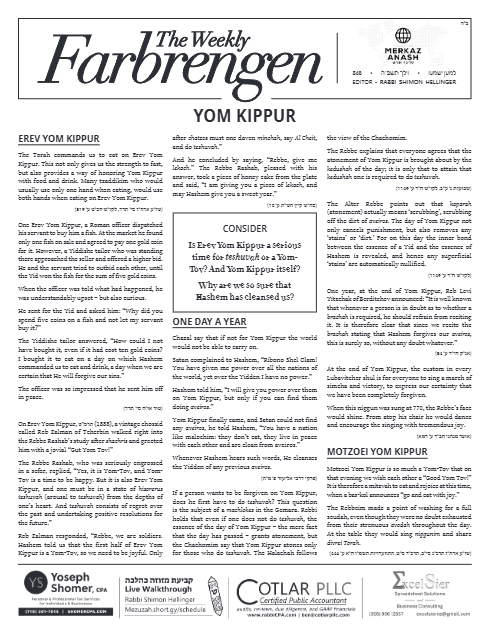
Chazal say that if not for Yom Kippur the world would not be able to carry on.

Satan complained to Hashem, “Ribono Shel Olam! You have given me power over all the nations of the world, yet over the Yidden I have no power.”

Hashem told him, “I will give you power over them on Yom Kippur, but only if you can find them doing aveiros.”

Yom Kippur finally came, and Satan could not find any aveiros, he told Hashem, “You have a nation like malochim: they don’t eat, they live in peace with each other and are clean from aveiros.”

Whenever Hashem hears such words, He cleanses the Yidden of any previous aveiros.

(פרקי דרבי אליעזר פ' מ"ה)

If a person wants to be forgiven on Yom Kippur, does he first have to do teshuvah? This question is the subject of a machlokes in the Gemara. Rebbi holds that even if one does not do teshuvah, the essence of the day of Yom Kippur – the mere fact that the day has passed – grants atonement, but the Chachomim say that Yom Kippur atones only for those who do teshuvah. The Halachah follows the view of the Chachomim.

The Rebbe explains that everyone agrees that the atonement of Yom Kippur is brought about by the kedushah of the day; it is only that to attain that kedushah one is required to do teshuvah.

(שבועות ג' ע"ב, לקו"ש ח"ד ע' 1149)

The Alter Rebbe points out that kaparah (atonement) actually means ‘scrubbing’, scrubbing off the dirt of aveiros. The day of Yom Kippur not only cancels punishment, but also removes any ‘stains’ or ‘dirt.’ For on this day the inner bond between the essence of a Yid and the essence of Hashem is revealed, and hence any superficial ‘stains’ are automatically nullified.

(לקו"ש ח"ד ע' 1149)

One year, at the end of Yom Kippur, Reb Levi Yitzchak of Berditchev announced: “It is well known that whenever a person is in doubt as to whether a brachah is required, he should refrain from reciting it. It is therefore clear that since we recite the brachah stating that Hashem forgives our aveiros, this is surely so, without any doubt whatever.”

(אג"ק חי"ד ע' 34)

At the end of Yom Kippur, the custom in every Lubavitcher shul is for everyone to sing a march of simcha and victory, to express our certainty that we have been completely forgiven.

When this niggun was sung at 770, the Rebbe’s face would shine. From atop his chair he would dance and encourage the singing with tremendous joy.

(אוצר מנהגי חב"ד ע' רמא)

PDF Preview