Ten Days of Repentance
Hama'aseh Hu Haikar | September 27, 2025
Print This Article
View Original PDF

Ten Days of Repentance

Hama'aseh Hu Haikar | December 10, 2025

Ten Days of Repentance

Aseres Yemei Teshuvah

Study the laws
It is important that we study the laws we need to know for these ten days – which includes many changes in the printed prayer text as well as many special customs. We should therefore study the pertinent Halachos in Shulchan Aruch.

Lu’ach Kolel Chabad

Lu’ach Kolel Chabad
Alternatively, we could study these laws from the yearly calendars, which now include very many Halachos concerning this time of year. The Lu’ach Colel Chabad is such an example, and it is printed as both a wall calendar and in pamphlet form.

Now’s the time

Now’s the time
It would be exceedingly proper if all individuals would examine such calendars until the laws dealing with these days are engraved in their memories. After all, questions concerning these points of law may arise at a time when one is unable to interrupt from prayer and inquire as to the correct procedure or at times when there is no one around to ask – further, he may not even be aware that there is a question to begin with.

Providing for the needy of the coming year

Providing for the needy of the coming year
Each of the seven days between Rosh Hashanah and Yom Kippur influences all of the same days of the week for the whole year. [I.e., the Monday between these two dates influences every Monday of the coming year, etc.] Therefore, we should concern ourselves with sufficiently providing for the needs of others on that same day of the week during the coming year.

Shabbos Farbrengen

Shabbos Farbrengen
Joyous gatherings should be made on the Shabbos that occurs between Rosh Hashanah and Yom Kippur, on Motzei Shabbos – which is when the meal of David HaMelech is held – and on the day before Yom Kippur.

Between Yom Kippur and Sukkos

Between Yom Kippur and Sukkos
We should steadily increase such Farbrengens on the days between Yom Kippur and Sukkos.
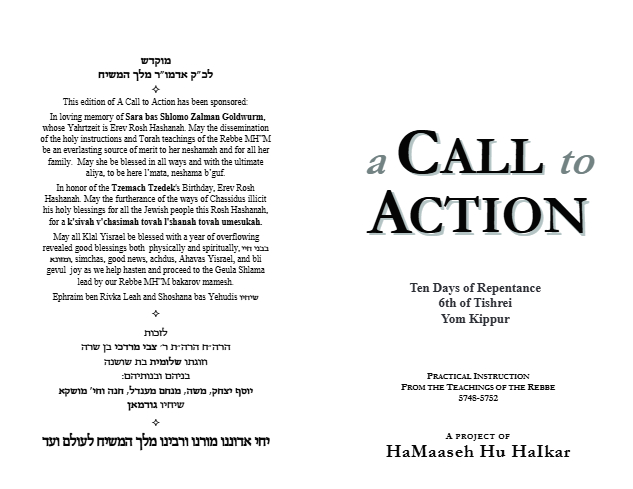
Ten Days of Repentance

Aseres Yemei Teshuvah

Study the laws
It is important that we study the laws we need to know for these ten days – which includes many changes in the printed prayer text as well as many special customs. We should therefore study the pertinent Halachos in Shulchan Aruch.

Lu’ach Kolel Chabad

Lu’ach Kolel Chabad
Alternatively, we could study these laws from the yearly calendars, which now include very many Halachos concerning this time of year. The Lu’ach Colel Chabad is such an example, and it is printed as both a wall calendar and in pamphlet form.

Now’s the time

Now’s the time
It would be exceedingly proper if all individuals would examine such calendars until the laws dealing with these days are engraved in their memories. After all, questions concerning these points of law may arise at a time when one is unable to interrupt from prayer and inquire as to the correct procedure or at times when there is no one around to ask – further, he may not even be aware that there is a question to begin with.

Providing for the needy of the coming year

Providing for the needy of the coming year
Each of the seven days between Rosh Hashanah and Yom Kippur influences all of the same days of the week for the whole year. [I.e., the Monday between these two dates influences every Monday of the coming year, etc.] Therefore, we should concern ourselves with sufficiently providing for the needs of others on that same day of the week during the coming year.

Shabbos Farbrengen

Shabbos Farbrengen
Joyous gatherings should be made on the Shabbos that occurs between Rosh Hashanah and Yom Kippur, on Motzei Shabbos – which is when the meal of David HaMelech is held – and on the day before Yom Kippur.

Between Yom Kippur and Sukkos

Between Yom Kippur and Sukkos
We should steadily increase such Farbrengens on the days between Yom Kippur and Sukkos.

PDF Preview