Yom Kippur During War
Living Jewish | September 25, 2025
Print This Article
View Original PDF

Yom Kippur During War

Living Jewish | December 10, 2025

The siege of Jerusalem grew harsher from Kislev 5708 (December 1947). Only a few convoys managed, by rough and dangerous routes, to bring supplies to Jerusalem’s residents. Each convoy suffered losses—casualties and vehicles set aflame. The greatest blows were sustained by the last convoys, especially the very last one, which tried to break the siege on the 21st of Adar. The convoy was hit with deadly fire. Most of the vehicles never reached their destination but went up in flames, leaving only the charred skeletons that today stand as a memorial along the road leading up to Jerusalem.

Among the few survivors of that convoy was Shmuel Deitch from Hadera. He had joined the convoy with his private truck, which he had dedicated at that time for escorting convoys. His escape from the inferno was a miracle in itself.

When the Burma Road was opened during Pesach, Shmuel seized the opportunity and received permission to join a convoy as a driver. “I took leave of the soldiers of the Fifth Battalion of the Palmach, whom I had been accompanying. I used to load food and equipment, deliver them to the outposts and positions, and return to Hadera,” he recalls.

Joining the IDF

After the establishment of the State, Shmuel decided to enlist in the IDF. He traveled south and joined the elite volunteer unit, “Samson’s Foxes.” The unit had already scored several victories against the Egyptians and was based in a packing house in one of the orchards.

Shmuel recounts: “The company commander, Aryeh Shafek, also a resident of Hadera, noticed the kippah on my head and tried to dissuade me. ‘You should know our kitchen is not kosher,’ he said.

“I replied: ‘I can live on bread alone.’ When he saw my determination, he accepted me into the ranks.

The Eve of Yom Kippur

“From then on, we were constantly at war. Sometimes I was given a half-track vehicle (with front wheels and rear tracks), but often we entered enemy territory in an unarmored jeep. It made no difference to us. The men of the unit fought like lions and indeed won many victories, though sadly at the cost of many fallen. The secret of their success was boundless devotion without personal considerations.

“Even in liberating territories from the Arabs, the unit’s power was great, surpassing even that of the regular brigades. Among the towns the unit helped capture were Ashdod, Ashkelon, and Kiryat Gat, most of the conquests carried out by charges in mostly unarmored jeeps against the enemy. In some cases, the conquest was by a single jeep, as in the case of Kiryat Gat, where I was the first to storm it.

“Then came the eve of Yom Kippur. We went down to the rear base to bathe and change clothes—something we had not done for a long time. Under one of the trees I ate the pre-fast meal and put on rubber shoes.

“I took my machzor with me on the way to the pilots’ quarters at Tel Nof. There, in the airbase, a special corner had been designated for prayer. I was overjoyed at the thought that I would be able to participate in the Kol Nidrei prayer with a minyan.

“I had not walked a hundred meters when suddenly the commander’s whistle blew, signaling an alarm for immediate action.

“I hurried back to the compound, and the commander shouted: ‘Five minutes on the jeeps!’ I placed my machzor under the driver’s seat, and we sped south. It was in response to a sudden call from outposts 6 and 7 in the Gaza area, which were under Egyptian attack and crying out for help.

Memories of Slabodka

“As we passed near Gedera, I saw a Jew walking to the Kol Nidrei prayer, machzor under his arm, with a boy and a girl at his side. The sight carried me back a few years, to Slabodka. It was after Lithuania had been occupied by the Nazis.

“Together we walked on Yom Kippur night to the Kol Nidrei prayer with my father of blessed memory, Rabbi Menachem Mendel Deitch, a Chabad chassid. Four sons at his right, four daughters at his left, and my mother, Rebbetzin Tzeitel, daughter of Rabbi Yitzchak Meltzer, walking in front with my baby brother. (On the 8th of Marcheshvan, 5701, they all perished, may G-d avenge their blood).

Sometime after that Yom Kippur I joined the partisans. In one internal discussion I suggested blowing up a bridge. The commander asked who I was, and was told: ‘That’s the one who puts black boxes on his head...’

“The commander reacted: ‘Are there still Jews who believe in G-d? How could He allow the Germans to do what they did?!’

“I answered him: ‘We have one day in the year called Yom Kippur, on which we recall the Ten Martyrs. The prayer tells how the angels cried out, unable to comprehend the pain and suffering they endured, but G-d silenced them so they would not dare to question further.’ I turned to the commander and declared boldly, ‘If the angels did not understand and were told to be silent, how much more so human beings!’

Alone with Hashem

“We reached the battlefield and managed to repel the Egyptians. Now I found myself near the jeep, at the entrance to the outpost bunker.

“I informed the commander that the drive back was no longer combat related, and therefore I was forbidden to drive. I left the radio on in case of need, and said I would be ready if combat action were required.

“I recited the Kol Nidrei prayer by the light of a kerosene lamp in the outpost. I had so hoped to pray on Yom Kippur in a synagogue with a minyan, but Divine Providence willed otherwise.

“I stood alone and cried out the ancient prayer. So too, I prayed the rest of the day’s prayers, with a broken heart but with overwhelming emotion.

“Thus passed Yom Kippur 5709 (1948), and at the close of the holy day I set out alone in a jeep on my way back to Tel Nof.”

(We thank the protagonist for sending this story; the above and Shabbos Table translated from Sichat HaShevua)
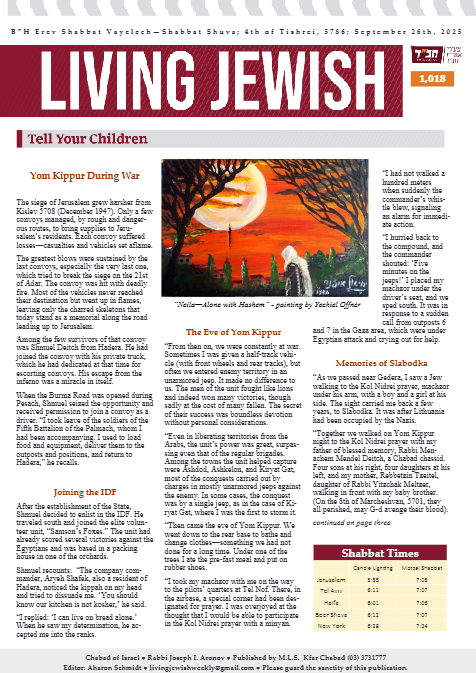

The siege of Jerusalem grew harsher from Kislev 5708 (December 1947). Only a few convoys managed, by rough and dangerous routes, to bring supplies to Jerusalem’s residents. Each convoy suffered losses—casualties and vehicles set aflame. The greatest blows were sustained by the last convoys, especially the very last one, which tried to break the siege on the 21st of Adar. The convoy was hit with deadly fire. Most of the vehicles never reached their destination but went up in flames, leaving only the charred skeletons that today stand as a memorial along the road leading up to Jerusalem.

Among the few survivors of that convoy was Shmuel Deitch from Hadera. He had joined the convoy with his private truck, which he had dedicated at that time for escorting convoys. His escape from the inferno was a miracle in itself.

When the Burma Road was opened during Pesach, Shmuel seized the opportunity and received permission to join a convoy as a driver. “I took leave of the soldiers of the Fifth Battalion of the Palmach, whom I had been accompanying. I used to load food and equipment, deliver them to the outposts and positions, and return to Hadera,” he recalls.

Joining the IDF

After the establishment of the State, Shmuel decided to enlist in the IDF. He traveled south and joined the elite volunteer unit, “Samson’s Foxes.” The unit had already scored several victories against the Egyptians and was based in a packing house in one of the orchards.

Shmuel recounts: “The company commander, Aryeh Shafek, also a resident of Hadera, noticed the kippah on my head and tried to dissuade me. ‘You should know our kitchen is not kosher,’ he said.

“I replied: ‘I can live on bread alone.’ When he saw my determination, he accepted me into the ranks.

The Eve of Yom Kippur

“From then on, we were constantly at war. Sometimes I was given a half-track vehicle (with front wheels and rear tracks), but often we entered enemy territory in an unarmored jeep. It made no difference to us. The men of the unit fought like lions and indeed won many victories, though sadly at the cost of many fallen. The secret of their success was boundless devotion without personal considerations.

“Even in liberating territories from the Arabs, the unit’s power was great, surpassing even that of the regular brigades. Among the towns the unit helped capture were Ashdod, Ashkelon, and Kiryat Gat, most of the conquests carried out by charges in mostly unarmored jeeps against the enemy. In some cases, the conquest was by a single jeep, as in the case of Kiryat Gat, where I was the first to storm it.

“Then came the eve of Yom Kippur. We went down to the rear base to bathe and change clothes—something we had not done for a long time. Under one of the trees I ate the pre-fast meal and put on rubber shoes.

“I took my machzor with me on the way to the pilots’ quarters at Tel Nof. There, in the airbase, a special corner had been designated for prayer. I was overjoyed at the thought that I would be able to participate in the Kol Nidrei prayer with a minyan.

“I had not walked a hundred meters when suddenly the commander’s whistle blew, signaling an alarm for immediate action.

“I hurried back to the compound, and the commander shouted: ‘Five minutes on the jeeps!’ I placed my machzor under the driver’s seat, and we sped south. It was in response to a sudden call from outposts 6 and 7 in the Gaza area, which were under Egyptian attack and crying out for help.

Memories of Slabodka

“As we passed near Gedera, I saw a Jew walking to the Kol Nidrei prayer, machzor under his arm, with a boy and a girl at his side. The sight carried me back a few years, to Slabodka. It was after Lithuania had been occupied by the Nazis.

“Together we walked on Yom Kippur night to the Kol Nidrei prayer with my father of blessed memory, Rabbi Menachem Mendel Deitch, a Chabad chassid. Four sons at his right, four daughters at his left, and my mother, Rebbetzin Tzeitel, daughter of Rabbi Yitzchak Meltzer, walking in front with my baby brother. (On the 8th of Marcheshvan, 5701, they all perished, may G-d avenge their blood).

Sometime after that Yom Kippur I joined the partisans. In one internal discussion I suggested blowing up a bridge. The commander asked who I was, and was told: ‘That’s the one who puts black boxes on his head...’

“The commander reacted: ‘Are there still Jews who believe in G-d? How could He allow the Germans to do what they did?!’

“I answered him: ‘We have one day in the year called Yom Kippur, on which we recall the Ten Martyrs. The prayer tells how the angels cried out, unable to comprehend the pain and suffering they endured, but G-d silenced them so they would not dare to question further.’ I turned to the commander and declared boldly, ‘If the angels did not understand and were told to be silent, how much more so human beings!’

Alone with Hashem

“We reached the battlefield and managed to repel the Egyptians. Now I found myself near the jeep, at the entrance to the outpost bunker.

“I informed the commander that the drive back was no longer combat related, and therefore I was forbidden to drive. I left the radio on in case of need, and said I would be ready if combat action were required.

“I recited the Kol Nidrei prayer by the light of a kerosene lamp in the outpost. I had so hoped to pray on Yom Kippur in a synagogue with a minyan, but Divine Providence willed otherwise.

“I stood alone and cried out the ancient prayer. So too, I prayed the rest of the day’s prayers, with a broken heart but with overwhelming emotion.

“Thus passed Yom Kippur 5709 (1948), and at the close of the holy day I set out alone in a jeep on my way back to Tel Nof.”

(We thank the protagonist for sending this story; the above and Shabbos Table translated from Sichat HaShevua)

PDF Preview