A Wonder: The Structure of Yosef's Words
Ben Chamesh L'Mikra | December 17, 2023
Print This Article
View Original PDF

A Wonder: The Structure of Yosef's Words

Ben Chamesh L'Mikra | December 31, 2025

A wonder

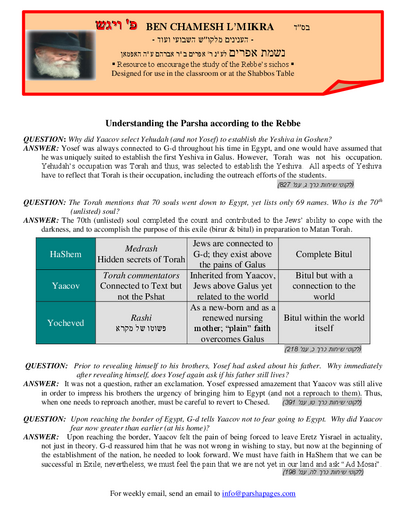
While Yosef’s words are usually translated to mean, “Is my father still alive?” and are expressive of a question, in their original Hebrew form, the structure of the phrase can be interpreted with a variant meaning. It is possible to explain that Yosef was not actually asking a question but was merely stating his astonishment at the possibility that his father was alive.

In certain instances, when a word is prefaced with a letter “hei,” as with the initial Hebrew word of Yosef’s statement, “Ha-od avi chai?”(העוד אבי חי), rather than expressing an actual question, its meaning takes on an expression of surprise.

This same structural form is found as well in the above verse regarding Kayin. After G-d asked Kayin, “Where is Hevel your brother?" Kayin responded with, “Am I my brother's keeper?” When Kayin told G-d, “Ha-shomer achi anochi?” (השומר אחי אנכי) he was not actually asking a question, but was stating his astonishment that he should be responsible for his brother’s fate, and was attempting to absolve himself of any responsibility.

Rashi explains this idea in regard to Kayin’s response, as follows:

This is a question asked in astonishment...
Rashi, ibid

A similar language is found regarding Avraham as well, in his response to hearing about the future birth of Yitzchak.

Text 9
And Avraham fell on his face and rejoiced, and he said to himself, "Will [a child] be born to one who is 100 years old, and will Sara, who is 90 years old, give birth?" [Ha-l’ven mei-ah shanim yulad?(הלבן מאה שנים יולד)]
Bereishis, 17:17

Rashi comments on the above verse:

Text 10
There are questions which are positive assertions, like : יליתגנגלה נה, “Did I appear?” [Meaning: “of course I appeared!”]; and : ראה ה אתה, “Do you see?” [Meaning: “of course you see!”] This too is a positive assertion, and so did he say to himself, “Was such kindness done to anyone else, that the Holy One, blessed be He, is doing for me?”
Rashi, ibid

Avraham was not asking a question of whether it was possible that someone who is 100 years old could give birth, as he knew that the Almighty was capable of doing anything He wished. Instead, he was expressing his astonishment at the amazing miracle that the Almighty was doing for him.

So too, Yosef did not have a question of whether or not his father was alive, and he therefore did not wait for the answer to his query. He was merely expressing his astonishment that this was indeed so.

Rashi did not find it necessary to ask the question as to why Yosef said, “(Ha-od) Is my father still alive?” being that if one had learned the above previous verses, he would know that a question prefaced by the lettter “hei” (ה) is not an actual question, but rather an expression of astonishment.
A wonder

While Yosef’s words are usually translated to mean, “Is my father still alive?” and are expressive of a question, in their original Hebrew form, the structure of the phrase can be interpreted with a variant meaning. It is possible to explain that Yosef was not actually asking a question but was merely stating his astonishment at the possibility that his father was alive.

In certain instances, when a word is prefaced with a letter “hei,” as with the initial Hebrew word of Yosef’s statement, “Ha-od avi chai?”(העוד אבי חי), rather than expressing an actual question, its meaning takes on an expression of surprise.

This same structural form is found as well in the above verse regarding Kayin. After G-d asked Kayin, “Where is Hevel your brother?" Kayin responded with, “Am I my brother's keeper?” When Kayin told G-d, “Ha-shomer achi anochi?” (השומר אחי אנכי) he was not actually asking a question, but was stating his astonishment that he should be responsible for his brother’s fate, and was attempting to absolve himself of any responsibility.

Rashi explains this idea in regard to Kayin’s response, as follows:

This is a question asked in astonishment...
Rashi, ibid

A similar language is found regarding Avraham as well, in his response to hearing about the future birth of Yitzchak.

Text 9
And Avraham fell on his face and rejoiced, and he said to himself, "Will [a child] be born to one who is 100 years old, and will Sara, who is 90 years old, give birth?" [Ha-l’ven mei-ah shanim yulad?(הלבן מאה שנים יולד)]
Bereishis, 17:17

Rashi comments on the above verse:

Text 10
There are questions which are positive assertions, like : יליתגנגלה נה, “Did I appear?” [Meaning: “of course I appeared!”]; and : ראה ה אתה, “Do you see?” [Meaning: “of course you see!”] This too is a positive assertion, and so did he say to himself, “Was such kindness done to anyone else, that the Holy One, blessed be He, is doing for me?”
Rashi, ibid

Avraham was not asking a question of whether it was possible that someone who is 100 years old could give birth, as he knew that the Almighty was capable of doing anything He wished. Instead, he was expressing his astonishment at the amazing miracle that the Almighty was doing for him.

So too, Yosef did not have a question of whether or not his father was alive, and he therefore did not wait for the answer to his query. He was merely expressing his astonishment that this was indeed so.

Rashi did not find it necessary to ask the question as to why Yosef said, “(Ha-od) Is my father still alive?” being that if one had learned the above previous verses, he would know that a question prefaced by the lettter “hei” (ה) is not an actual question, but rather an expression of astonishment.

PDF Preview