Insights from the Ohr Hachaim on Parshas Vayigash
Ohr Hachaim Hakadosh | December 21, 2023
Print This Article
View Original PDF

Insights from the Ohr Hachaim on Parshas Vayigash

Ohr Hachaim Hakadosh | December 31, 2025

And Yehuda drew near to him and he said, “Please my master, allow your servant to say something now in my master’s ears, and you shall not get angry with your servant, for you are like Par’oh.”

The Ohr Hachaim asks why Yehuda had to draw near to Yosef, was he not standing close to him the whole time?

The Ohr Hachaim quotes a possuk in Mishlei: כַּמַּ יִם הַּפָּנִים לַּפָּנִים כֵּן לֵּב הָּאָּדָּם לָּאָּדָּם - like water shows a face to a face, so too the heart of a person to a person. A person can change someone else’s heart and mindset, by changing his own.

Yehuda wished to influence Yosef and to change his mind about Binyomin. Yosef was greatly angered by the chutzpah of the person who stole his goblet, and he was adamant to punish the perpetrator. Yehuda was not a natural friend of Mitzri ministers. They were idol worshippers and Yehuda was someone who had overthrown the yoke of any idols, and had no connection to the worship, beliefs, or purported powers of any of these idols. By nature, he had to hate Yosef and all that Yosef stood for, because of this strong wall between Yehuda and the idols.

Now, Yehuda made a decision to draw close to Yosef, overcoming his natural inclinations. This is the meaning of this possuk. Yehuda did not draw physically close to Yosef, because he was standing right there. But he did draw emotionally close to him, in order to feel a connection that he could use to change Yosef’s mind.

Do Not Be Sad or Angry

And now, do not be sad and you should not get angry in your eyes that you sold me here, because Hashem sent me ahead of you to provide life.

The Ohr Hachaim asks a number of questions on this possuk.

  1. Why did Yosef say ‘now’? What other time was he excluding?
  2. Why did he repeat himself with asking them not to be upset and not to be angry? What were the two things?
  3. Moreover, the two should be mutually exclusive. If they were upset that they sold him, that would denote a humility on their part, that they accept blame for what they did. If so, how would they be so arrogant as to get angry about it? And if they were angry, how would they be sad?
  4. Why does the Torah write הֵּנָּה – here? What is it telling us?

The Ohr Hachaim explains that Yosef was saying that he knew that they regretted the sale. First, because he heard them saying to each other that they were to blame for their suffering because they saw their brother’s suffering. And second, because they came willing to redeem him for any money in the world. They were sad about what they had done, but now they had no more reason to be sad. That is the meaning of the word וְעַּתָּה – and now. Now that they have seen Yosef in his full glory as a minister in Mitzrayim, they had no reason to be sad about the sale. He was also hinting to them that he knew about their regrets and that he was not angry with them.

However, it was possible that they would still be angry at themselves. After all, the sale of Yosef had caused them no end of trouble, and it was now clear that they had done this to themselves. They wished to sell him as a slave to ensure that his dreams of his brothers bowing down to him would never come true, and now it turned out that it was their actions that caused him to become a minister to whom they all must bow. Essentially, their actions were not only useless, but counter-productive. This could cause them to get angry.

At this, Yosef told them that the end result of their actions was positive. Now they could be supported and sustained by the minister of the king. Although in the short term, their plans were thwarted through their own actions, in the long term they gained.

It Was Not You Who Sent Me Here

And now, it was not you who sent me here, but Hashem.

The Ohr Hachaim explains this possuk as a continuation of before. Yosef wished to remove the hatred from their hearts. He wanted to remove from them the slightest suspicion that Yosef still hated them for their cruelty to him. It would be hard for them to believe that Yosef had fully forgiven them and was ready to act to them as a regular brother. They would consider themselves worthy of being hated.

Now that he could see quite clearly that the entire sequence of events that brought him to Mitzrayim was clearly the hand of Hashem, and now they could all see how the brothers’ hand was entirely incidental. There was no reason for them to be considered enemies.

The Ohr Hachaim explains that this could be how the brothers managed to face their father after this story. He writes that it is unlikely that Yaakov never found out that the brothers sold Yosef. Yaakov must have inquired as to what had happened to his son, and eventually he must have heard what happened. He must have asked about the bloody shirt that he was shown and how it got to be that way if Yosef was not killed.

Yosef pre-empted his father’s anger by announcing that no harm was done, and their hands were clean. The brothers were mere pawns in Hashem’s plan to ensure that Yosef have a job as a father to Par’oh. As Chazal tell us, Yaakov would have been dragged to Mitzrayim with iron chains, but Hashem took pity on him and he went there with great honor.

Why Did Yosef Not Tell His Father Where He Was?

The Ohr Hachaim asks, why did Yosef not care for his father’s pain? Once he was freed from the dungeons, and he was no longer a slave, why would he allow his father to suffer so terribly? He knew how much his father loved him, he must have known how much his father suffered when Yosef was sold, and how much he mourned about him. Additionally, when the years of hunger began, why did he not care about his father’s sustenance? And when his brothers arrived, how was he permitted to lengthen his father’s suffering? Why did he not at least send a letter to him telling him that he was still alive?

We do know that Hashem decreed that Yosef would be apart from his father for twenty-two years. This was a punishment for Yaakov’s keeping apart from his father for twenty-two years. Additionally, these years lessened the two hundred and ten years that Klal Yisroel had to suffer in Mitzrayim. Also, Yaakov got to travel to Mitzrayim with great honor precisely because Yosef waited until his father was invited to Mitzrayim to show him the great honor that he received. But Yosef could not rely on any of this, he was obligated to honor his father and lessen his pain. Why did he not do so?

The Ohr Hachaim gives a reason for Yosef’s activities. Since Yosef arrived in Mitzrayim until Hashem freed him from jail, he did not have a single chance to contact his father.

Even if he would have had a chance to contact his father, he was worried that when his father would hear about it, his brothers would intervene and cause him real damage, and perhaps even kill him. They would be too embarrassed in front of their father to allow Yosef to survive. Alternatively, Yaakov would end up cursing the brothers and that would kill them.

After Yosef was released from jail and promoted to his job as minister for Par’oh, he still could not contact his father. He knew that by contacting his father, he would cause extreme embarrassment to his brothers in front of their father and grandfather, and Chazal tell us that it is best for a person to place himself in a fiery inferno rather than embarrass his friend in public.

Additionally, he was still scared of his brothers. Even after he had reached the pinnacle of success, he was scared that his brothers would find a way to make him suffer. The Medrash says that they tried to uproot him from the world, but the angel Gavriel prevented them. They had no problem redeeming him with their money, when he would be in their debt and would have to recognize them as brothers. But if they hadn’t redeemed him, he would stay angry with them and they would come first to kill him.

When the hunger began, he did not wish to reveal himself to his father or brothers. He was still in danger until he had been the one to feed them and support them. By serving them food, he showed them that he did not hate them and that they had nothing to fear from him. He also showed them how everything came from Hashem and that they could not take credit for anything.

Now they also did not have to be embarrassed in front of their father. Yaakov was no longer upset at his children for selling Yosef, because he too saw it as only good.
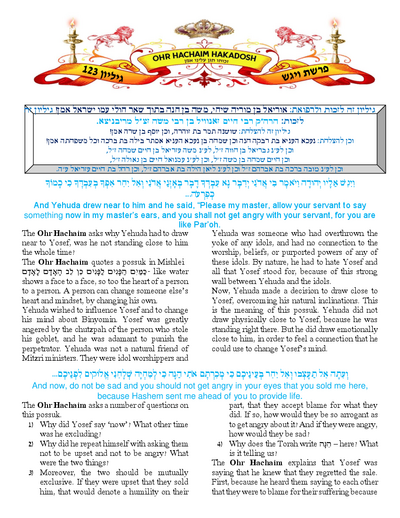

And Yehuda drew near to him and he said, “Please my master, allow your servant to say something now in my master’s ears, and you shall not get angry with your servant, for you are like Par’oh.”

The Ohr Hachaim asks why Yehuda had to draw near to Yosef, was he not standing close to him the whole time?

The Ohr Hachaim quotes a possuk in Mishlei: כַּמַּ יִם הַּפָּנִים לַּפָּנִים כֵּן לֵּב הָּאָּדָּם לָּאָּדָּם - like water shows a face to a face, so too the heart of a person to a person. A person can change someone else’s heart and mindset, by changing his own.

Yehuda wished to influence Yosef and to change his mind about Binyomin. Yosef was greatly angered by the chutzpah of the person who stole his goblet, and he was adamant to punish the perpetrator. Yehuda was not a natural friend of Mitzri ministers. They were idol worshippers and Yehuda was someone who had overthrown the yoke of any idols, and had no connection to the worship, beliefs, or purported powers of any of these idols. By nature, he had to hate Yosef and all that Yosef stood for, because of this strong wall between Yehuda and the idols.

Now, Yehuda made a decision to draw close to Yosef, overcoming his natural inclinations. This is the meaning of this possuk. Yehuda did not draw physically close to Yosef, because he was standing right there. But he did draw emotionally close to him, in order to feel a connection that he could use to change Yosef’s mind.

Do Not Be Sad or Angry

And now, do not be sad and you should not get angry in your eyes that you sold me here, because Hashem sent me ahead of you to provide life.

The Ohr Hachaim asks a number of questions on this possuk.

  1. Why did Yosef say ‘now’? What other time was he excluding?
  2. Why did he repeat himself with asking them not to be upset and not to be angry? What were the two things?
  3. Moreover, the two should be mutually exclusive. If they were upset that they sold him, that would denote a humility on their part, that they accept blame for what they did. If so, how would they be so arrogant as to get angry about it? And if they were angry, how would they be sad?
  4. Why does the Torah write הֵּנָּה – here? What is it telling us?

The Ohr Hachaim explains that Yosef was saying that he knew that they regretted the sale. First, because he heard them saying to each other that they were to blame for their suffering because they saw their brother’s suffering. And second, because they came willing to redeem him for any money in the world. They were sad about what they had done, but now they had no more reason to be sad. That is the meaning of the word וְעַּתָּה – and now. Now that they have seen Yosef in his full glory as a minister in Mitzrayim, they had no reason to be sad about the sale. He was also hinting to them that he knew about their regrets and that he was not angry with them.

However, it was possible that they would still be angry at themselves. After all, the sale of Yosef had caused them no end of trouble, and it was now clear that they had done this to themselves. They wished to sell him as a slave to ensure that his dreams of his brothers bowing down to him would never come true, and now it turned out that it was their actions that caused him to become a minister to whom they all must bow. Essentially, their actions were not only useless, but counter-productive. This could cause them to get angry.

At this, Yosef told them that the end result of their actions was positive. Now they could be supported and sustained by the minister of the king. Although in the short term, their plans were thwarted through their own actions, in the long term they gained.

It Was Not You Who Sent Me Here

And now, it was not you who sent me here, but Hashem.

The Ohr Hachaim explains this possuk as a continuation of before. Yosef wished to remove the hatred from their hearts. He wanted to remove from them the slightest suspicion that Yosef still hated them for their cruelty to him. It would be hard for them to believe that Yosef had fully forgiven them and was ready to act to them as a regular brother. They would consider themselves worthy of being hated.

Now that he could see quite clearly that the entire sequence of events that brought him to Mitzrayim was clearly the hand of Hashem, and now they could all see how the brothers’ hand was entirely incidental. There was no reason for them to be considered enemies.

The Ohr Hachaim explains that this could be how the brothers managed to face their father after this story. He writes that it is unlikely that Yaakov never found out that the brothers sold Yosef. Yaakov must have inquired as to what had happened to his son, and eventually he must have heard what happened. He must have asked about the bloody shirt that he was shown and how it got to be that way if Yosef was not killed.

Yosef pre-empted his father’s anger by announcing that no harm was done, and their hands were clean. The brothers were mere pawns in Hashem’s plan to ensure that Yosef have a job as a father to Par’oh. As Chazal tell us, Yaakov would have been dragged to Mitzrayim with iron chains, but Hashem took pity on him and he went there with great honor.

Why Did Yosef Not Tell His Father Where He Was?

The Ohr Hachaim asks, why did Yosef not care for his father’s pain? Once he was freed from the dungeons, and he was no longer a slave, why would he allow his father to suffer so terribly? He knew how much his father loved him, he must have known how much his father suffered when Yosef was sold, and how much he mourned about him. Additionally, when the years of hunger began, why did he not care about his father’s sustenance? And when his brothers arrived, how was he permitted to lengthen his father’s suffering? Why did he not at least send a letter to him telling him that he was still alive?

We do know that Hashem decreed that Yosef would be apart from his father for twenty-two years. This was a punishment for Yaakov’s keeping apart from his father for twenty-two years. Additionally, these years lessened the two hundred and ten years that Klal Yisroel had to suffer in Mitzrayim. Also, Yaakov got to travel to Mitzrayim with great honor precisely because Yosef waited until his father was invited to Mitzrayim to show him the great honor that he received. But Yosef could not rely on any of this, he was obligated to honor his father and lessen his pain. Why did he not do so?

The Ohr Hachaim gives a reason for Yosef’s activities. Since Yosef arrived in Mitzrayim until Hashem freed him from jail, he did not have a single chance to contact his father.

Even if he would have had a chance to contact his father, he was worried that when his father would hear about it, his brothers would intervene and cause him real damage, and perhaps even kill him. They would be too embarrassed in front of their father to allow Yosef to survive. Alternatively, Yaakov would end up cursing the brothers and that would kill them.

After Yosef was released from jail and promoted to his job as minister for Par’oh, he still could not contact his father. He knew that by contacting his father, he would cause extreme embarrassment to his brothers in front of their father and grandfather, and Chazal tell us that it is best for a person to place himself in a fiery inferno rather than embarrass his friend in public.

Additionally, he was still scared of his brothers. Even after he had reached the pinnacle of success, he was scared that his brothers would find a way to make him suffer. The Medrash says that they tried to uproot him from the world, but the angel Gavriel prevented them. They had no problem redeeming him with their money, when he would be in their debt and would have to recognize them as brothers. But if they hadn’t redeemed him, he would stay angry with them and they would come first to kill him.

When the hunger began, he did not wish to reveal himself to his father or brothers. He was still in danger until he had been the one to feed them and support them. By serving them food, he showed them that he did not hate them and that they had nothing to fear from him. He also showed them how everything came from Hashem and that they could not take credit for anything.

Now they also did not have to be embarrassed in front of their father. Yaakov was no longer upset at his children for selling Yosef, because he too saw it as only good.

PDF Preview

