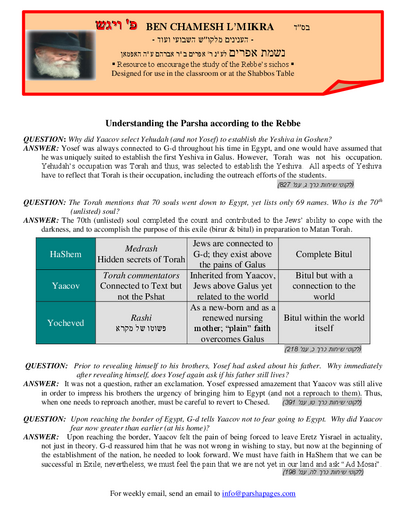
Is My Father Still Alive
At the moment that Yosef reveals himself to his brothers, he asks if his father Yaakov is still living. This question seems out of place for a number of reasons. The following Sicha explores the true meaning behind Yosef’s words, and the reason he chose to express them at this pivotal time.
Rashi, the foremost commentator on the Torah, clarifies all possible queries found in the simple meaning of the Torah. Just as one can learn from what Rashi does explain, one can learn from what Rashi doesn’t explain as well. If there is a difficulty found in a verse of the Torah which Rashi does not address, this is due to one of two possibilities:
- He has already addressed a similar query earlier in the Torah. By understanding the manner in which he dealt with the similar question previously, one will inevitably understand the answer to the question at hand.
- The question is not truly a question according to the simple way of learning the Torah.
In this week’s parsha (Torah portion), an example of the first possibility is found. There is a seemingly obvious question, which anyone who is learning the Torah with a simple approach would ask. Yet, Rashi does not address the question. The reason for this is that a prior knowledge of an idea which Rashi explained earlier in the Torah allows the question to be answered on its own.
Yosef’s inquiry
Yosef reveals himself to his brothers, and informs them of who he truly is. In Yosef’s opening statement to his brothers, he asks; “Is my father still alive?” The question is puzzling however, being that it seems clear that he already knew that his father Yaakov was alive, based on the dialogue he had just had with his brothers.
The following is the complete exchange between Yosef and his brothers, when he divulged to them that he was in truth their long lost brother.
Text 1
Now Yosef could not bear all those standing beside him, and he called out, "Take everyone away from me!" Thus no one stood with him when Yosef made himself known to his brothers. And he wept out loud, so the Egyptians heard, and the house of Pharaoh heard. And Yosef said to his brothers, "I am Yosef. Is my father still alive?" but his brothers could not answer him because they were startled by his presence. Then Yosef said to his brothers, "Please come closer to me," and they drew closer. And he said, "I am your brother Yosef, whom you sold into Egypt. But now do not be sad, and let it not trouble you that you sold me here, for it was to preserve life that G-d sent me before you. For already two years of famine [have passed] in the midst of the land, and [for] another five years, there will be neither plowing nor harvest. And G-d sent me before you to make for you a remnant in the land, and to preserve [it] for you for a great deliverance. And now, you did not send me here, but G-d, and He made me a father to Pharaoh, a lord over all his household, and a ruler over the entire land of Egypt. Hasten and go up to my father, and say to him, 'So said your son, Yosef: "G-d has made me a lord over all the Egyptians. Come down to me, do not tarry.”’
Bereishis, 45:1-9
Yosef asks if his father is alive, but he does not wait for an answer and proceeds to give instructions for bringing his father down to Egypt. Throughout the entire exchange it seems abundantly clear that Yosef knows that his father is alive. So, why did he ask?
Indeed, not only did Yosef not wait for an answer about whether or not his father was alive (as he apparently knew), but the brothers had essentially already answered this question, as they themselves had previously expressed that their father was living.
The entire conversation that led up to Yosef revealing his identity to his brothers revolved around the concern for Yaakov’s well-being. In fact, most recently, it was Yehuda’s concern for the life of Binyamin and his father that brought Yosef to finally admit his true identity. Yehuda had already expressed that it was because his father was alive, and his life was strongly tied with his youngest son, that Yehuda was so concerned about Binyamin’s welfare. Yehuda states the following to Yosef in the beginning of the parsha:
Text 2
And we said to my lord, 'The boy cannot leave his father, for if he leaves his father, he will die.' And you said to your servants, 'If your youngest brother does not come down with you, you will not see my face again.' And it came to pass when we went up to your servant, my father, and we told him the words of my lord that our father said, 'Go back, and buy us a little food.' But we said, 'We cannot go down; [only] if our youngest brother is with us will we go down, for we cannot see the man's face if our youngest brother is not with us...And now, when I come to your servant, my father, and the boy is not with us [since] his soul is attached to his (the boy's) soul, it will come to pass, when he sees that the boy is gone, he will die, and your servants will have brought down the hoary head of your servant, our father, in grief to the grave. For your servant assumed responsibility for the boy from my father, saying, 'If I do not bring him to you, I will have sinned against my father forever.' So now, please let your servant stay instead of the boy, as a slave to my lord, and may the boy go up with his brothers. For how will I go up to my father if the boy is not with me? Let me not see the misery that will befall my father!
Bereishis, 44: 22-34
Yehuda repeats time and again how his father is alive, and that if Binyamin does not return, he is concerned that his father will not be able to withstand the loss of a second son. This being the case, why does Yosef ask if Yaakov is alive? It seems he had already received the answer numerous times. Furthermore, Yosef does not even wait for an answer to his question but instead goes on to instruct them on the next steps that they should take. He immediately tells his brothers, “Please come closer to me,” and then proceeds to say to them that they should not be upset that they sold him to Egypt, since it was all part of G-d’s plan. Yosef ends his conversation with the instructions: “Hasten and go up to my father, and say to him, 'So said your son, Yosef: "G-d has made me a lord over all the Egyptians. Come down to me, do not tarry.”
Yosef had still not heard the confirmation that his father was alive, yet he already had a message for them to deliver to him! From all the above, it is certain that Yosef discerned that his father was living. There must therefore be another meaning to his inquiry. Why indeed did he ask if his father is still alive and what could possibly be the intent of his question? Rashi, however, does not comment on this basic question, which would be raised by anyone learning the Torah. This must be because the question has already been answered by something that Rashi has explained elsewhere.
An ice-breaker
There are commentators who explain that Yosef asked about the well-being of his father as a way of breaking the ice after having not seen his brothers for 22 years. He knew that the announcement that he was Yosef would cause his brothers to be stunned by the fact that their brother whom they had sold into slavery, had become the viceroy of Egypt and was now in control of their destiny. He therefore intended to discuss his father’s well-being, and possibly others in the family, as a means to lighten the mood. (In the end, we find that the conversation didn’t continue, being that the brothers “could not answer him because they were startled by his presence.”)
Text 3
And for this reason he said to them, “I am Yosef. Is my father still alive?” He was not asking if he was still alive, since they had already told him that he was alive...rather, he said this to them in order to begin a conversation with them. For, he primarily intended that they should not become embarrassed about what they had done—that he should not remind them about the incident of selling him. Rather, he thought to speak to them concerning other matters. This is why he began with his father, [asking] if he was still alive...and he had in mind to ask them afterwards concerning all of their wives, their children, their livestock, and all of the household matters, but since they were overwhelmed and did not answer him [he didn’t continue].
Abarbanel, Bereishis 45:3
Yosef was not asking a question that he didn’t know the answer to. He was directing the conversation to familial matters, in order to make his brothers more comfortable. According to this, it is understood why Rashi did not feel the need to explain anything at this place in the Torah. Rashi had already explained this concept previously: that it is normal to ask a question that one knows the answer to, in order to begin a conversation. The first example of such an instance is found after Adam sinned and ate from the Tree of Knowledge. Adam hid from G-d amongst the trees in the garden, and G-d called out to him, asking where he was.
Text 4
And the Lord G-d called to man, and He said to him, "Where are you?"
Bereishis, 3:9
Surely G-d knew where Adam was to be found and had no need to ask him where he was. Rashi therefore explains the meaning of the question as follows:
Text 5
He knew where he was, but [He asked him this] in order to enter into conversation with him, lest he be frightened to answer if He should punish him suddenly.
Rashi, ibid
Similarly, after Kayin kills Hevel, there too, G-d asks Kayin a question of which He is already aware of the answer. The verse says as follows:
Text 6
And the Lord said to Kayin, "Where is Hevel your brother?" And he said, "I do not know. Am I my brother's keeper?"
Bereishis, 4:9
There as well, Rashi explains that G-d asks Kayin a question that he already knew the answer to, for a specific intent:
Text 7
To enter with him, using mild words. [For] perhaps he would repent and say, “I killed him, and I sinned against You.”
Rashi, ibid