IT CAN THUS BE SETTLED
IT CAN THUS BE SETTLED
By Rabbi Yeshaya Zushe a"h Wilhelm
1. (1:) It is written in “Sefer Hachayim” of the Arizal’s brother that the letters Gimmel and Samech are never immediately adjacent to each other in the Torah. He writes that this is because Hashem despises one who is “רוחגס — haughty.”
(2:) The Gra (in “Divrei Eliyahu”) writes that the letters Gimmel and Tes are not found consecutively in the Torah — and because these letters are always separated in the Torah, it is fitting to use them for something which separates between husband and wife — ”גט — divorce.”
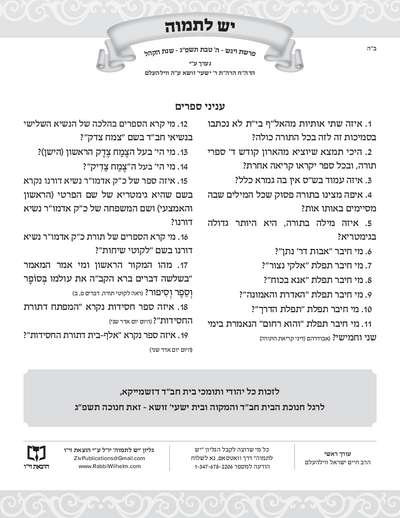
2. If a congregation forgot to read parshas Para on Shabbos Para, Kaf Hachayim writes that it should be read on the following Shabbos, which is Shabbos Hachodesh. If that Shabbos is also Rosh Chodesh, 4 Torahs are to be removed from the Aron: (1:) For that week’s parsha. (2:) For Rosh Chodesh. (3:) For parshas Para. (4:) For parshas Hachodesh.
3. Maseches Nozir, 33b.
4. All words of the following pesukim end with a Final Mem:
- (1:) In Vayishlach, 32:15: "עזִ ים מָ אתַ יִ ם וּתְ יָ שִ ׁים עֶ שְ ׂרִ ים רְ חַ לִ ים מָ אתַ יִ ם וְ אֵ ילִ ים עֶ שְ ׂרִ ים".
- (2:) In Pinchas, 29:33: "וּ מִ נְ חָ תָ ם וְ נִ סְ כֵּ י הֶ ם לַ פָּ רִ י ם לָ אֵ י לִ ם וְלַכְּבָשִׂים בְּמִסְפָּרָם כְּמַשְׁפָּטָם".
- (3:) In Devorim, 1:13: "לָ כֶ ם אַ נָ שִ ׁים חֲ כָ מִ ים וּנְ בֹנִ ים וִ ידֶ עים לְ שִ ׁבְ טֵ יכֶ ם וַ אֲ שִ ׂימֵ ם בְּ רָ אשֵ ׁיכֶ ם" (besides the first word).
5. In Koirach, 16:13: "תשתרר".
6. The Tana, Rabi Nosson Habavli.
7. Mar, the son of Rav Huna. (Berachos, 17a)
8. Rabi Nechunya ben Hakana.
9. Rabi Yishma’el ben Elisha, the Kohen Gadol.
10. Rav Chisda. (Berachos, 29b)
11. The Beis Yosef writes that this prayer came about because of a great miracle.
The story as told by the Avudraham:
3 elders of the Yidden were on a boat of exiles from Yerushalayim which landed on the territory of one ruler, who said that he would test their lineage as Jews through putting them into a fire, as was done to Chanaya, Misha’el and Azarya, who survived. They asked for 30 days, and he gave that to them. When the end of that period neared, one of the elders dreamt of a passuk which said the word “ki — if ” and “lo — not” 3 times, but he did not know which passuk was being conveyed.
He was told that it was the passuk: “If you pass through water, I will be with you; through streams — they shall not overwhelm you. If you walk through fire, you shall not be scorched; through flame, it shall not burn you” (Yeshaya, 43:2).
Following this message, they entered the fire and it split into 3, and they exited it unharmed. In thanks for this miracle, these elders instituted the prayer of Vehu Rachum (“and He is merciful”), which includes 3 parts, each beginning and ending with the idea that Hashem is merciful.
12. Those who published “Sha’alos Uteshuvos Tzemach Tzedek,” which was first printed in the year 5631 (after the Rebbe’s passing). This name was chosen because the word “Tzemach” has the same numerical value as the the Rebbe’s first name, “Menachem” (138), and the word “Tzedek” has the same value as his second name, “Mendel” (194).
It should be noted that the Tzemach Tzedek himself would sometimes sign with the name Tzemach when it needed to be in a discreet manner.
13. Rabi Menachem Mendel Krumchal, the Head of Beis Din in Nikolsburg (who passed away in 5421).
14. Rabi Menacham Mendil Hager, the first Rebbe of Vishnitz (who passed away in 5645).
15. "Chidushim Ubiurim B’shas” (has the numerical value of 1015).
16. The chossid and shliach, Rabbi Yehuda Leib Raskin a”h wrote that it was the Rebbe who suggested this name.
17. It is brought in Likutei Torah in the name of Sefer Yetzira (1:1). It has been passed down that Sefer Yetzira was authored by Avrohom Avinu.
18. "Sha’ar Hayichud” of the Mitteler Rebbe.
19. "Sha’arei Orah” of the Mitteler Rebbe.
Related Articles