Parshas Vayigash
Lamplighter | December 30, 2024
Print This Article
View Original PDF

Parshas Vayigash

Lamplighter | June 27, 2025

The Jewish nation has endured four exiles: The first in Egypt, the second in Babylonia, the third in Assyria. The fourth and final exile is the one we have been in for the last two thousand years, the "exile of Edom." (Edom stands for Rome, and symbolizes the countries of the Western world.)

The Torah portion of Vayigash delineates the beginning of the Jewish people's journey into exile. G-d appeared to Jacob and promised, "I will descend with you into Egypt, and I will also surely bring you up again." Bolstered by this promise, Jacob and his sons went down to Egypt and began the Jewish people's 210-year sojourn there.

In many respects the exile in Egypt was the harshest of all the exiles; it occurred before the giving of the Torah, which afforded future generations the strength to withstand the suffering. Also, as with other painful experiences, the first time it occurs the wound is always the deepest and the hardest to overcome.

In addition, the Jews' exile in Egypt differed from future ones in that all Jews were involved. Later exiles found Jews scattered all over the world, assuring that whenever Jews were discriminated against in one country there were other lands in which they enjoyed relative freedom, and could come to the aid of their brethren.

Furthermore, Egypt itself was a land that posed particular difficulties. Not only was it spiritually corrupt, but our Sages describe it as a fortified country from which not even one slave could escape.

This first and most difficult exile served one positive purpose - to act as preparation for the giving of the Torah on Mount Sinai. Egypt was the crucible in which the Jewish nation was purified and made worthy of the Torah.

We learn this from the Hebrew name for Egypt, "Mitzrayim," which comes from the word meaning "limitation" and "constriction."

When water's flow is artificially blocked by placing an obstruction in its path, the water flows even more forcefully because of the temporary impasse. When one's thumb is held over the tap to partially obstruct the flow, the water shoots out that much more forcefully from the faucet.

Such is the Divine purpose of our exile, to uncover within every Jew the hidden strengths and stores of faith that are in the Jewish soul. The difficulties and pressures of the exile cause these inner qualities and self-sacrifice to be revealed.

The experience of exile can be used for our maximum benefit - to strengthen our commitment to Torah and mitzvot (commandments). Just as the Jews eventually left Egypt victorious and with "great wealth," and were worthy of receiving the Torah, may we be worthy to usher in the Messianic era, now.
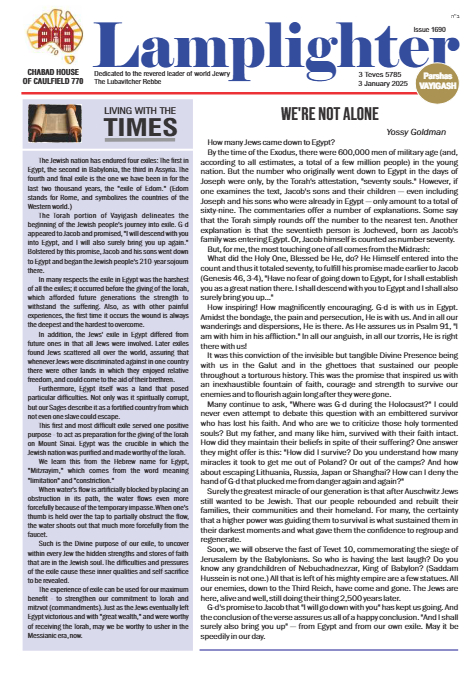

The Jewish nation has endured four exiles: The first in Egypt, the second in Babylonia, the third in Assyria. The fourth and final exile is the one we have been in for the last two thousand years, the "exile of Edom." (Edom stands for Rome, and symbolizes the countries of the Western world.)

The Torah portion of Vayigash delineates the beginning of the Jewish people's journey into exile. G-d appeared to Jacob and promised, "I will descend with you into Egypt, and I will also surely bring you up again." Bolstered by this promise, Jacob and his sons went down to Egypt and began the Jewish people's 210-year sojourn there.

In many respects the exile in Egypt was the harshest of all the exiles; it occurred before the giving of the Torah, which afforded future generations the strength to withstand the suffering. Also, as with other painful experiences, the first time it occurs the wound is always the deepest and the hardest to overcome.

In addition, the Jews' exile in Egypt differed from future ones in that all Jews were involved. Later exiles found Jews scattered all over the world, assuring that whenever Jews were discriminated against in one country there were other lands in which they enjoyed relative freedom, and could come to the aid of their brethren.

Furthermore, Egypt itself was a land that posed particular difficulties. Not only was it spiritually corrupt, but our Sages describe it as a fortified country from which not even one slave could escape.

This first and most difficult exile served one positive purpose - to act as preparation for the giving of the Torah on Mount Sinai. Egypt was the crucible in which the Jewish nation was purified and made worthy of the Torah.

We learn this from the Hebrew name for Egypt, "Mitzrayim," which comes from the word meaning "limitation" and "constriction."

When water's flow is artificially blocked by placing an obstruction in its path, the water flows even more forcefully because of the temporary impasse. When one's thumb is held over the tap to partially obstruct the flow, the water shoots out that much more forcefully from the faucet.

Such is the Divine purpose of our exile, to uncover within every Jew the hidden strengths and stores of faith that are in the Jewish soul. The difficulties and pressures of the exile cause these inner qualities and self-sacrifice to be revealed.

The experience of exile can be used for our maximum benefit - to strengthen our commitment to Torah and mitzvot (commandments). Just as the Jews eventually left Egypt victorious and with "great wealth," and were worthy of receiving the Torah, may we be worthy to usher in the Messianic era, now.

PDF Preview