Sidra of the Week Vayigash
Questions on the Sidra | December 19, 2023
Print This Article
View Original PDF

Sidra of the Week Vayigash

Questions on the Sidra | December 31, 2025

1. After the silver cup of Yosef was found in Binyomin’s baggage, the brothers return to the city, to Yosef’s palace. He is awaiting their return and, intending to test their feelings towards Binyomin, he stipulates that Binyomin is to be punished for this “theft” by being made his slave.

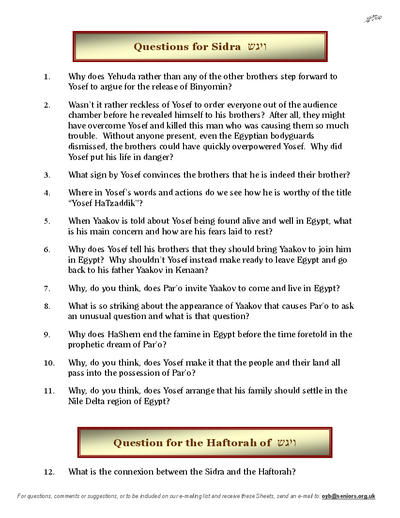
2. Yehuda then steps forward to speak to the Viceroy of Egypt. Thinly veiling his anger in a speech of submission and a plea for clemency, he complains that the whole episode of the stolen cup is nothing more than a frame-up and that this is but the culmination of the many false accusations that the Viceroy has made against them from the moment they came. He goes on to explain that the brothers dare not return to their father without Binyomin for the loss of this most precious son would in all probability cause him to die of grief. The brothers will not allow Binyomin to be detained under any circumstances, says Yehuda, implying that they are willing to fight to the death for the release of their youngest brother. Finally, Yehuda beseeches the Viceroy to have compassion upon their old father Yaakov, for he has suffered enough sorrow in his lifetime.

3. When Yosef sees that his brothers are united in their determination to save Binyomin, he knows that any blemish of jealousy in the family of Yaakov is no more. And at the mention of his grieving father, he feels that he can control his emotions no longer. He orders all Egyptians — even his bodyguards — out of the audience chamber for he does not want anyone to see the embarrassment of his brothers when he makes himself known to his brothers.

4. When they are thus alone, Yosef tells them, “I am Yosef your brother.” He speaks to them directly (in שׁלְןהַשׁדֶקוֹ) and assures them that he is indeed their brother who was sold down to Egypt. The brothers are speechless with shock at the terrible mistake that it now transpires they made about their brother so many years ago. Now they see how their actions then must have been prompted by motives that were all wrong.

5. Yosef comforts his brothers. He tells them that it is not they who sent him down to Egypt: it is HaShem’s plan that through Yosef there should be a great deliverance from the terrible famine that was plaguing the land of Kenaan as well as the land of Egypt.

6. He tells his brothers to quickly go back to their father and inform him that Yosef his son is alive and to inform him too of his great high office in Egypt so that Yaakov and all his family should feel free to come and join Yosef — for only two years of the foretold seven years of famine had passed. Par’o, the king of Egypt, personally encourages Yaakov to come and join his son Yosef, too.

7. When the news is carefully told to Yaakov, he can hardly believe it. His spirit is revived and Yaakov and all his family, with all their possessions, travel down to Egypt. On the way down, Yaakov stops at Be’er She’va, where HaShem reassures him that although he is indeed going down into Exile as foretold to Avrohom at the Covenant of the Pieces, HaShem will increase Yaakov’s family and they will grow into a great nation there. HaShem tells Yaakov that just as He, HaShem, is going down to Egypt with him, so too, when the time comes, will He bring the Jewish People up from there.

8. Yaakov sends Yehuda ahead of the family (to make arrangements for a schoolhouse and thus ensure that there should be a place where the traditions of the family shall be taught) and when they all arrive, Yosef presents some of his brothers at the Court of Par’o. The king of Egypt is clearly amazed at the apparent great age of Yaakov and he is overwhelmed too by the saintly appearance and great dignity of Yaakov. Yaakov, in turn, salutes Par’o and bestows his blessing upon him and his country. As a result, the waters of the Nile flow again and the famine ended the following year, five years early. (Its purpose, to cause the family of Yaakov to go down to Egypt, was accomplished and HaShem therefore ended the misery of the famine before the predicted time.)

9. But until the new crops grow, the people are desperate for food. Yosef supplies them all from his storehouses and in return the people willingly become the servants of Par’o. Their land, too, comes into the possession of the king. Thus, through Yosef’s capable administration, the people survive, Egypt becomes an exceedingly wealthy country and Par’o is its powerful monarch.

10. The family of Yaakov settle in the region of Goshen (in the northern part of Egypt, known today as the Nile Delta) and they begin to multiply and grow strong, just as HaShem said.

1. After the silver cup of Yosef was found in Binyomin’s baggage, the brothers return to the city, to Yosef’s palace. He is awaiting their return and, intending to test their feelings towards Binyomin, he stipulates that Binyomin is to be punished for this “theft” by being made his slave.

2. Yehuda then steps forward to speak to the Viceroy of Egypt. Thinly veiling his anger in a speech of submission and a plea for clemency, he complains that the whole episode of the stolen cup is nothing more than a frame-up and that this is but the culmination of the many false accusations that the Viceroy has made against them from the moment they came. He goes on to explain that the brothers dare not return to their father without Binyomin for the loss of this most precious son would in all probability cause him to die of grief. The brothers will not allow Binyomin to be detained under any circumstances, says Yehuda, implying that they are willing to fight to the death for the release of their youngest brother. Finally, Yehuda beseeches the Viceroy to have compassion upon their old father Yaakov, for he has suffered enough sorrow in his lifetime.

3. When Yosef sees that his brothers are united in their determination to save Binyomin, he knows that any blemish of jealousy in the family of Yaakov is no more. And at the mention of his grieving father, he feels that he can control his emotions no longer. He orders all Egyptians — even his bodyguards — out of the audience chamber for he does not want anyone to see the embarrassment of his brothers when he makes himself known to his brothers.

4. When they are thus alone, Yosef tells them, “I am Yosef your brother.” He speaks to them directly (in שׁלְןהַשׁדֶקוֹ) and assures them that he is indeed their brother who was sold down to Egypt. The brothers are speechless with shock at the terrible mistake that it now transpires they made about their brother so many years ago. Now they see how their actions then must have been prompted by motives that were all wrong.

5. Yosef comforts his brothers. He tells them that it is not they who sent him down to Egypt: it is HaShem’s plan that through Yosef there should be a great deliverance from the terrible famine that was plaguing the land of Kenaan as well as the land of Egypt.

6. He tells his brothers to quickly go back to their father and inform him that Yosef his son is alive and to inform him too of his great high office in Egypt so that Yaakov and all his family should feel free to come and join Yosef — for only two years of the foretold seven years of famine had passed. Par’o, the king of Egypt, personally encourages Yaakov to come and join his son Yosef, too.

7. When the news is carefully told to Yaakov, he can hardly believe it. His spirit is revived and Yaakov and all his family, with all their possessions, travel down to Egypt. On the way down, Yaakov stops at Be’er She’va, where HaShem reassures him that although he is indeed going down into Exile as foretold to Avrohom at the Covenant of the Pieces, HaShem will increase Yaakov’s family and they will grow into a great nation there. HaShem tells Yaakov that just as He, HaShem, is going down to Egypt with him, so too, when the time comes, will He bring the Jewish People up from there.

8. Yaakov sends Yehuda ahead of the family (to make arrangements for a schoolhouse and thus ensure that there should be a place where the traditions of the family shall be taught) and when they all arrive, Yosef presents some of his brothers at the Court of Par’o. The king of Egypt is clearly amazed at the apparent great age of Yaakov and he is overwhelmed too by the saintly appearance and great dignity of Yaakov. Yaakov, in turn, salutes Par’o and bestows his blessing upon him and his country. As a result, the waters of the Nile flow again and the famine ended the following year, five years early. (Its purpose, to cause the family of Yaakov to go down to Egypt, was accomplished and HaShem therefore ended the misery of the famine before the predicted time.)

9. But until the new crops grow, the people are desperate for food. Yosef supplies them all from his storehouses and in return the people willingly become the servants of Par’o. Their land, too, comes into the possession of the king. Thus, through Yosef’s capable administration, the people survive, Egypt becomes an exceedingly wealthy country and Par’o is its powerful monarch.

10. The family of Yaakov settle in the region of Goshen (in the northern part of Egypt, known today as the Nile Delta) and they begin to multiply and grow strong, just as HaShem said.

PDF Preview


