The Importance of Not Getting Upset Over Petty Matters
Brooklyn Torah Gazette | December 23, 2025
Print This Article
View Original PDF

The Importance of Not Getting Upset Over Petty Matters

Brooklyn Torah Gazette | December 31, 2025

Rabbi Yosef Viener

One of the featured speakers at the recent Thanksgiving Day Hakhel Event in Flatbush was Rabbi Yosef Viener, mora d’asra of Khal Shaar Hashomayim in Monsey. The topic of his lecture was “Secret Keys to an Optimistic, Happy and Friendly Disposition.”

The Importance of Being Optimistic, Happy and Friendly

Rabbi Viener began by declaring for avodas Hashem (one’s spiritual service to Hashem) to be successful, it is very important to have an optimistic, happy and friendly disposition.

Unfortunately, too many people believe that only fools are friendly and give other people the benefit of a doubt. The downside of such an attitude, Rabbi Viener explained is that it puts such a person at a serious disadvantage with one’s important relationship with Hakodesh Baruch Hu. This negative attitude causes one to unfortunately to develop complaints against our greatest friend and protector – Hakodesh Baruch Hu.

Rabbi Viener spoke about an important lesson that we could learn from Parshas Toldos. Yaakov tells Rivka that he is her relative and that if her father (also his uncle – Lavan) tries to swindle him, Yaakov can protect himself. Yet, ironically he quickly gets swindled when he thought he had an agreement with his future father-in-law to marry Rochel in exchange for working hard with Lavan’s flock for seven years and instead discovers that he has married Lavan’s older daughter – Leah.

For almost the entire 20 years that Yaakov works with the flocks of his father-in-law, he is repeatedly swindled more than 100 times by Lavan who repeatedly changes the terms of his agreements as to how Yaakov was to paid for his work.

Yaakov’s Life Was Too Important to Waste with Petty Arguments

But, Yaakov doesn’t allow himself to develop a negative attitude towards others and more importantly to Hashem. Indeed, his attitude is that life is too precious and important for him to waste with petty arguments and disputes with his father-in-law that will distract one from the important mission in life of serving Hashem to the best of one’s abilities.

All too often we waste our time on unimportant issues – “because of the principle.” Somebody could wait on the phone for hours in order to talk to a customer service representative from Verizon (for example) because of a dispute on an overcharge of $20.

Rabbi Viener argues that time is too important and valuable to allow one to get lost in arguments with others on petty matters. It was only when Yaakov, following a command from Hashem left by fleeing from his father-in-law, that after being chased down by Lavan that he finally unloaded his frustrations about all of his disputes and disagreements.

We Must Constantly Strive on Focusing on the Good in Our Lives

Hakodesh Baruch Hu doesn’t want us to do and perform our avodas Hashem in a bad mood. The remedy, Rabbi Viener said is to constantly strive on focusing on the good in your life.

When the meraglim (the spies) went on a mission to spy out the Land of Canaan, they didn’t learn the lesson of Miriam, Moshe’s sister whose great mistake was not to realize the importance of navuahs (prophecies) that her brother was constantly getting from Hakodesh Baruch Hu and how important it was to the good of Klal Yisroel. Likewise, the meraglim failed in their important mission because of their tendency to interpret everything they saw with a bad eye.

Life is long, but not long enough. Yaakov teaches us not to constantly haggle with the Lavans of the world and as a result stumble in the sin of bittel Torah (the important mitzvah of studying Hashem’s precious Torah) and also lose the opportunity to perform other precious mitzvahs.

It was only towards the end of Yaakov’s sojourn in Haran that G-d taught him the science of genetics which allowed him to gain most of the wealth that his father-in-law had swindled him of during the past couple of decades.

The Yetzer Hora Doesn’t Want a Jew to Study Torah

What is the main weapon of the Yetzer Hora (one’s evil inclination) against frum people? Rabbi Viener answer that it is to get a Jew not to study Torah. The Yetzer Hora wants us not to focus on our davening and limud Torah by making us nervous about some petty problems. Since the sin of the eitz hadass (Adam’s eating of the fruit of the tree of the knowledge of good and bad in Gan Eden), the Yetzer Hora is inside our mind.

Why does the Yetzer Hora make it difficult for a frum Jew to sleep at night? Rabbi Viener conjectured that the Yetzer Hora wants you to be so exhausted that you come late to daven in shul the next morning. Your response is at night when you can’t fall asleep should be to grab a sefer and start learning Torah and thus frustrate the goal of the Yetzer Hora.

People have the ability to grow! The nisayon, challenge of a ben Torah is to say Modeh Ani upon waking up in the morning, pour negal vasser water on his hands and get to shul on time to learn and pray.

At the end of the day, life doesn’t always go our way, but Rabbi Viener said that we can and have the obligation to push ourselves to do our utmost to be optimistic, happy and friendly in our avodas Hashem.

Reprinted from the December 18, 2025 edition of The Flatbush Jewish Journal.
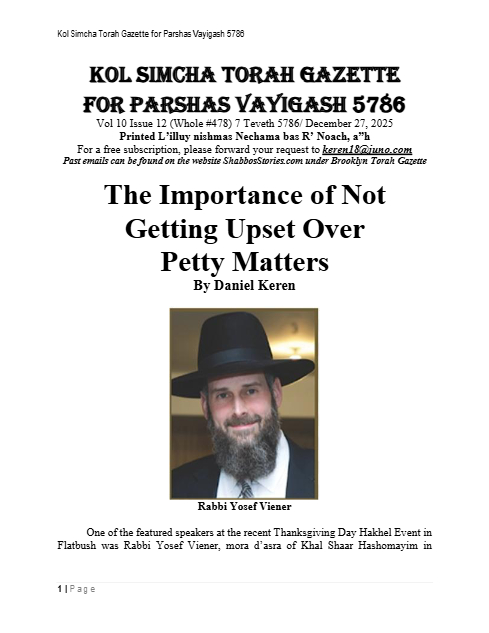
Rabbi Yosef Viener

One of the featured speakers at the recent Thanksgiving Day Hakhel Event in Flatbush was Rabbi Yosef Viener, mora d’asra of Khal Shaar Hashomayim in Monsey. The topic of his lecture was “Secret Keys to an Optimistic, Happy and Friendly Disposition.”

The Importance of Being Optimistic, Happy and Friendly

Rabbi Viener began by declaring for avodas Hashem (one’s spiritual service to Hashem) to be successful, it is very important to have an optimistic, happy and friendly disposition.

Unfortunately, too many people believe that only fools are friendly and give other people the benefit of a doubt. The downside of such an attitude, Rabbi Viener explained is that it puts such a person at a serious disadvantage with one’s important relationship with Hakodesh Baruch Hu. This negative attitude causes one to unfortunately to develop complaints against our greatest friend and protector – Hakodesh Baruch Hu.

Rabbi Viener spoke about an important lesson that we could learn from Parshas Toldos. Yaakov tells Rivka that he is her relative and that if her father (also his uncle – Lavan) tries to swindle him, Yaakov can protect himself. Yet, ironically he quickly gets swindled when he thought he had an agreement with his future father-in-law to marry Rochel in exchange for working hard with Lavan’s flock for seven years and instead discovers that he has married Lavan’s older daughter – Leah.

For almost the entire 20 years that Yaakov works with the flocks of his father-in-law, he is repeatedly swindled more than 100 times by Lavan who repeatedly changes the terms of his agreements as to how Yaakov was to paid for his work.

Yaakov’s Life Was Too Important to Waste with Petty Arguments

But, Yaakov doesn’t allow himself to develop a negative attitude towards others and more importantly to Hashem. Indeed, his attitude is that life is too precious and important for him to waste with petty arguments and disputes with his father-in-law that will distract one from the important mission in life of serving Hashem to the best of one’s abilities.

All too often we waste our time on unimportant issues – “because of the principle.” Somebody could wait on the phone for hours in order to talk to a customer service representative from Verizon (for example) because of a dispute on an overcharge of $20.

Rabbi Viener argues that time is too important and valuable to allow one to get lost in arguments with others on petty matters. It was only when Yaakov, following a command from Hashem left by fleeing from his father-in-law, that after being chased down by Lavan that he finally unloaded his frustrations about all of his disputes and disagreements.

We Must Constantly Strive on Focusing on the Good in Our Lives

Hakodesh Baruch Hu doesn’t want us to do and perform our avodas Hashem in a bad mood. The remedy, Rabbi Viener said is to constantly strive on focusing on the good in your life.

When the meraglim (the spies) went on a mission to spy out the Land of Canaan, they didn’t learn the lesson of Miriam, Moshe’s sister whose great mistake was not to realize the importance of navuahs (prophecies) that her brother was constantly getting from Hakodesh Baruch Hu and how important it was to the good of Klal Yisroel. Likewise, the meraglim failed in their important mission because of their tendency to interpret everything they saw with a bad eye.

Life is long, but not long enough. Yaakov teaches us not to constantly haggle with the Lavans of the world and as a result stumble in the sin of bittel Torah (the important mitzvah of studying Hashem’s precious Torah) and also lose the opportunity to perform other precious mitzvahs.

It was only towards the end of Yaakov’s sojourn in Haran that G-d taught him the science of genetics which allowed him to gain most of the wealth that his father-in-law had swindled him of during the past couple of decades.

The Yetzer Hora Doesn’t Want a Jew to Study Torah

What is the main weapon of the Yetzer Hora (one’s evil inclination) against frum people? Rabbi Viener answer that it is to get a Jew not to study Torah. The Yetzer Hora wants us not to focus on our davening and limud Torah by making us nervous about some petty problems. Since the sin of the eitz hadass (Adam’s eating of the fruit of the tree of the knowledge of good and bad in Gan Eden), the Yetzer Hora is inside our mind.

Why does the Yetzer Hora make it difficult for a frum Jew to sleep at night? Rabbi Viener conjectured that the Yetzer Hora wants you to be so exhausted that you come late to daven in shul the next morning. Your response is at night when you can’t fall asleep should be to grab a sefer and start learning Torah and thus frustrate the goal of the Yetzer Hora.

People have the ability to grow! The nisayon, challenge of a ben Torah is to say Modeh Ani upon waking up in the morning, pour negal vasser water on his hands and get to shul on time to learn and pray.

At the end of the day, life doesn’t always go our way, but Rabbi Viener said that we can and have the obligation to push ourselves to do our utmost to be optimistic, happy and friendly in our avodas Hashem.

Reprinted from the December 18, 2025 edition of The Flatbush Jewish Journal.

PDF Preview