To bless for the bad just as one blesses for the good
טיב הקהילה English | January 02, 2025
Print This Article
View Original PDF

To bless for the bad just as one blesses for the good

טיב הקהילה English | June 27, 2025

I will go down with you to Egypt, and I shall surely bring you up (46:4)

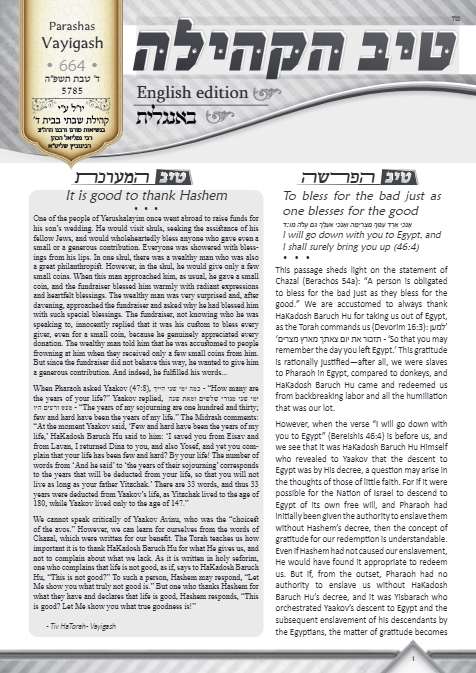
This passage sheds light on the statement of Chazal (Berachos 54a): “A person is obligated to bless for the bad just as they bless for the good.” We are accustomed to always thank HaKadosh Baruch Hu for taking us out of Egypt, as the Torah commands us (Devorim 16:3): ‘למען תזכור את יום צאתך מארץ מצרים’ - ‘So that you may remember the day you left Egypt.‘ This gratitude is rationally justified—after all, we were slaves to Pharaoh in Egypt, compared to donkeys, and HaKadosh Baruch Hu came and redeemed us from backbreaking labor and all the humiliation that was our lot.

However, when the verse “I will go down with you to Egypt” (Bereishis 46:4) is before us, and we see that it was HaKadosh Baruch Hu Himself who revealed to Yaakov that the descent to Egypt was by His decree, a question may arise in the thoughts of those of little faith. For if it were possible for the Nation of Israel to descend to Egypt of its own free will, and Pharaoh had initially been given the authority to enslave them without Hashem‘s decree, then the concept of gratitude for our redemption is understandable. Even if Hashem had not caused our enslavement, He would have found it appropriate to redeem us. But if, from the outset, Pharaoh had no authority to enslave us without HaKadosh Baruch Hu‘s decree, and it was Yisbarach who orchestrated Yaakov‘s descent to Egypt and the subsequent enslavement of his descendants by the Egyptians, the matter of gratitude becomes unclear. For one might argue: “Do not enslave us, and there will be no need to redeem us!”

However, in practice, the Torah obligates us to give thanks for this, and every day we are commanded to remember the Exodus twice. It must be that not only was the redemption beneficial for us, but also the enslavement that preceded it. Even during the enslavement itself, HaKadosh Baruch Hu was already benefiting us. Indeed, with human eyes, we saw only humiliation under the hand of Egypt. They treated us as if we were ownerless, beat us until we were utterly exhausted, threw our children into the river, and slaughtered them to bathe in their blood, Rachmana litzlan. Nevertheless, we are commanded to believe that Hashem intended it all for good. He alone knew the hidden goodness embedded in those sufferings, and we must thank Him for them.

From this, we must also learn a lesson about the Creator‘s governance. We must understand that nothing evil comes from Him. Even when we endure various hardships, we must recognize that they are for our benefit and thank the Creator for them with the same joy as we thank Him for the good. Indeed, since suffering by its nature evokes pain, it is proper for us to pray for our salvation. But as long as we are not yet redeemed, we are obligated to give thanks even for the suffering. Without a doubt, HaKadosh Baruch Hu brought us this hardship to benefit us, even though we cannot understand why or how it is for our good.

And so said Dovid HaMelech (Tehilim 101:1): ‘חסד ומשפט אשירה לך ה’ אזמרה’ - “I will sing of kindness and justice; to You, Hashem, I will sing praises.” On this, Chazal expounded (Berachos 60b): “If it is kindness, I will sing; if it is justice, I will sing.” This means that whether a person merits to see the kindness of the Creator in the world, or whether they perceive only His might, that is, His judgment, they must thank the Creator and even sing to Him. For these too are ultimately considered acts of kindness.

This is also the intent of the pasuk before us: ‘I will go down with you to Egypt, and I will also surely bring you up again‘. This statement was not directed solely to Yaakov but to all those included within him. HaKadosh Baruch Hu knew what the future held for Bnei Yisrael in Egypt and said to them: At the time when your suffering increases, know that I am with you and that I see all your afflictions. Do not wonder why I allow you to remain in your distress—it is only because I see the hidden good within it. Therefore, you must thank Me for it, and you must also believe that these sufferings are faithful. Once they have completed their purpose, they will depart from you. So, be assured that “I will also surely bring you up again.”

And Chazal said (Pesachim 50a): ‘והיה ה’ למלך על כל הארץ ביום ההוא יהיה ה’ אחד ושמו אחד’ - ‘Hashem will be King over the entire earth; on that day Hashem will be One, and His name will be One‘ (Zechariah 14:9). Is He not One now? Rav Acḥa bar Chanina said: The World to Come is not like this world. In this world, one blesses over good tidings, ‘Blessed is He who is good and does good, ‘ and over bad tidings, ’Blessed is the True Judge.‘ But in the World to Come, it will all be ‘He who is good and does good.‘”

This is because, in this world, a person sees only the existing reality. With their physical eyes, they perceive only the difficulties and visible suffering. The hidden goodness within them is not seen, and therefore, one may experience anguish. The only way to cope is through faith—believing that these are truly acts of kindness. Since the good is not apparent to the senses, one cannot bless for it explicitly. Instead, one blesses based on the faith that everything is for the best, and the expression of this is the blessing of ‘ברוך דיין האמת’ - “Blessed is the True Judge.” This blessing reveals one‘s belief that there is no injustice in their situation and that it must be for their benefit.

However, in the World to Come—there, all is good. There, one can already see with their eyes the hidden goodness in their measure of suffering. In that upper world, a person will realize that their suffering, beyond sweetening the judgments at the time, was also inherently good. Nevertheless, the task incumbent upon us is to live with faith during our lifetime that “everything the Merciful One does is for the good.” The joy that arises from such faith is a semblance of the joy of the World to Come. For in the World to Come, this will be one‘s joy: realizing the immense good hidden in their measure of sorrow. Those who believe can already merit, even in this world, a semblance of that joy.

It is well known what has been recounted about several tzaddikim who, before their passing, declared that they would not allow the world to continue as it was. They promised that as soon as they ascended to the World Above, they would persistently demand the salvation of Israel and the coming of their Messiach. Yet, a long time has passed since their passing, and the awaited transformation in the world has not yet come. When these tzaddikim revealed themselves to their disciples or to other tzaddikim of that generation, they were asked, “Where is your promise to act for the complete redemption?”

They replied, saying that while it was indeed correct to make such statements in this world, there, in the World of Truth, they see that everything is truly for the good, in the most literal sense, and there is no evil in the world at all!

I will go down with you to Egypt, and I shall surely bring you up (46:4)

This passage sheds light on the statement of Chazal (Berachos 54a): “A person is obligated to bless for the bad just as they bless for the good.” We are accustomed to always thank HaKadosh Baruch Hu for taking us out of Egypt, as the Torah commands us (Devorim 16:3): ‘למען תזכור את יום צאתך מארץ מצרים’ - ‘So that you may remember the day you left Egypt.‘ This gratitude is rationally justified—after all, we were slaves to Pharaoh in Egypt, compared to donkeys, and HaKadosh Baruch Hu came and redeemed us from backbreaking labor and all the humiliation that was our lot.

However, when the verse “I will go down with you to Egypt” (Bereishis 46:4) is before us, and we see that it was HaKadosh Baruch Hu Himself who revealed to Yaakov that the descent to Egypt was by His decree, a question may arise in the thoughts of those of little faith. For if it were possible for the Nation of Israel to descend to Egypt of its own free will, and Pharaoh had initially been given the authority to enslave them without Hashem‘s decree, then the concept of gratitude for our redemption is understandable. Even if Hashem had not caused our enslavement, He would have found it appropriate to redeem us. But if, from the outset, Pharaoh had no authority to enslave us without HaKadosh Baruch Hu‘s decree, and it was Yisbarach who orchestrated Yaakov‘s descent to Egypt and the subsequent enslavement of his descendants by the Egyptians, the matter of gratitude becomes unclear. For one might argue: “Do not enslave us, and there will be no need to redeem us!”

However, in practice, the Torah obligates us to give thanks for this, and every day we are commanded to remember the Exodus twice. It must be that not only was the redemption beneficial for us, but also the enslavement that preceded it. Even during the enslavement itself, HaKadosh Baruch Hu was already benefiting us. Indeed, with human eyes, we saw only humiliation under the hand of Egypt. They treated us as if we were ownerless, beat us until we were utterly exhausted, threw our children into the river, and slaughtered them to bathe in their blood, Rachmana litzlan. Nevertheless, we are commanded to believe that Hashem intended it all for good. He alone knew the hidden goodness embedded in those sufferings, and we must thank Him for them.

From this, we must also learn a lesson about the Creator‘s governance. We must understand that nothing evil comes from Him. Even when we endure various hardships, we must recognize that they are for our benefit and thank the Creator for them with the same joy as we thank Him for the good. Indeed, since suffering by its nature evokes pain, it is proper for us to pray for our salvation. But as long as we are not yet redeemed, we are obligated to give thanks even for the suffering. Without a doubt, HaKadosh Baruch Hu brought us this hardship to benefit us, even though we cannot understand why or how it is for our good.

And so said Dovid HaMelech (Tehilim 101:1): ‘חסד ומשפט אשירה לך ה’ אזמרה’ - “I will sing of kindness and justice; to You, Hashem, I will sing praises.” On this, Chazal expounded (Berachos 60b): “If it is kindness, I will sing; if it is justice, I will sing.” This means that whether a person merits to see the kindness of the Creator in the world, or whether they perceive only His might, that is, His judgment, they must thank the Creator and even sing to Him. For these too are ultimately considered acts of kindness.

This is also the intent of the pasuk before us: ‘I will go down with you to Egypt, and I will also surely bring you up again‘. This statement was not directed solely to Yaakov but to all those included within him. HaKadosh Baruch Hu knew what the future held for Bnei Yisrael in Egypt and said to them: At the time when your suffering increases, know that I am with you and that I see all your afflictions. Do not wonder why I allow you to remain in your distress—it is only because I see the hidden good within it. Therefore, you must thank Me for it, and you must also believe that these sufferings are faithful. Once they have completed their purpose, they will depart from you. So, be assured that “I will also surely bring you up again.”

And Chazal said (Pesachim 50a): ‘והיה ה’ למלך על כל הארץ ביום ההוא יהיה ה’ אחד ושמו אחד’ - ‘Hashem will be King over the entire earth; on that day Hashem will be One, and His name will be One‘ (Zechariah 14:9). Is He not One now? Rav Acḥa bar Chanina said: The World to Come is not like this world. In this world, one blesses over good tidings, ‘Blessed is He who is good and does good, ‘ and over bad tidings, ’Blessed is the True Judge.‘ But in the World to Come, it will all be ‘He who is good and does good.‘”

This is because, in this world, a person sees only the existing reality. With their physical eyes, they perceive only the difficulties and visible suffering. The hidden goodness within them is not seen, and therefore, one may experience anguish. The only way to cope is through faith—believing that these are truly acts of kindness. Since the good is not apparent to the senses, one cannot bless for it explicitly. Instead, one blesses based on the faith that everything is for the best, and the expression of this is the blessing of ‘ברוך דיין האמת’ - “Blessed is the True Judge.” This blessing reveals one‘s belief that there is no injustice in their situation and that it must be for their benefit.

However, in the World to Come—there, all is good. There, one can already see with their eyes the hidden goodness in their measure of suffering. In that upper world, a person will realize that their suffering, beyond sweetening the judgments at the time, was also inherently good. Nevertheless, the task incumbent upon us is to live with faith during our lifetime that “everything the Merciful One does is for the good.” The joy that arises from such faith is a semblance of the joy of the World to Come. For in the World to Come, this will be one‘s joy: realizing the immense good hidden in their measure of sorrow. Those who believe can already merit, even in this world, a semblance of that joy.

It is well known what has been recounted about several tzaddikim who, before their passing, declared that they would not allow the world to continue as it was. They promised that as soon as they ascended to the World Above, they would persistently demand the salvation of Israel and the coming of their Messiach. Yet, a long time has passed since their passing, and the awaited transformation in the world has not yet come. When these tzaddikim revealed themselves to their disciples or to other tzaddikim of that generation, they were asked, “Where is your promise to act for the complete redemption?”

They replied, saying that while it was indeed correct to make such statements in this world, there, in the World of Truth, they see that everything is truly for the good, in the most literal sense, and there is no evil in the world at all!

PDF Preview


