Various Halachos Related to Taking Three Steps Back After Shemonah Esrei Part 1
Limuday Moshe | January 01, 2025
Print This Article
View Original PDF

Various Halachos Related to Taking Three Steps Back After Shemonah Esrei Part 1

Limuday Moshe | June 27, 2025

There is an interesting Rokeach that is connected with this week’s parsha. The Rokeach says that the source of the Jewish custom to take three steps forward prior to reciting Shemoneh Esrei is the fact that there are three times in the Torah – in connection with tefillah– where we find the word “vayigash” [and he drew closer]. The first place is when Avraham pleaded with Hashem that He should not destroy Sodom, as it is written: “And Avraham drew near and said, ‘Will You even obliterate righteous with wicked?’” (Bereishis 18:23). The second time is in our parsha when Yehudah stepped toward Yosef before delivering his appeal (Bereishis 44:18). The third time is in Melachim, regarding Eliyohu on Har HaCarmel (Melachim I 18:36): “And it was at the time of the Mincha offering, Eliyohu the prophet drew near and said, “Hashem, G-d of Avraham, Yitzchok, and Yisroel, today it will become known that You are G-d of Yisroel and I am Your servant, and that it is by Your word that I have done all these things.”

Thus, says the Rokeach, the source for the minhag Yisroel [Jewish custom] to take three steps forward before beginning Shemonah Esrei is the three times that the word “vayigash” [he came near] is used in connection with tefillah and petitioning. The question, however, is obvious. While it is true that the context of the word “vayigash” by Avraham and by Eliyohu HaNavi was drawing near to Hashem before offering a petition to Him, that does not seem to be the case with Yehudah, who drew closer to Yosef before making his plea. This is not an example of tefillah so how can it be used to establish the criteria for the number of steps to take forward before reciting Shemonah Esrei. What does the Rokeach mean?

There is another troublesome issue in this parsha. If we read over Yehudah’s speech, we see that there is nothing new that has not been said in the previous Chumash narrative. He adds absolutely nothing to the details that unfolded in Parshas Miketz. Yosef was aware of everything in Yehudah’s plea before he offered it and yet for some reason it is only now that Yosef breaks down crying and reveals himself to his brothers.

Perhaps it is possible to say that one question answers the other. Even though Yehudah may physically have been in the same room as Yosef and he may have been approaching Yosef and ostensibly petitioning him, however the Being that Yehudah is really petitioning is the Ribbono Shel Olam. What is on Yehudah’s mind is not the Egyptian Viceroy but the Ribbono Shel Olam. All else has failed. We are in the eleventh hour. Binyomin is held captive and the brothers are looking at the specter of having to return to their father without him. They know this will kill their father. Yehudah is desperate. He may be speaking to Yosef, approaching him and looking at him, but the petition is primarily to Him with a capital “H”.

Therefore, indeed the Rokeach is correct. “Vayigash elav Yehudah” is a petition to the Ribbono Shel Olam and can count as one of the three places where the word “vayigash” [he drew near] is used prior to tefillah. True, it is the same information that Yehudah already told Yosef. He is adding no new information in his communication with the Viceroy of Egypt, but now it is directed primarily to someone else – to the Ribbono Shel Olam.

We see from the above, that taking three steps forward before starting Shemonah Esrei is related to this week’s parsha, therefore, although it’s a slight stretch, I would like to take this week’s opportunity to discuss various halachos related to taking three steps back after Shemonah Esrei, pertaining to both the individual and the chazon. Believe it or not, although this is something we do three times a day, many people actually do this wrongly. Taking three steps back after Shemonah Esrei is very important, and if not done properly, it could be that it’s better not to daven. Therefore, I feel it is a very important topic to discuss, read on and be enlightened.

The Severity of the Obligation to Take Three Steps Back After Shemonah Esrei

The Gemara in Yoma (53b) teaches: “R’ Yehoshua ben Levi says: One who davens must take three steps back and extend sholam ... it also says in a beraisa that one who davens must take three steps back and extend sholam. If one doesn’t (Rashi explains, it looks like he hasn’t asked permission to leave) then it would be better not to daven.”

Why Do We Take Three Steps Back?

The Beis Yosef (123, d.h. kosav oid Rabbeinu HaGadol) brings five reasons for why we take three steps back after Shemonah Esrei. One reason he brings is the Shibolay HaLeket (18) who brings from the Geonim: “When one is standing and davening, he is standing in a holy place, and the Shechinah is above is head, therefore, when one finishes he must take three steps back to leave the holy place he is in, and to enter back into a mundane place. Proof for this is, that when one takes three steps back he has to extend sholam (i.e. he has to say goodbye, like a talmid does to his rebbe), so we see that until now he was in a holy place, and now he is going back to a mundane place.” (The Mishnah Berurah 97:3 writes that it’s forbidden to spit when saying tachanunim [supplications] after Shemonah Esrei, as until one takes three steps back, it is like he is still standing in front of the King. See also Mishnah Berurah 122:5.)

Rav Hai Gaon offers another reason for why we take three steps back. He writes: “Our tefillos were enacted in place of the korban tamid, and when the kohanim would go up on the mizbayach with the limbs of the tamid they would go up on the right side and would walk around and leave on the left side, and between the ramp and the top of the mizbayach there were three stratums of rock, and a Kohen descending from the mizbayach would traverse them by taking three steps backwards, therefore, we copy what they use to do.” (See Divrei Chamudos, Berachos 5:68 and Pri MeGodim, M.Z. 123:1, who ask what these three stratums of stone were, and see Mor U’Ketziah end of 123, and Toras Chaim s.k. 1, how they try to answer.)

The Darkei Moshe writes, that based on the above, when taking three steps back after Shemonah Esrei, one should have his big toe and heel aligned like the Kohanim. Especially, as it is more respectful to walk back after davening slowly, then it is to take big steps which shows that one is desperate to run off and that the tefillah was very difficult for him and he can’t wait to run away.

Left Foot First, And What to Do If One Is Left-Footed

The Shulchan Aruch (Orach Chaim 123:3) rules, that when taking three steps back after Shemonah Esrei, one should start with the left foot. The Mishnah Berurah (s.k. 13) quotes the Magen Avraham who explains as follows:

Generally speaking, when walking backwards one moves his right foot first, therefore, after Shemonah Esrei when we want to show that we are reluctant to depart from the Shechinah, we specifically start with the left foot.

The Biur Halachah then adds from the Magen Avraham, that according to this, if one is left-footed, then he should move his weak right foot first. Others learn however, that the reason we start with the left foot is to show honor to the Shechinah (it is to the right of the Shechinah). According to this reason, even a left-footed person should start with his left foot.

Small Steps

When taking three steps back after Shemonah Esrei, one should take small steps. The Shulchan Aruch (Orach Chaim 123:3) writes:ושיעור פסיעות אלו לכל הפחות הוא כדי שיתן גודל בצד עקב – “And the distance of these steps is minimally that one places the big toe [of one foot] next to the heel [of the other foot].”

The Rema adds, “That ideally one shouldn’t take wider steps than this”. This is based on Rav Hai Gaon that we mentioned above. The Mishnah Berurah (s.k. 16) explains: If one takes wide steps, it shows that he is desperate to run away from the King.

Three Steps Back, Not Six

The Biur Halachah (123:3) brings the opinion of Rabbeinu Mano’ach who learns that one really needs to take six steps back after Shemonah Esrei. He learns that one steps back with the left foot, then one should step back with the right foot and make it level with the left foot, and this is considered one step. One should then repeat this two more times. This totals a number of six steps. However, the Mishnah Berurah doesn’t bring this, as many Achronim disagree. This is also the ruling of the Igros Moshe (Orach Chaim 4:122:2)

What To Do If There Is No Space

The Mishnah Berurah (123:14) writes: That steps smaller than this are not considered steps at all and one shouldn’t be lenient even in pressing circumstances. However, he brings that there are those who are lenient if there is a great need. Either way, one must be careful when taking three steps back, not to walk into the four amos of someone who is still davening Shemonah Esrei behind him (as is clear from 102:5). The Aruch HaShulchan (sif 5) writes: If it is not possible to go backwards, then one may be lenient and step back sideways, and he concludes, “This is how I was accustomed, in places which were squashy going backwards.”

Putting Feet Together For “Oseh Shalom”

The Mishnah Berurah (123:6) writes: When saying “Oseh Shalom” one should stand with his feet together like in Shemonah Esrei, as one is bowing down to the Shechinah. When davening Shemonah Esrei the halachah is (95:1): “One must put his feet together, as if they are one, to appear like a malach which it says about them “their feet are straight”, i.e. their feet appear as one.” Therefore, the same is with “Oseh Shalom”.

How Long Does One Need to Keep His Feet Together For?

The Be’er Heitev (123:4) and the Shulchan Aruch HaRav (sif 5) rule like the Magen Avraham that one should stand with his feet together until he returns to his original place which is when the chazon reaches kedusha. However, the Sha’ar HaTziyun (s.k. 5) disagrees.

When Can One Return to His Place?

The Shulchan Aruch (123:2) writes:במקום שכלו הג' פסיעות יעמוד ולא יחזור למקומו עד שיגיע ש"ץ לקדושה – “In the place that the three steps [backwards] are concluded, one should stand and not return to one's place until the chazon reaches kedusha”. The Mishnah Berurah (s.k 7) explains: If one returns to his place immediately, then he looks like a talmid who takes leave from his rebbe who walks backwards and then immediately returns, which shows that he didn’t walk backwards to depart, and such a thing is repulsive.

However, the Shulchan Aruch writes: ולפחות עד שיתחיל הש"ץ להתפלל בקול רם – “If one waits at least until the beginning of chazoras hashatz then it’s ok.” The Mishnah Berurah (s.k. 10) in the name of the Bach and Divrei Chamudos explains, that ideally one should wait until kedusha, if, however, he is squashed etc. and he doesn’t want to get into a fight then there is room to be lenient and he can return to his place already at the beginning of chazoras hashatz. Similarly, on Yomim Noraim when there are lots of piyyutim recited before kedusha, there is room for leniency.

The Pri Megodim (M.Z. 123 s.k 5) rules like the Elyah Rabbah (s.k. 13) that even if one finished his Shemonah Esrei a long time before the tzibbur and he has waited a long time, he should still not return to his place before chazoras hashatz begins.

When Can a Chazon Return to His Place – When Can an Individual Return to His Place if He Davens at Home by Himself?

The Rema (123:2) writes: A chazon can return to his place in order to daven chazoras hashatz [the repetition] after he stands for the amount of time it takes to walk four amos. (It would seem, that if the chazon isn’t starting chazoras hashatz straight away, i.e. he needs to wait for nine people to finish davening, then he is no different to everyone else, and he shouldn’t return to his place until he starts chazoras hashatz.)

The Rema adds: An individual davening should also wait the amount of time it takes to walk four amos before returning to his place after reciting “Oseh Sholam”. However, the Mishnah Berurah (123, s.k. 11) brings from the Bach and Magen Avraham that even if one is davening at home by himself, he should still wait the amount of time it would take for the chazon to get to kedusha, or at least the amount of time it would take for the chazon to start chazoras hashatz. However, he concludes (see also 131, s.k. 10) that if there is a great need, one can be lenient and wait the amount of time it takes to walk four amos. Similarly, if one is going to daven a second Shemonah Esrei (tefillas tashlumin) and everyone knows he is stepping forwards to daven a second Shemonah Esrei, then there is no need to wait more than the amount of time it takes to walk four amos.

Is One Allowed to Return to His Place Straight Away If the Chazon Is Up To Kedusha?

The Mishnah Berurah (123, s.k. 9) quotes the Sha’arei Teshuvah who brings the Birkay Yosef who writes, that if one davens a long Shemonah Esrei and by the time he takes three steps back after Shemonah Esrei the chazon is already up to kedusha, he can return to his place straight away. The Birkay Yosef explains, that in such a case it is clear that he is returning to his place to answer kedusha in his place like everyone else in the tzibbur.

However, the Aruch HaShulchan (123:5) asks, that even if its clear why he is returning, one still can’t ignore a din of the Gemara, therefore, it is better to answer kedusha where he is, and not to return to his place. Or, at least he should wait the amount of time it takes to walk four amos, especially as one still has until “Kodosh, Kodosh, Kodosh” which is when kedusha really starts.

When To Return to One’s Place by Ma’ariv?

When it comes to davening Shemonah Esrei of Ma’ariv the poskim say (see Halichos Shlomah, 13:12, and Beis Boruch on the Chayei Adam, Klal 24, end of s.k. 125) that one should wait until the chazon starts kaddish, and some say to wait until after kaddish, so as to not take steps during kaddish. On Friday night, R’ Shlomah Zalman Auerbach ruled one can return to his place when the chazon starts “Vayechulu”. However, if the person himself started to recite “Vayechulu”, it’s best to wait until one finishes reciting “Vayechulu” before stepping forward.

Being Particular That No One Walks Infront of You Before Stepping Forward and Returning to Original Place, and What If Someone Did

The Mishnah Berurah (123, s.k. 8) brings from the Magen Avraham, that according to the Beis Yosef that one needs to take six steps, three backwards and three forwards, some people are particular to make sure that people don’t walk in front of them until they return to their original place, in order that people don’t interrupt their six steps. However, the Mishnah Beruah writes: Because of this hakpodah, they end up making a mistake, as when they see someone wants to walk past they quickly take three steps forward which is against the Gemara which says one should wait until the chazon starts chazoras hashatz. So, they are going against something which is meikar hadin [strictly required according to halachah], for something which isn’t.

There is still lots more to discuss and iy’H next week we will continue with this topic.
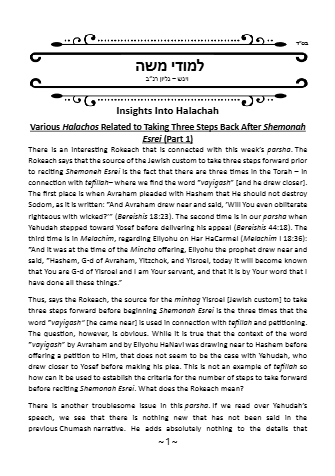
There is an interesting Rokeach that is connected with this week’s parsha. The Rokeach says that the source of the Jewish custom to take three steps forward prior to reciting Shemoneh Esrei is the fact that there are three times in the Torah – in connection with tefillah– where we find the word “vayigash” [and he drew closer]. The first place is when Avraham pleaded with Hashem that He should not destroy Sodom, as it is written: “And Avraham drew near and said, ‘Will You even obliterate righteous with wicked?’” (Bereishis 18:23). The second time is in our parsha when Yehudah stepped toward Yosef before delivering his appeal (Bereishis 44:18). The third time is in Melachim, regarding Eliyohu on Har HaCarmel (Melachim I 18:36): “And it was at the time of the Mincha offering, Eliyohu the prophet drew near and said, “Hashem, G-d of Avraham, Yitzchok, and Yisroel, today it will become known that You are G-d of Yisroel and I am Your servant, and that it is by Your word that I have done all these things.”

Thus, says the Rokeach, the source for the minhag Yisroel [Jewish custom] to take three steps forward before beginning Shemonah Esrei is the three times that the word “vayigash” [he came near] is used in connection with tefillah and petitioning. The question, however, is obvious. While it is true that the context of the word “vayigash” by Avraham and by Eliyohu HaNavi was drawing near to Hashem before offering a petition to Him, that does not seem to be the case with Yehudah, who drew closer to Yosef before making his plea. This is not an example of tefillah so how can it be used to establish the criteria for the number of steps to take forward before reciting Shemonah Esrei. What does the Rokeach mean?

There is another troublesome issue in this parsha. If we read over Yehudah’s speech, we see that there is nothing new that has not been said in the previous Chumash narrative. He adds absolutely nothing to the details that unfolded in Parshas Miketz. Yosef was aware of everything in Yehudah’s plea before he offered it and yet for some reason it is only now that Yosef breaks down crying and reveals himself to his brothers.

Perhaps it is possible to say that one question answers the other. Even though Yehudah may physically have been in the same room as Yosef and he may have been approaching Yosef and ostensibly petitioning him, however the Being that Yehudah is really petitioning is the Ribbono Shel Olam. What is on Yehudah’s mind is not the Egyptian Viceroy but the Ribbono Shel Olam. All else has failed. We are in the eleventh hour. Binyomin is held captive and the brothers are looking at the specter of having to return to their father without him. They know this will kill their father. Yehudah is desperate. He may be speaking to Yosef, approaching him and looking at him, but the petition is primarily to Him with a capital “H”.

Therefore, indeed the Rokeach is correct. “Vayigash elav Yehudah” is a petition to the Ribbono Shel Olam and can count as one of the three places where the word “vayigash” [he drew near] is used prior to tefillah. True, it is the same information that Yehudah already told Yosef. He is adding no new information in his communication with the Viceroy of Egypt, but now it is directed primarily to someone else – to the Ribbono Shel Olam.

We see from the above, that taking three steps forward before starting Shemonah Esrei is related to this week’s parsha, therefore, although it’s a slight stretch, I would like to take this week’s opportunity to discuss various halachos related to taking three steps back after Shemonah Esrei, pertaining to both the individual and the chazon. Believe it or not, although this is something we do three times a day, many people actually do this wrongly. Taking three steps back after Shemonah Esrei is very important, and if not done properly, it could be that it’s better not to daven. Therefore, I feel it is a very important topic to discuss, read on and be enlightened.

The Severity of the Obligation to Take Three Steps Back After Shemonah Esrei

The Gemara in Yoma (53b) teaches: “R’ Yehoshua ben Levi says: One who davens must take three steps back and extend sholam ... it also says in a beraisa that one who davens must take three steps back and extend sholam. If one doesn’t (Rashi explains, it looks like he hasn’t asked permission to leave) then it would be better not to daven.”

Why Do We Take Three Steps Back?

The Beis Yosef (123, d.h. kosav oid Rabbeinu HaGadol) brings five reasons for why we take three steps back after Shemonah Esrei. One reason he brings is the Shibolay HaLeket (18) who brings from the Geonim: “When one is standing and davening, he is standing in a holy place, and the Shechinah is above is head, therefore, when one finishes he must take three steps back to leave the holy place he is in, and to enter back into a mundane place. Proof for this is, that when one takes three steps back he has to extend sholam (i.e. he has to say goodbye, like a talmid does to his rebbe), so we see that until now he was in a holy place, and now he is going back to a mundane place.” (The Mishnah Berurah 97:3 writes that it’s forbidden to spit when saying tachanunim [supplications] after Shemonah Esrei, as until one takes three steps back, it is like he is still standing in front of the King. See also Mishnah Berurah 122:5.)

Rav Hai Gaon offers another reason for why we take three steps back. He writes: “Our tefillos were enacted in place of the korban tamid, and when the kohanim would go up on the mizbayach with the limbs of the tamid they would go up on the right side and would walk around and leave on the left side, and between the ramp and the top of the mizbayach there were three stratums of rock, and a Kohen descending from the mizbayach would traverse them by taking three steps backwards, therefore, we copy what they use to do.” (See Divrei Chamudos, Berachos 5:68 and Pri MeGodim, M.Z. 123:1, who ask what these three stratums of stone were, and see Mor U’Ketziah end of 123, and Toras Chaim s.k. 1, how they try to answer.)

The Darkei Moshe writes, that based on the above, when taking three steps back after Shemonah Esrei, one should have his big toe and heel aligned like the Kohanim. Especially, as it is more respectful to walk back after davening slowly, then it is to take big steps which shows that one is desperate to run off and that the tefillah was very difficult for him and he can’t wait to run away.

Left Foot First, And What to Do If One Is Left-Footed

The Shulchan Aruch (Orach Chaim 123:3) rules, that when taking three steps back after Shemonah Esrei, one should start with the left foot. The Mishnah Berurah (s.k. 13) quotes the Magen Avraham who explains as follows:

Generally speaking, when walking backwards one moves his right foot first, therefore, after Shemonah Esrei when we want to show that we are reluctant to depart from the Shechinah, we specifically start with the left foot.

The Biur Halachah then adds from the Magen Avraham, that according to this, if one is left-footed, then he should move his weak right foot first. Others learn however, that the reason we start with the left foot is to show honor to the Shechinah (it is to the right of the Shechinah). According to this reason, even a left-footed person should start with his left foot.

Small Steps

When taking three steps back after Shemonah Esrei, one should take small steps. The Shulchan Aruch (Orach Chaim 123:3) writes:ושיעור פסיעות אלו לכל הפחות הוא כדי שיתן גודל בצד עקב – “And the distance of these steps is minimally that one places the big toe [of one foot] next to the heel [of the other foot].”

The Rema adds, “That ideally one shouldn’t take wider steps than this”. This is based on Rav Hai Gaon that we mentioned above. The Mishnah Berurah (s.k. 16) explains: If one takes wide steps, it shows that he is desperate to run away from the King.

Three Steps Back, Not Six

The Biur Halachah (123:3) brings the opinion of Rabbeinu Mano’ach who learns that one really needs to take six steps back after Shemonah Esrei. He learns that one steps back with the left foot, then one should step back with the right foot and make it level with the left foot, and this is considered one step. One should then repeat this two more times. This totals a number of six steps. However, the Mishnah Berurah doesn’t bring this, as many Achronim disagree. This is also the ruling of the Igros Moshe (Orach Chaim 4:122:2)

What To Do If There Is No Space

The Mishnah Berurah (123:14) writes: That steps smaller than this are not considered steps at all and one shouldn’t be lenient even in pressing circumstances. However, he brings that there are those who are lenient if there is a great need. Either way, one must be careful when taking three steps back, not to walk into the four amos of someone who is still davening Shemonah Esrei behind him (as is clear from 102:5). The Aruch HaShulchan (sif 5) writes: If it is not possible to go backwards, then one may be lenient and step back sideways, and he concludes, “This is how I was accustomed, in places which were squashy going backwards.”

Putting Feet Together For “Oseh Shalom”

The Mishnah Berurah (123:6) writes: When saying “Oseh Shalom” one should stand with his feet together like in Shemonah Esrei, as one is bowing down to the Shechinah. When davening Shemonah Esrei the halachah is (95:1): “One must put his feet together, as if they are one, to appear like a malach which it says about them “their feet are straight”, i.e. their feet appear as one.” Therefore, the same is with “Oseh Shalom”.

How Long Does One Need to Keep His Feet Together For?

The Be’er Heitev (123:4) and the Shulchan Aruch HaRav (sif 5) rule like the Magen Avraham that one should stand with his feet together until he returns to his original place which is when the chazon reaches kedusha. However, the Sha’ar HaTziyun (s.k. 5) disagrees.

When Can One Return to His Place?

The Shulchan Aruch (123:2) writes:במקום שכלו הג' פסיעות יעמוד ולא יחזור למקומו עד שיגיע ש"ץ לקדושה – “In the place that the three steps [backwards] are concluded, one should stand and not return to one's place until the chazon reaches kedusha”. The Mishnah Berurah (s.k 7) explains: If one returns to his place immediately, then he looks like a talmid who takes leave from his rebbe who walks backwards and then immediately returns, which shows that he didn’t walk backwards to depart, and such a thing is repulsive.

However, the Shulchan Aruch writes: ולפחות עד שיתחיל הש"ץ להתפלל בקול רם – “If one waits at least until the beginning of chazoras hashatz then it’s ok.” The Mishnah Berurah (s.k. 10) in the name of the Bach and Divrei Chamudos explains, that ideally one should wait until kedusha, if, however, he is squashed etc. and he doesn’t want to get into a fight then there is room to be lenient and he can return to his place already at the beginning of chazoras hashatz. Similarly, on Yomim Noraim when there are lots of piyyutim recited before kedusha, there is room for leniency.

The Pri Megodim (M.Z. 123 s.k 5) rules like the Elyah Rabbah (s.k. 13) that even if one finished his Shemonah Esrei a long time before the tzibbur and he has waited a long time, he should still not return to his place before chazoras hashatz begins.

When Can a Chazon Return to His Place – When Can an Individual Return to His Place if He Davens at Home by Himself?

The Rema (123:2) writes: A chazon can return to his place in order to daven chazoras hashatz [the repetition] after he stands for the amount of time it takes to walk four amos. (It would seem, that if the chazon isn’t starting chazoras hashatz straight away, i.e. he needs to wait for nine people to finish davening, then he is no different to everyone else, and he shouldn’t return to his place until he starts chazoras hashatz.)

The Rema adds: An individual davening should also wait the amount of time it takes to walk four amos before returning to his place after reciting “Oseh Sholam”. However, the Mishnah Berurah (123, s.k. 11) brings from the Bach and Magen Avraham that even if one is davening at home by himself, he should still wait the amount of time it would take for the chazon to get to kedusha, or at least the amount of time it would take for the chazon to start chazoras hashatz. However, he concludes (see also 131, s.k. 10) that if there is a great need, one can be lenient and wait the amount of time it takes to walk four amos. Similarly, if one is going to daven a second Shemonah Esrei (tefillas tashlumin) and everyone knows he is stepping forwards to daven a second Shemonah Esrei, then there is no need to wait more than the amount of time it takes to walk four amos.

Is One Allowed to Return to His Place Straight Away If the Chazon Is Up To Kedusha?

The Mishnah Berurah (123, s.k. 9) quotes the Sha’arei Teshuvah who brings the Birkay Yosef who writes, that if one davens a long Shemonah Esrei and by the time he takes three steps back after Shemonah Esrei the chazon is already up to kedusha, he can return to his place straight away. The Birkay Yosef explains, that in such a case it is clear that he is returning to his place to answer kedusha in his place like everyone else in the tzibbur.

However, the Aruch HaShulchan (123:5) asks, that even if its clear why he is returning, one still can’t ignore a din of the Gemara, therefore, it is better to answer kedusha where he is, and not to return to his place. Or, at least he should wait the amount of time it takes to walk four amos, especially as one still has until “Kodosh, Kodosh, Kodosh” which is when kedusha really starts.

When To Return to One’s Place by Ma’ariv?

When it comes to davening Shemonah Esrei of Ma’ariv the poskim say (see Halichos Shlomah, 13:12, and Beis Boruch on the Chayei Adam, Klal 24, end of s.k. 125) that one should wait until the chazon starts kaddish, and some say to wait until after kaddish, so as to not take steps during kaddish. On Friday night, R’ Shlomah Zalman Auerbach ruled one can return to his place when the chazon starts “Vayechulu”. However, if the person himself started to recite “Vayechulu”, it’s best to wait until one finishes reciting “Vayechulu” before stepping forward.

Being Particular That No One Walks Infront of You Before Stepping Forward and Returning to Original Place, and What If Someone Did

The Mishnah Berurah (123, s.k. 8) brings from the Magen Avraham, that according to the Beis Yosef that one needs to take six steps, three backwards and three forwards, some people are particular to make sure that people don’t walk in front of them until they return to their original place, in order that people don’t interrupt their six steps. However, the Mishnah Beruah writes: Because of this hakpodah, they end up making a mistake, as when they see someone wants to walk past they quickly take three steps forward which is against the Gemara which says one should wait until the chazon starts chazoras hashatz. So, they are going against something which is meikar hadin [strictly required according to halachah], for something which isn’t.

There is still lots more to discuss and iy’H next week we will continue with this topic.

PDF Preview