A Potpourri of Some Important Megillas Esther Related Halachos Part 2
Limuday Moshe | March 22, 2024
Print This Article
View Original PDF

A Potpourri of Some Important Megillas Esther Related Halachos Part 2

Limuday Moshe | June 27, 2025

Aseres Bnei Haman

The Shulchan Aruch (690:15) writes: “One must say the ten sons of Haman and the word ‘aseres’, all in one breath, to show that they were all killed and hung at once.” The Kaf HaChaim (s.k. 97) cites the Ben Ish Chai who says that one must be careful to read the “ואת ואת”, which is mentioned by the Aseres Bnei Haman from the Megillah. Many people rush through the Aseres Bnei Haman in order to say them in one breath, and they end up saying many of the ואת’s off by heart. It’s important to be mindful of the above. One should also be careful, to read the correct “ואת”, and not the one from the line above, or from the line below.

Oops, I Missed a Word, Now What?

The Shulchan Aruch (690:3) rules: “One must read the entire Megillah, from a written scroll”. The Mishnah Berurah (s.k. 5) writes, this halachah is me’akev [detrimental], and according to many poskim if one missed out even one word, he doesn’t fulfill his obligation. The Biur Halachah (690:14, d.h. Ein) writes, that if one missed out even a single letter, he should read the Megillah again.

In regard to whether one should make a berachah when reading it again, the Biur Halachah writes that if one is repeating it because he missed out an entire word, then according to all poskim a berachah should be recited, even if the word that was missed out doesn’t change the meaning. However, the Chayei Adam is worried for the opinion of the Riaz and writes, that if one missed out a word which doesn’t change the meaning, he should repeat the Megillah, however, he should do it without a berachah.

The Shu”t L’Horos Nossan (9:20) says, the whole discussion is only if one was masiach da’as [took his mind off the mitzvah] after reading Megillah, if, however, one has not yet been masiach da’as, everyone agrees that it should be repeated without a berachah.

If one missed a word, and wants to make it up, it’s not enough to simply read that word, as during that time the ba’al koreh will also continue and he will be up to the next word, and one can’t be yoitsa two different words at the same time. What one should do is, he should read a bit ahead of the ba’al koreh, and then stop and wait for the ba’al koreh to catch up, and then continue listening.

If one is making up a missed word, he should be careful to read it in a way that he is able to hear with his ears what he is saying. The reason for this is, according to the Beis Yosef the mitzvah of Megillah is different to other mitzvos and if one can’t hear what he is saying, he doesn’t fulfil his obligation even on a bedieved level, as is clear from Mishnah Berurah (689:5) and Sha’ar Hatziyon (s.k. 7). With this he explains why a person who is able to speak but not able to hear isn’t able to read Megillah for others. By the mitzvah of Megillah which is all about pirsumay nisa [publicizing the miracle], Chazal were more stringent, and required that it be read in a way that one is able to hear it with his ears, therefore, one who is unable to hear can’t read for others.

Although, there are those that argue on the Beis Yosef and hold that bedieved it’s ok, the Mishnah Berurah says, lechatchilah one should worry for the opinion of the Beis Yosef.

Nonetheless, one should be careful not to read the Megillah too loud, as he may disturb the people around him. Additionally, the people nearby may listen in to him and will have da’as [intention] to be fulfil their obligation with his reading and not the reading of the ba’al koreh. And since he doesn’t have any kavonah to be moitzi them, even if one is reading from a kosher Megillah, it’s clear from the Sha’ar HaTziyon (690:11) that even bedieved it doesn’t help.

Oops, I’m Not Sure If I Missed a Word, Now What?

If one is in doubt as to whether he missed a word or not, if it is in the nighttime reading then we can apply the general rule of sofek derabonon lekulah [when it comes to a doubt in a rabbinic law, we rule leniently]. If, however, it’s in the daytime reading which is more stringent as it is a chiyuv m’divrei kabbolah, then it would seem that we can no longer apply the rule of sofek derabonon lekulah and one should read the Megillah again (Netei Gavriel, Purim, 44:14).

The Mishnah Berurah (end of 692) cites the Pri Megodim who says, if one has a sofek [doubt] if he read Megillah altogether, perhaps we don’t apply the rule of sofek derabonon lekulah and say he is exempt, as the mitzvah of Megillah is m’divrei kabbolah.

Seemingly, the Mishnah Berurah is difficult, as he should have differentiated between the nighttime Megillah, and the daytime Megillah. He should have said, by night which is derabonon, sofek derabonon lekulah, whereas in the day which is divrei kabbolah then one must be stringent, like the Mishnah Berurah himself does in Sha’ar HaTziyon (s.k. 27)?

Perhaps the answer is, the Mishnah Berurah is simply quoting the Pri Megodim, and the Pri Megodim (see beginning of s.k. 3) seems to hold that even the nighttime reading is m’divrei kabbolah. However, according to how we take on, that the nighttime reading is a chiyuv derabonon, in a case of doubt one can be lenient, like we mentioned from the Netei Gavriel.

The Tel Torah (Megillah 20a) writes, according to the Turei Even (Megillah 4a, d.h. Noshim) that the chiyuv for women to read Megillah is only a chiyuv derabonon and not m’divrei kabbolah, as the reason they are obligated is because of af hein hoyu b’oisi hanes [they were also part of the miracle], if a woman is in doubt if she read/heard Megillah, it’s a sofek in a matter which is derabonon and we can be lenient, even by the day time reading.

Reading the Four Pasukim Aloud by the Tzibbur

The Shulchan Aruch (690:3) rules: “One must read the entire Megillah from a written scroll, if one read it off by heart, he doesn’t fulfill his obligation, ideally, one should have the entire Megillah written out in front of him”. The Mishnah Berurah (s.k. 7) writes: That which we say that if one reads it off by heart, he doesn’t fulfill his obligation, is only if he reads the entire Megillah or the majority of it off that way, if, however, one only read parts of it off by heart, then he does fulfill his obligation.

According to this, a well-accepted minhag that Rema brings down seems very difficult. The Rema (690:17) brings down a minhag, that the four pasukim of geulah [redemption] in the Megillah should be read by the tzibbur [congregation] in a loud voice, and after the tzibbur has finished, the ba’al koreh should repeat the pasuk. The Mishnah Berurah (s.k. 58) explains, that the reason the tzibbur does this, is because of simcha, and the reason the ba’al koreh repeats it, is so that the tzibbur gets the mitzvah lechatchilah of hearing the entire Megillah being read from a written scroll.

According to what we mentioned above, once the tzibbur reads these pasukim from a Chumash (those who don’t have kosher Megillah), since these four pasukim are only a minority of the Megillah, they have already fulfilled their obligation bedieved. If so, that which the ba’al koreh repeats these pasukim seems pointless, as the tzibbur has already fulfilled their obligation?

If so, it comes out that by doing the minhag of the Rema, people only ever fulfill the mitzvah of Megillah on a bedieved level, how can such a thing be?

Considering the above, R’ Shlomah Zalman Auerbach (Halichos Shlomah Vol. 2, pg. 330) writes, that one must have implicit intention that he doesn’t want to fulfill his mitzvah of Megillah whilst reading these pasukim.

However, R’ Yom Tov Sanger (Maadanay Yom Tov) suggests an answer to the minhag ha’olam [widespread custom] which seems not to be worried about the above:

According to the Magen Avraham, one fulfills the mitzvah de’O’raisa of kiddush in shul during davening on Friday night, and the kiddush recited a second time at home is only derabonon. This creates problems, as a man who davened in shul now only has a derabonon chiyuv of kiddush, whereas his wife still has a chiyuv de’O’raisa, and one who is obligated in a mitzvah on a derabonon level can’t be moitzi someone who has a chiyuv on a de’O’raisa level. It also means that one who davens Maariv in shul and fulfills his chiyuv of kiddush in davening misses out on kiddush bemakom seudah [making kiddush together with a meal].

To answer the Magen Avraham, the Chasam Sofer (Shu”t, Orach Chaim 21) says, since any good Jew wants to fulfill the mitzvah of kiddush de’O’raisa in the most ideal fashion, and wants to do it bemakom seudah, we say that it’s like he had implicit intention not to fulfill the mitzvah of kiddush in davening,וכאילו לב חכמים מתנים ע"ז – “It’s like Chazal made a special stipulation that one doesn’t fulfill his obligation”. R’ Sanger suggests, that we can say the same thing by the mitzvah of Megillah. Certainly, people want to fulfill the mitzvah of Megillah in the optimum fashion. Consequently, even if they didn’t have implicit intention not to fulfill the mitzvah when reading the four pasukim out loud, we say that it’s like they did, וכאילו לב חכמים מתנים ע"ז – “it’s like Chazal made a special stipulation that one doesn’t fulfill his obligation”.

My dear friend, R’ Menachem Mosbacher shlita suggest another answer: Although the tzibbur may already be yoitza on a bedieved level, the ba’al koreh isn’t, and as long as there is one person who hasn’t yet been yoitza on a bedieved level it helps for the entire tzibbur. However, this would only help the first time the ba’al koreh reads the Megillah. If he would read it a second time for another minyan, then this answer wouldn’t help.

The minhag in Teiman is that first the ba’al koreh reads the pasuk, and only then the tzibbur. Perhaps the reason for this is because of the aforementioned difficulty.

The Prohibition of Eating Before Megillah, In Regard to Women

The Rema (692:4) writes: “It is forbidden to eat before hearing Megillah, even if one is finding the fast difficult.” It is obvious, that since women also have an obligation to hear Megillah, they also have a prohibition to eat before hearing the Megillah. The above is implicit in the Mishnah Berurah. The Mishnah Berurah (692, end of s.k. 14) writes, that one who is lenient to read the Megillah early (whilst it’s still day) for one who is ill, or pregnant has what to rely on.” We see, that a woman isn’t supposed to eat before hearing Megillah, and there is therefore room to be lenient to allow an early reading.

From the Mishnah Berurah (s.k. 15) it’s clear that the prohibition is in the day as well. The Sha’ar HaTziyon (s.k. 27) explains, that they day time reading is m’divrei kabbolah and is more stringent than the night reading which is a regular derabonon, so if by night one isn’t supposed to eat before Megillah, all the more so in the day (see above, however, where we mentioned the Turei Even who learns that for women, the day reading is also a regular chiyuv derabonon).

However, if a woman is weak, and waiting to eat could be dangerous for her health (common for pregnant or nursing women) and could make her ill, the Mishnah Berurah (s.k. 16) writes, if tasting a little bit won’t help, then it seems that she may eat. However, she should make sure to appoint a shomer [guardian] to remind her to read Megillah after she has eaten.

There are men who come home from shul after Megillah, and straight away want to sit down and eat a big meal, so they tell their wives to go hear Megillah later. It’s difficult to find a heter for such a thing, especially as the husband isn’t able to be a shomer as he is also partaking in the meal. Perhaps a solution in such a case would be for the woman to set an alarm to serve as a reminder, similar to what R’ Shlomah Zalman (Shevus Yitzchok, Vol 2, 23:3) says in regards to eating before davening, However, it’s not so simple that such a thing helps, as it could that when it comes to Megillah, the halachah is more stringent (as is clear from the Mishnah Berurah 692:14).

The Berachah Before Megillah for Women

The Shulchan Aruch (692:3) writes: “Even if one has already fulfilled his obligation, he can still make a berachah if he helps someone else fulfill his duty”. The Mishnah Berurah (s.k. 10) explains, although there are poskim who say that if one is fulfilling a mitzvah and he is able to make his own berachos he should, the minhag is to be lenient and let the ba’al koreh who is being moitzi them make the berachah.

Practically, the minhag is not like this, rather, it is like what the Minchas Yitzchok (3:53,54) discusses at great length, that if the ba’al koreh has already fulfilled his obligation, then everyone listening should make their own berachah. Especially, when one is reading for women, where there are opinions that there is no arvus from men to women.

Even if there are ten women, one woman shouldn’t make the berachah for all of them, as it’s ziloh behu milsa, a disgraceful thing that one women should be moitzi all the others (see Sha’ar HaTziyon 689:15), therefore, each woman should say the berachah of “lishmo’ah Megillah” (Rema 689:2, and Mishnah Berurah 692:11) or “lishmo’ah mikra Megillah” (Mishnah Berurah, 689:8) themselves.

However, there are those who argue, in the Luach Eretz Yisroel , R’ Tuchachinzky writes: “One women should make a berachah for all the women”. This was also the minhag in the house of R’ Shlomah Zalman Auerbach (Halichos Shlomah, Vol. 2, Perek 19, heorah 5).

R’ Shlomah Zalman proves that we aren’t worried for the Sha’ar HaTziyon (689:15) who cites the Korban Nesanel that if one woman is moitzi others it’s ziloh behu milsa [disgraceful thing]. As we find that one woman can make kiddush for other women (see Mishnah Berurah 271:4). Similarly, we find that one woman can lead the zimmun for other women (199:6).

However, it could be that when a woman makes a berachah in a loud voice in order to be moitzi other women in front of a ba’al koreh in part of a large tzibbur, that is exactly when it is considered ziloh behu milsa (as is clear from Tosfos in Succah 38a). However, in the case of R’ Shlomah Zalman, it was different, it was a reading being held at home, and the rebbetzen was making a berachah for those present, and it was either R’ Shlomah Zalman or some other family member reading the Megillah, and there is much less of a problem of ziloh behu milsa. Therefore, practically, if there is a big public reading for women, with a man being the ba’al koreh, it would seem that the best thing to do is go like the Minchas Yitzchok, and each woman should make her own berachah.

The Berachah of “Harav Es Riveinu” After the Megillah for Women

In regard to the berachah after Megillah (“harav es riveinu”), the Rema (692:1) writes: “A berachah afterwards should only be recited in a tzibbur”. Although there are poskim who maintain that this berachah can be recited even by an individual, the Biur Halachah says it’s not worthwhile following there opinion, as even b’tzibbur [with a congregation] there is no obligation to recite the berachah. Consequently, we apply the rule of sofek berachos l’hokel [when there is a doubt when it comes to berachos, we rule leniently].

The Aruch HaShulchan (692:5) explains, that the reason we only recite this berachah when there is a tzibbur, is because the berachah is not really related to the Megillah, rather, it is a berachah of hoda’ah [thanks] and of pirsumay nisa [publicizing the miracle], therefore, it is only said when there is a tzibbur.

Based on this reasoning, R’ Tzvi Pesach Frank (Mikra’ei Kodesh, Purim 35) writes, since there is pirsumay nisa by ten women, the berachah should be recited. Although the Rema (690:18) is in doubt as to whether ten women can join together for pirsumay nisa, that’s only when joining together with men. If, however, there are ten women, they certainly join together for pirsumay nisa.

However, the above is not so simple. The Tur (692) cites a dispute as to whether the berachah of “harav es riveinu” is a berachah on the Megillah, or if it is a berachah of thanks on the miracle of Purim. The Beis Yosef cites the Ran and Ba’al HaItur who learn that it’s a berachah of thanks, however, the Tur argues and maintains that it’s a berachah on the Megillah. The practical difference is if one may interrupt between the end of the reading of the Megillah and the recital of the berachah. According to the Tur one isn’t allowed, and according to the Ran and the Ba’al HaItur one may. Halachah lemaseh, the Mishnah Berurah (s.k. 9) rules like the Tur that it’s forbidden to interrupt between the end of the Megillah and the berachah. See also the Sha’ar HaTziyon (s.k .12) who is in doubt if bedieved one did talk, if the berachah can still be recited. It seems that we rule that the berachah is a berachah on the Megillah, and not a general berachah of thanks. Consequently, even if there are ten women, it only helps for pirsumay nisa, and not for something which requires a din of a tzibbur, therefore, it would seem that they can’t make the berachah. Practically, the general minhag seems to be that they don’t, and this is what R’ Elyashiv held.

Who Should Babysit, the Mother or the Older Boy?

The poskim discuss an interesting scenario: A family with two children, ages eleven and two. It is Purim night and time to go hear the Megillah. The two-year-old cannot be brought to shul since he will disturb the reading. Where someone will come later to read the Megillah for the one who cannot go to shul, who should remain home to watch the toddler – the mother or her eleven-year-old son?

Some poskim maintain that the eleven-year-old should go to shul while his mother remains home. In order to understand this, we must point out that there are actually two separate mitzvos at work here. There is the mitzvah of hearing the Megillah and there is an additional mitzvah of “b’rov om hadras melech” – that it is preferable to perform a mitzvah along with a large group, in this case, to hear the Megillah reading in shul.

With regards to our question, the mother has a greater obligation to hear the Megillah than her eleven-year-old child. This is because, as an adult, she has a mitzvah derabonon to hear the Megillah, while a child that has reached the age of chinuch does not. (Although technically speaking, such a child is obligated mi’d’rabonon to hear the Megillah because of chinuch, it is a lower-level obligation than an adult’s. An adult has a first-level responsibility to perform the mitzvah derabonon, while a child has a mitzvah derabonon to perform another mitzvah derabonon).

On the other hand, when it comes to the mitzvah of “b’rov om hadras melech,” the eleven-year-old boy has a greater obligation than his mother. The reason is, since he will be obligated to perform mitzvos “b’rov om” when he becomes an adult, he is also obligated now because of chinuch. However, a woman is exempt from the mitzvah of b’rov om hadras melech. This is because of the concept of “kol kevudah bas melech penimah,” that the most honorable place for a bas melech, a Jewish woman, is indoors, away from the public eye (Shu”t Chelkas Yaakov 3:144).

Others contend that the mother should go to shul and the eleven-year-old boy should baby-sit his younger sibling. The reason for this is that there are opinions amongst the poskim that lechatchilah [ideally], a woman should not read the Megillah herself, rather she should hear it from a man. (See Rema 689:2 and Magen Avraham 6 in the name of Medrash HaNe’elam.) Regarding a child, on the other hand, we quoted the Shulchan Aruch earlier as saying that a child should be trained to read it. Therefore, a woman has a greater chiyuv to hear the Megillah than a child. Since this is true, it is the woman who should go hear the Megillah reading in shul, while the eleven-year-old stays home (Shu”t Mishneh Halachos 4:82).
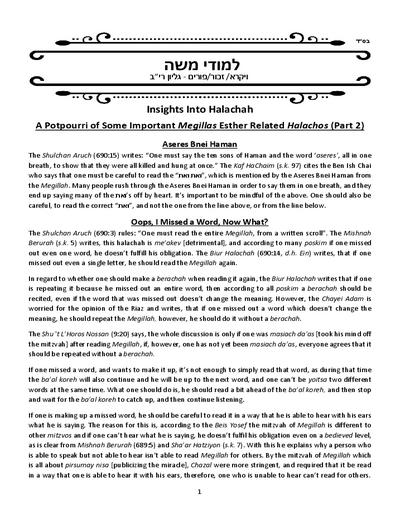

Aseres Bnei Haman

The Shulchan Aruch (690:15) writes: “One must say the ten sons of Haman and the word ‘aseres’, all in one breath, to show that they were all killed and hung at once.” The Kaf HaChaim (s.k. 97) cites the Ben Ish Chai who says that one must be careful to read the “ואת ואת”, which is mentioned by the Aseres Bnei Haman from the Megillah. Many people rush through the Aseres Bnei Haman in order to say them in one breath, and they end up saying many of the ואת’s off by heart. It’s important to be mindful of the above. One should also be careful, to read the correct “ואת”, and not the one from the line above, or from the line below.

Oops, I Missed a Word, Now What?

The Shulchan Aruch (690:3) rules: “One must read the entire Megillah, from a written scroll”. The Mishnah Berurah (s.k. 5) writes, this halachah is me’akev [detrimental], and according to many poskim if one missed out even one word, he doesn’t fulfill his obligation. The Biur Halachah (690:14, d.h. Ein) writes, that if one missed out even a single letter, he should read the Megillah again.

In regard to whether one should make a berachah when reading it again, the Biur Halachah writes that if one is repeating it because he missed out an entire word, then according to all poskim a berachah should be recited, even if the word that was missed out doesn’t change the meaning. However, the Chayei Adam is worried for the opinion of the Riaz and writes, that if one missed out a word which doesn’t change the meaning, he should repeat the Megillah, however, he should do it without a berachah.

The Shu”t L’Horos Nossan (9:20) says, the whole discussion is only if one was masiach da’as [took his mind off the mitzvah] after reading Megillah, if, however, one has not yet been masiach da’as, everyone agrees that it should be repeated without a berachah.

If one missed a word, and wants to make it up, it’s not enough to simply read that word, as during that time the ba’al koreh will also continue and he will be up to the next word, and one can’t be yoitsa two different words at the same time. What one should do is, he should read a bit ahead of the ba’al koreh, and then stop and wait for the ba’al koreh to catch up, and then continue listening.

If one is making up a missed word, he should be careful to read it in a way that he is able to hear with his ears what he is saying. The reason for this is, according to the Beis Yosef the mitzvah of Megillah is different to other mitzvos and if one can’t hear what he is saying, he doesn’t fulfil his obligation even on a bedieved level, as is clear from Mishnah Berurah (689:5) and Sha’ar Hatziyon (s.k. 7). With this he explains why a person who is able to speak but not able to hear isn’t able to read Megillah for others. By the mitzvah of Megillah which is all about pirsumay nisa [publicizing the miracle], Chazal were more stringent, and required that it be read in a way that one is able to hear it with his ears, therefore, one who is unable to hear can’t read for others.

Although, there are those that argue on the Beis Yosef and hold that bedieved it’s ok, the Mishnah Berurah says, lechatchilah one should worry for the opinion of the Beis Yosef.

Nonetheless, one should be careful not to read the Megillah too loud, as he may disturb the people around him. Additionally, the people nearby may listen in to him and will have da’as [intention] to be fulfil their obligation with his reading and not the reading of the ba’al koreh. And since he doesn’t have any kavonah to be moitzi them, even if one is reading from a kosher Megillah, it’s clear from the Sha’ar HaTziyon (690:11) that even bedieved it doesn’t help.

Oops, I’m Not Sure If I Missed a Word, Now What?

If one is in doubt as to whether he missed a word or not, if it is in the nighttime reading then we can apply the general rule of sofek derabonon lekulah [when it comes to a doubt in a rabbinic law, we rule leniently]. If, however, it’s in the daytime reading which is more stringent as it is a chiyuv m’divrei kabbolah, then it would seem that we can no longer apply the rule of sofek derabonon lekulah and one should read the Megillah again (Netei Gavriel, Purim, 44:14).

The Mishnah Berurah (end of 692) cites the Pri Megodim who says, if one has a sofek [doubt] if he read Megillah altogether, perhaps we don’t apply the rule of sofek derabonon lekulah and say he is exempt, as the mitzvah of Megillah is m’divrei kabbolah.

Seemingly, the Mishnah Berurah is difficult, as he should have differentiated between the nighttime Megillah, and the daytime Megillah. He should have said, by night which is derabonon, sofek derabonon lekulah, whereas in the day which is divrei kabbolah then one must be stringent, like the Mishnah Berurah himself does in Sha’ar HaTziyon (s.k. 27)?

Perhaps the answer is, the Mishnah Berurah is simply quoting the Pri Megodim, and the Pri Megodim (see beginning of s.k. 3) seems to hold that even the nighttime reading is m’divrei kabbolah. However, according to how we take on, that the nighttime reading is a chiyuv derabonon, in a case of doubt one can be lenient, like we mentioned from the Netei Gavriel.

The Tel Torah (Megillah 20a) writes, according to the Turei Even (Megillah 4a, d.h. Noshim) that the chiyuv for women to read Megillah is only a chiyuv derabonon and not m’divrei kabbolah, as the reason they are obligated is because of af hein hoyu b’oisi hanes [they were also part of the miracle], if a woman is in doubt if she read/heard Megillah, it’s a sofek in a matter which is derabonon and we can be lenient, even by the day time reading.

Reading the Four Pasukim Aloud by the Tzibbur

The Shulchan Aruch (690:3) rules: “One must read the entire Megillah from a written scroll, if one read it off by heart, he doesn’t fulfill his obligation, ideally, one should have the entire Megillah written out in front of him”. The Mishnah Berurah (s.k. 7) writes: That which we say that if one reads it off by heart, he doesn’t fulfill his obligation, is only if he reads the entire Megillah or the majority of it off that way, if, however, one only read parts of it off by heart, then he does fulfill his obligation.

According to this, a well-accepted minhag that Rema brings down seems very difficult. The Rema (690:17) brings down a minhag, that the four pasukim of geulah [redemption] in the Megillah should be read by the tzibbur [congregation] in a loud voice, and after the tzibbur has finished, the ba’al koreh should repeat the pasuk. The Mishnah Berurah (s.k. 58) explains, that the reason the tzibbur does this, is because of simcha, and the reason the ba’al koreh repeats it, is so that the tzibbur gets the mitzvah lechatchilah of hearing the entire Megillah being read from a written scroll.

According to what we mentioned above, once the tzibbur reads these pasukim from a Chumash (those who don’t have kosher Megillah), since these four pasukim are only a minority of the Megillah, they have already fulfilled their obligation bedieved. If so, that which the ba’al koreh repeats these pasukim seems pointless, as the tzibbur has already fulfilled their obligation?

If so, it comes out that by doing the minhag of the Rema, people only ever fulfill the mitzvah of Megillah on a bedieved level, how can such a thing be?

Considering the above, R’ Shlomah Zalman Auerbach (Halichos Shlomah Vol. 2, pg. 330) writes, that one must have implicit intention that he doesn’t want to fulfill his mitzvah of Megillah whilst reading these pasukim.

However, R’ Yom Tov Sanger (Maadanay Yom Tov) suggests an answer to the minhag ha’olam [widespread custom] which seems not to be worried about the above:

According to the Magen Avraham, one fulfills the mitzvah de’O’raisa of kiddush in shul during davening on Friday night, and the kiddush recited a second time at home is only derabonon. This creates problems, as a man who davened in shul now only has a derabonon chiyuv of kiddush, whereas his wife still has a chiyuv de’O’raisa, and one who is obligated in a mitzvah on a derabonon level can’t be moitzi someone who has a chiyuv on a de’O’raisa level. It also means that one who davens Maariv in shul and fulfills his chiyuv of kiddush in davening misses out on kiddush bemakom seudah [making kiddush together with a meal].

To answer the Magen Avraham, the Chasam Sofer (Shu”t, Orach Chaim 21) says, since any good Jew wants to fulfill the mitzvah of kiddush de’O’raisa in the most ideal fashion, and wants to do it bemakom seudah, we say that it’s like he had implicit intention not to fulfill the mitzvah of kiddush in davening,וכאילו לב חכמים מתנים ע"ז – “It’s like Chazal made a special stipulation that one doesn’t fulfill his obligation”. R’ Sanger suggests, that we can say the same thing by the mitzvah of Megillah. Certainly, people want to fulfill the mitzvah of Megillah in the optimum fashion. Consequently, even if they didn’t have implicit intention not to fulfill the mitzvah when reading the four pasukim out loud, we say that it’s like they did, וכאילו לב חכמים מתנים ע"ז – “it’s like Chazal made a special stipulation that one doesn’t fulfill his obligation”.

My dear friend, R’ Menachem Mosbacher shlita suggest another answer: Although the tzibbur may already be yoitza on a bedieved level, the ba’al koreh isn’t, and as long as there is one person who hasn’t yet been yoitza on a bedieved level it helps for the entire tzibbur. However, this would only help the first time the ba’al koreh reads the Megillah. If he would read it a second time for another minyan, then this answer wouldn’t help.

The minhag in Teiman is that first the ba’al koreh reads the pasuk, and only then the tzibbur. Perhaps the reason for this is because of the aforementioned difficulty.

The Prohibition of Eating Before Megillah, In Regard to Women

The Rema (692:4) writes: “It is forbidden to eat before hearing Megillah, even if one is finding the fast difficult.” It is obvious, that since women also have an obligation to hear Megillah, they also have a prohibition to eat before hearing the Megillah. The above is implicit in the Mishnah Berurah. The Mishnah Berurah (692, end of s.k. 14) writes, that one who is lenient to read the Megillah early (whilst it’s still day) for one who is ill, or pregnant has what to rely on.” We see, that a woman isn’t supposed to eat before hearing Megillah, and there is therefore room to be lenient to allow an early reading.

From the Mishnah Berurah (s.k. 15) it’s clear that the prohibition is in the day as well. The Sha’ar HaTziyon (s.k. 27) explains, that they day time reading is m’divrei kabbolah and is more stringent than the night reading which is a regular derabonon, so if by night one isn’t supposed to eat before Megillah, all the more so in the day (see above, however, where we mentioned the Turei Even who learns that for women, the day reading is also a regular chiyuv derabonon).

However, if a woman is weak, and waiting to eat could be dangerous for her health (common for pregnant or nursing women) and could make her ill, the Mishnah Berurah (s.k. 16) writes, if tasting a little bit won’t help, then it seems that she may eat. However, she should make sure to appoint a shomer [guardian] to remind her to read Megillah after she has eaten.

There are men who come home from shul after Megillah, and straight away want to sit down and eat a big meal, so they tell their wives to go hear Megillah later. It’s difficult to find a heter for such a thing, especially as the husband isn’t able to be a shomer as he is also partaking in the meal. Perhaps a solution in such a case would be for the woman to set an alarm to serve as a reminder, similar to what R’ Shlomah Zalman (Shevus Yitzchok, Vol 2, 23:3) says in regards to eating before davening, However, it’s not so simple that such a thing helps, as it could that when it comes to Megillah, the halachah is more stringent (as is clear from the Mishnah Berurah 692:14).

The Berachah Before Megillah for Women

The Shulchan Aruch (692:3) writes: “Even if one has already fulfilled his obligation, he can still make a berachah if he helps someone else fulfill his duty”. The Mishnah Berurah (s.k. 10) explains, although there are poskim who say that if one is fulfilling a mitzvah and he is able to make his own berachos he should, the minhag is to be lenient and let the ba’al koreh who is being moitzi them make the berachah.

Practically, the minhag is not like this, rather, it is like what the Minchas Yitzchok (3:53,54) discusses at great length, that if the ba’al koreh has already fulfilled his obligation, then everyone listening should make their own berachah. Especially, when one is reading for women, where there are opinions that there is no arvus from men to women.

Even if there are ten women, one woman shouldn’t make the berachah for all of them, as it’s ziloh behu milsa, a disgraceful thing that one women should be moitzi all the others (see Sha’ar HaTziyon 689:15), therefore, each woman should say the berachah of “lishmo’ah Megillah” (Rema 689:2, and Mishnah Berurah 692:11) or “lishmo’ah mikra Megillah” (Mishnah Berurah, 689:8) themselves.

However, there are those who argue, in the Luach Eretz Yisroel , R’ Tuchachinzky writes: “One women should make a berachah for all the women”. This was also the minhag in the house of R’ Shlomah Zalman Auerbach (Halichos Shlomah, Vol. 2, Perek 19, heorah 5).

R’ Shlomah Zalman proves that we aren’t worried for the Sha’ar HaTziyon (689:15) who cites the Korban Nesanel that if one woman is moitzi others it’s ziloh behu milsa [disgraceful thing]. As we find that one woman can make kiddush for other women (see Mishnah Berurah 271:4). Similarly, we find that one woman can lead the zimmun for other women (199:6).

However, it could be that when a woman makes a berachah in a loud voice in order to be moitzi other women in front of a ba’al koreh in part of a large tzibbur, that is exactly when it is considered ziloh behu milsa (as is clear from Tosfos in Succah 38a). However, in the case of R’ Shlomah Zalman, it was different, it was a reading being held at home, and the rebbetzen was making a berachah for those present, and it was either R’ Shlomah Zalman or some other family member reading the Megillah, and there is much less of a problem of ziloh behu milsa. Therefore, practically, if there is a big public reading for women, with a man being the ba’al koreh, it would seem that the best thing to do is go like the Minchas Yitzchok, and each woman should make her own berachah.

The Berachah of “Harav Es Riveinu” After the Megillah for Women

In regard to the berachah after Megillah (“harav es riveinu”), the Rema (692:1) writes: “A berachah afterwards should only be recited in a tzibbur”. Although there are poskim who maintain that this berachah can be recited even by an individual, the Biur Halachah says it’s not worthwhile following there opinion, as even b’tzibbur [with a congregation] there is no obligation to recite the berachah. Consequently, we apply the rule of sofek berachos l’hokel [when there is a doubt when it comes to berachos, we rule leniently].

The Aruch HaShulchan (692:5) explains, that the reason we only recite this berachah when there is a tzibbur, is because the berachah is not really related to the Megillah, rather, it is a berachah of hoda’ah [thanks] and of pirsumay nisa [publicizing the miracle], therefore, it is only said when there is a tzibbur.

Based on this reasoning, R’ Tzvi Pesach Frank (Mikra’ei Kodesh, Purim 35) writes, since there is pirsumay nisa by ten women, the berachah should be recited. Although the Rema (690:18) is in doubt as to whether ten women can join together for pirsumay nisa, that’s only when joining together with men. If, however, there are ten women, they certainly join together for pirsumay nisa.

However, the above is not so simple. The Tur (692) cites a dispute as to whether the berachah of “harav es riveinu” is a berachah on the Megillah, or if it is a berachah of thanks on the miracle of Purim. The Beis Yosef cites the Ran and Ba’al HaItur who learn that it’s a berachah of thanks, however, the Tur argues and maintains that it’s a berachah on the Megillah. The practical difference is if one may interrupt between the end of the reading of the Megillah and the recital of the berachah. According to the Tur one isn’t allowed, and according to the Ran and the Ba’al HaItur one may. Halachah lemaseh, the Mishnah Berurah (s.k. 9) rules like the Tur that it’s forbidden to interrupt between the end of the Megillah and the berachah. See also the Sha’ar HaTziyon (s.k .12) who is in doubt if bedieved one did talk, if the berachah can still be recited. It seems that we rule that the berachah is a berachah on the Megillah, and not a general berachah of thanks. Consequently, even if there are ten women, it only helps for pirsumay nisa, and not for something which requires a din of a tzibbur, therefore, it would seem that they can’t make the berachah. Practically, the general minhag seems to be that they don’t, and this is what R’ Elyashiv held.

Who Should Babysit, the Mother or the Older Boy?

The poskim discuss an interesting scenario: A family with two children, ages eleven and two. It is Purim night and time to go hear the Megillah. The two-year-old cannot be brought to shul since he will disturb the reading. Where someone will come later to read the Megillah for the one who cannot go to shul, who should remain home to watch the toddler – the mother or her eleven-year-old son?

Some poskim maintain that the eleven-year-old should go to shul while his mother remains home. In order to understand this, we must point out that there are actually two separate mitzvos at work here. There is the mitzvah of hearing the Megillah and there is an additional mitzvah of “b’rov om hadras melech” – that it is preferable to perform a mitzvah along with a large group, in this case, to hear the Megillah reading in shul.

With regards to our question, the mother has a greater obligation to hear the Megillah than her eleven-year-old child. This is because, as an adult, she has a mitzvah derabonon to hear the Megillah, while a child that has reached the age of chinuch does not. (Although technically speaking, such a child is obligated mi’d’rabonon to hear the Megillah because of chinuch, it is a lower-level obligation than an adult’s. An adult has a first-level responsibility to perform the mitzvah derabonon, while a child has a mitzvah derabonon to perform another mitzvah derabonon).

On the other hand, when it comes to the mitzvah of “b’rov om hadras melech,” the eleven-year-old boy has a greater obligation than his mother. The reason is, since he will be obligated to perform mitzvos “b’rov om” when he becomes an adult, he is also obligated now because of chinuch. However, a woman is exempt from the mitzvah of b’rov om hadras melech. This is because of the concept of “kol kevudah bas melech penimah,” that the most honorable place for a bas melech, a Jewish woman, is indoors, away from the public eye (Shu”t Chelkas Yaakov 3:144).

Others contend that the mother should go to shul and the eleven-year-old boy should baby-sit his younger sibling. The reason for this is that there are opinions amongst the poskim that lechatchilah [ideally], a woman should not read the Megillah herself, rather she should hear it from a man. (See Rema 689:2 and Magen Avraham 6 in the name of Medrash HaNe’elam.) Regarding a child, on the other hand, we quoted the Shulchan Aruch earlier as saying that a child should be trained to read it. Therefore, a woman has a greater chiyuv to hear the Megillah than a child. Since this is true, it is the woman who should go hear the Megillah reading in shul, while the eleven-year-old stays home (Shu”t Mishneh Halachos 4:82).

PDF Preview