Chasidic Insights on Vayikra
Torah Papers | March 30, 2025
Print This Article
View Original PDF

Chasidic Insights on Vayikra

Torah Papers | June 27, 2025

Chasidic Insights

1. He called to Moses: The alef of the word for “He called” (ויקרא), the first word in the Book of Leviticus, is written smaller than usual, alluding to Moses’ humility even in the face of his own greatness and his selection by God for his exalted role in human history.

In contrast, the alef in Adam’s name (אדם) as the first word of the Book of Chronicles is written larger than usual, alluding to Adam’s self-esteem as the acme of God’s creation. Although it is both necessary and good to be aware of one’s positive qualities, Adam allowed his self-esteem to degenerate into conceit, and this caused his downfall.

Moses rectified Adam’s mistake. He recognized his greatness but nevertheless remained humble. His humility was not self-delusional but the result of simple reasoning. “I cannot take any credit for any of my gifts or accomplishments,” he thought, “since they are all God-given. Indeed, were another person to have been given my potentials, he would have accomplished more and climbed to greater heights than I have.” He understood that true humility does not mean denigrating oneself but seeing the virtue in others.

We are all spiritual heirs of Adam and Moses. When we feel inadequate we must remember that we are Adam, with a big alef. When thoughts of “Who am I?” deter us from our task, we must recall that we are Adam, formed by God’s own hands, and fully capable of caring for His garden. At the same time, we must recall that we Moses, and thereby ensure that our self-assurance does not develop into conceit.

Moreover, if we remember the small alef, we, too, will merit to be called by God, and this revelation will provide us with the strength to answer God’s call, drawing ourselves and the world at large closer to Him. This is the true essence of the sacrifices, whose laws are introduced by the lesson of the small alef.

Sacrifices

The institution of sacrifice seems counterintuitive to the teachings of the Torah on several counts, not the least of which is that it involves the seemingly unnecessary taking of animal life. Even from a cold, technical point of view, why would the laws of sacrifice be so central?

With regard to sacrifices, however, no such “ulterior” motivation is possible. As we pointed out, they not only defy any attempt at rationalization but openly violate it; they not only do not make sense but are blatantly counterintuitive. Therefore, no self-interest can be involved here; in fact, the offerer is not at all the focus. Rather, the focus is God—“I said [something] and My will was implemented,” virtually by itself, without any human involvement. The offerer is all but transparent.

Clearly, this is a much more sublime state of self-nullification than that required to fulfill other commandments, even other chukim. It is in this otherwise unattainable absorption of the human self into the Divine self that constitutes the unique virtue of the sacrifices.

The laws regarding voluntary offerings will be given first: One would think that the Torah would begin with the obligatory offerings, yet those are left for later. By beginning with voluntary offerings, the Torah implies that all offerings, even the obligatory ones, should be voluntary in essence. A voluntary offering is brought by a person cognizant of the spiritual significance of the offering. He knows that the offering must express an inner process occurring within the person, not the animal; what matters is not the size or impressiveness of the animal but the intention of the heart.

The importance of the involvement of the offerer’s mind and heart is expressed by the Hebrew word for “sacrifice” (korban), which is derived from the verb “to bring close.” The experience of the offering consists of bringing and offering oneself, devoting one’s heart, talents, and capabilities to God.

On a deeper level, a sacrifice is an experience of the mind and heart even when the offerer is not aware of it. This is because our inner essence—our Divine soul—is always intrinsically aware of the true meaning of the state of our relationship with God and in what ways it needs to be enhanced or improved (this being the purpose of the sacrifices). Therefore the Torah does not state explicitly that the physical offering up of the animal must be accompanied by the spiritual, inner offering up of the self; it is assumed.
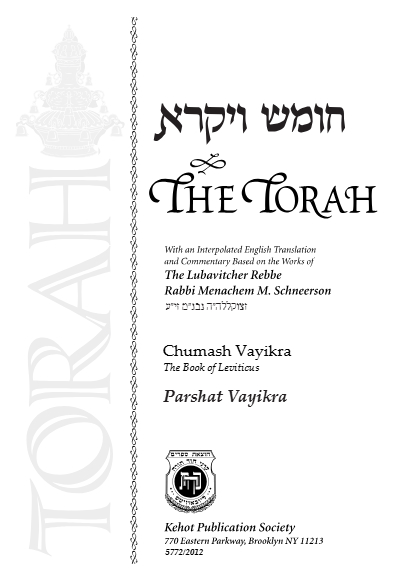
Chasidic Insights

1. He called to Moses: The alef of the word for “He called” (ויקרא), the first word in the Book of Leviticus, is written smaller than usual, alluding to Moses’ humility even in the face of his own greatness and his selection by God for his exalted role in human history.

In contrast, the alef in Adam’s name (אדם) as the first word of the Book of Chronicles is written larger than usual, alluding to Adam’s self-esteem as the acme of God’s creation. Although it is both necessary and good to be aware of one’s positive qualities, Adam allowed his self-esteem to degenerate into conceit, and this caused his downfall.

Moses rectified Adam’s mistake. He recognized his greatness but nevertheless remained humble. His humility was not self-delusional but the result of simple reasoning. “I cannot take any credit for any of my gifts or accomplishments,” he thought, “since they are all God-given. Indeed, were another person to have been given my potentials, he would have accomplished more and climbed to greater heights than I have.” He understood that true humility does not mean denigrating oneself but seeing the virtue in others.

We are all spiritual heirs of Adam and Moses. When we feel inadequate we must remember that we are Adam, with a big alef. When thoughts of “Who am I?” deter us from our task, we must recall that we are Adam, formed by God’s own hands, and fully capable of caring for His garden. At the same time, we must recall that we Moses, and thereby ensure that our self-assurance does not develop into conceit.

Moreover, if we remember the small alef, we, too, will merit to be called by God, and this revelation will provide us with the strength to answer God’s call, drawing ourselves and the world at large closer to Him. This is the true essence of the sacrifices, whose laws are introduced by the lesson of the small alef.

Sacrifices

The institution of sacrifice seems counterintuitive to the teachings of the Torah on several counts, not the least of which is that it involves the seemingly unnecessary taking of animal life. Even from a cold, technical point of view, why would the laws of sacrifice be so central?

With regard to sacrifices, however, no such “ulterior” motivation is possible. As we pointed out, they not only defy any attempt at rationalization but openly violate it; they not only do not make sense but are blatantly counterintuitive. Therefore, no self-interest can be involved here; in fact, the offerer is not at all the focus. Rather, the focus is God—“I said [something] and My will was implemented,” virtually by itself, without any human involvement. The offerer is all but transparent.

Clearly, this is a much more sublime state of self-nullification than that required to fulfill other commandments, even other chukim. It is in this otherwise unattainable absorption of the human self into the Divine self that constitutes the unique virtue of the sacrifices.

The laws regarding voluntary offerings will be given first: One would think that the Torah would begin with the obligatory offerings, yet those are left for later. By beginning with voluntary offerings, the Torah implies that all offerings, even the obligatory ones, should be voluntary in essence. A voluntary offering is brought by a person cognizant of the spiritual significance of the offering. He knows that the offering must express an inner process occurring within the person, not the animal; what matters is not the size or impressiveness of the animal but the intention of the heart.

The importance of the involvement of the offerer’s mind and heart is expressed by the Hebrew word for “sacrifice” (korban), which is derived from the verb “to bring close.” The experience of the offering consists of bringing and offering oneself, devoting one’s heart, talents, and capabilities to God.

On a deeper level, a sacrifice is an experience of the mind and heart even when the offerer is not aware of it. This is because our inner essence—our Divine soul—is always intrinsically aware of the true meaning of the state of our relationship with God and in what ways it needs to be enhanced or improved (this being the purpose of the sacrifices). Therefore the Torah does not state explicitly that the physical offering up of the animal must be accompanied by the spiritual, inner offering up of the self; it is assumed.

PDF Preview