Fifth Reading Inner Process of Sin and Rectification
Wonders | March 22, 2024
Print This Article
View Original PDF

Fifth Reading Inner Process of Sin and Rectification

Wonders | June 27, 2025

The Torah’s treatment of the sin offering consists of a general principle and four specific cases. Firstly, there is a general heading: “If a person sins unintentionally by violating any of God’s commands that should not be broken, and then violates any one of them.” Following the opening statement, the Torah lists four specific sinners:

1. “If it is an anointed priest who sins, thus bringing guilt on the people.” This refers to a High Priest who has sinned and is required to bring a bull for a sin offering (when he errs in a ruling and performs an action according to his own judgment).

2. “Or if the whole Israelite community sins unintentionally.” This refers to a Sanhedrin (the highest court) that erred in a ruling and the majority of the congregation acted according to their incorrect ruling, then it is the Sanhedrin that must bring a bull for a sin offering. This bull is known as the “bull of an unwitting communal sin.”

3. “When a Nasi [a king] sins unintentionally.” When the king sins, he is required to bring a male goat for a sin offering.

4. “If any member of the community sins unintentionally,” referring to an individual’s unwitting sin, for which he must bring a female goat or a lamb.

FOUR lEvElS iN THE SOUl

Our teacher, the Ba’al Shem Tov, taught that everything in the Torah relates to every individual, in every place, and in every time period. Accordingly, we must interpret the inner meaning of the paragraphs describing the sin offering for us. Each person has within their soul a general principle that corresponds to the initial general introduction to this topic, and sparks of the High Priest, of the Sanhedrin, and of the king; and in addition, he is also an individual Jew alluded to in the simple meaning of the verses under the general title “If a person sins,” hence all four categories are to be found within the soul of each person.

We can understand the universality of the four categories of people that permeate every one of our souls by looking at them as a psychological process that accompanies every unintentional sin. This psychological process begins from the general point that dwells in me, continues with the High Priest within me, the Sanhedrin within me, the king within me, and finally down to the simple person. These four, or five levels correspond to the Name of God, Havayah (which has 4 letters) together with the tip of the yud:

The source and root are found in the essence of the soul and corresponds to the words, “If a person sins.” At this level, the relationship between the individual and God needs to be one of absolute nullification, and the transgression begins with a slight imperfection. This level corresponds to the tip of the yud in God’s essential Name, Havayah, and to the sefirah of crown.

The priests in general are the teachers of the Torah, and the High Priest is the chief instructor whose role is to teach the Torah with Divine inspiration. Another role of the High Priest is to be in the Temple, to pray for all of Israel, and to bless them. In the psyche, the beginning of sin is within the High Priest within me. I am not sufficiently connected to the whole, I do not pray enough for everyone, I do not bless them as I should. This level corresponds to the letter yud in God’s Name, Havayah, representing the sefirah of wisdom. The inner experience of wisdom is self-nullification. The power of self-nullification provides proper inspiration that leads to proper instruction, and from it stems the caring connection to all, and the ability to evoke abundant mercy and blessing.

The next level of error is within the Sanhedrin. In the psyche, the Sanhedrin is the judicial system, determining for myself and others the difference between right and wrong. This level corresponds to the first hei in God’s Name Havayah, representing the sefirah of understanding. After the blemish in self-nullification in the intellectual power of wisdom, there is to be found a lack of proper judgment on the left side, the intellectual power of understanding (the analytical mind). These two levels, the anointed High Priest and the entire congregation of Israel, referring to the Sanhedrin, as in the verse above, correspond to the letters yud and hei, and thus reflect the “hidden things” that are the domain of God, i.e., Havayah. The value of these two phrases together is the product of “grace” and Havayah.

The next level is the king. Everyone has a leadership role in relation to others, and that is his sovereignty in life. The role of leadership is to determine what and who to bring close and what to keep away, and if one errs in this regard, it is a reason for sin. This level corresponds to the letter vav in the God’s Name Havayah, representing Ze’ir Anpin—the small countenance, which is often referred to as malka, meaning, “king.” Regarding the king’s leadership, it is said, “One person he raises, another he takes down,” referring to the practical leadership that “pushes away with the left and draws near with the right.” The primary role of the king is to go out to war, and for this, a lot of careful consideration is needed, especially in instances when the king conducts a voluntary war meant to expand the borders of the kingdom, or for the honor of the king himself. A mistake in judgment affects all of Israel!

In the soul, wars are battles against the evil inclination (and all methods of battling the evil inclination and rectifying the soul belong to the intellect of Ze’ir Anpin). Regarding the king, it is written, “When a leader sins”— the first letters of which spell “I”. The main error that causes a king to sin is that his ego takes over. The rectification is to be found in the trait of lowliness. So too in rectifying the soul, various methods lead to missing the mark and sin by either fostering the ego in the worst case, or in a less severe case, by ignoring the attribute of lowliness and making various ‘compromises’ that miss the mark.

The last level returns to the individual himself, ”one soul... from among the people.” Up to this point, there are three levels of responsibility towards others: 1) to be a High Priest, to teach Torah, to be involved with everyone and pray for everyone; 2) to be a judge, to judge correctly; and 3) to be a king, practical leadership. If there is sin, misguided actions, and error at these levels, it ultimately manifests in my personal sin. This level corresponds to the final letter hei in Havayah, representing the sefirah of “kingdom,” referred to as “I.” The principle is reiterated, “But if one person sins,” and it is reflected in the individual soul. To rectify this state, a person must feel lowliness towards others (humility is the internal aspect of kingdom). Towards God, the work of nullifying being is essential.
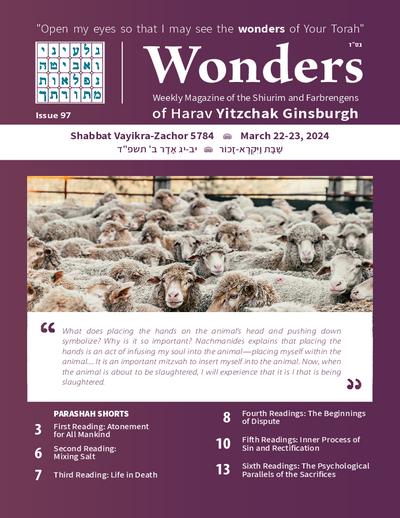
The Torah’s treatment of the sin offering consists of a general principle and four specific cases. Firstly, there is a general heading: “If a person sins unintentionally by violating any of God’s commands that should not be broken, and then violates any one of them.” Following the opening statement, the Torah lists four specific sinners:

1. “If it is an anointed priest who sins, thus bringing guilt on the people.” This refers to a High Priest who has sinned and is required to bring a bull for a sin offering (when he errs in a ruling and performs an action according to his own judgment).

2. “Or if the whole Israelite community sins unintentionally.” This refers to a Sanhedrin (the highest court) that erred in a ruling and the majority of the congregation acted according to their incorrect ruling, then it is the Sanhedrin that must bring a bull for a sin offering. This bull is known as the “bull of an unwitting communal sin.”

3. “When a Nasi [a king] sins unintentionally.” When the king sins, he is required to bring a male goat for a sin offering.

4. “If any member of the community sins unintentionally,” referring to an individual’s unwitting sin, for which he must bring a female goat or a lamb.

FOUR lEvElS iN THE SOUl

Our teacher, the Ba’al Shem Tov, taught that everything in the Torah relates to every individual, in every place, and in every time period. Accordingly, we must interpret the inner meaning of the paragraphs describing the sin offering for us. Each person has within their soul a general principle that corresponds to the initial general introduction to this topic, and sparks of the High Priest, of the Sanhedrin, and of the king; and in addition, he is also an individual Jew alluded to in the simple meaning of the verses under the general title “If a person sins,” hence all four categories are to be found within the soul of each person.

We can understand the universality of the four categories of people that permeate every one of our souls by looking at them as a psychological process that accompanies every unintentional sin. This psychological process begins from the general point that dwells in me, continues with the High Priest within me, the Sanhedrin within me, the king within me, and finally down to the simple person. These four, or five levels correspond to the Name of God, Havayah (which has 4 letters) together with the tip of the yud:

The source and root are found in the essence of the soul and corresponds to the words, “If a person sins.” At this level, the relationship between the individual and God needs to be one of absolute nullification, and the transgression begins with a slight imperfection. This level corresponds to the tip of the yud in God’s essential Name, Havayah, and to the sefirah of crown.

The priests in general are the teachers of the Torah, and the High Priest is the chief instructor whose role is to teach the Torah with Divine inspiration. Another role of the High Priest is to be in the Temple, to pray for all of Israel, and to bless them. In the psyche, the beginning of sin is within the High Priest within me. I am not sufficiently connected to the whole, I do not pray enough for everyone, I do not bless them as I should. This level corresponds to the letter yud in God’s Name, Havayah, representing the sefirah of wisdom. The inner experience of wisdom is self-nullification. The power of self-nullification provides proper inspiration that leads to proper instruction, and from it stems the caring connection to all, and the ability to evoke abundant mercy and blessing.

The next level of error is within the Sanhedrin. In the psyche, the Sanhedrin is the judicial system, determining for myself and others the difference between right and wrong. This level corresponds to the first hei in God’s Name Havayah, representing the sefirah of understanding. After the blemish in self-nullification in the intellectual power of wisdom, there is to be found a lack of proper judgment on the left side, the intellectual power of understanding (the analytical mind). These two levels, the anointed High Priest and the entire congregation of Israel, referring to the Sanhedrin, as in the verse above, correspond to the letters yud and hei, and thus reflect the “hidden things” that are the domain of God, i.e., Havayah. The value of these two phrases together is the product of “grace” and Havayah.

The next level is the king. Everyone has a leadership role in relation to others, and that is his sovereignty in life. The role of leadership is to determine what and who to bring close and what to keep away, and if one errs in this regard, it is a reason for sin. This level corresponds to the letter vav in the God’s Name Havayah, representing Ze’ir Anpin—the small countenance, which is often referred to as malka, meaning, “king.” Regarding the king’s leadership, it is said, “One person he raises, another he takes down,” referring to the practical leadership that “pushes away with the left and draws near with the right.” The primary role of the king is to go out to war, and for this, a lot of careful consideration is needed, especially in instances when the king conducts a voluntary war meant to expand the borders of the kingdom, or for the honor of the king himself. A mistake in judgment affects all of Israel!

In the soul, wars are battles against the evil inclination (and all methods of battling the evil inclination and rectifying the soul belong to the intellect of Ze’ir Anpin). Regarding the king, it is written, “When a leader sins”— the first letters of which spell “I”. The main error that causes a king to sin is that his ego takes over. The rectification is to be found in the trait of lowliness. So too in rectifying the soul, various methods lead to missing the mark and sin by either fostering the ego in the worst case, or in a less severe case, by ignoring the attribute of lowliness and making various ‘compromises’ that miss the mark.

The last level returns to the individual himself, ”one soul... from among the people.” Up to this point, there are three levels of responsibility towards others: 1) to be a High Priest, to teach Torah, to be involved with everyone and pray for everyone; 2) to be a judge, to judge correctly; and 3) to be a king, practical leadership. If there is sin, misguided actions, and error at these levels, it ultimately manifests in my personal sin. This level corresponds to the final letter hei in Havayah, representing the sefirah of “kingdom,” referred to as “I.” The principle is reiterated, “But if one person sins,” and it is reflected in the individual soul. To rectify this state, a person must feel lowliness towards others (humility is the internal aspect of kingdom). Towards God, the work of nullifying being is essential.

PDF Preview