Life's Ordinary Moments
L’Chaim | March 18, 2024
Print This Article
View Original PDF

Life's Ordinary Moments

L’Chaim | June 27, 2025

By Rabbi Lazer Gurkow

Life's ordinary moments are, well, simply put ordinary. Can’t G-d just give us a life filled with thrills and excitement rather than a life with long stretches of ordinary, often uneventful and or mundane moments?

The Book of Esther that we read on Purim (this year, Saturday night, March 23 and Sunday, March 24) begins with a heated exchange that broke out at a party between King Achashverosh and his wife, Vashti, for which he had her put to death.

These details seem not to be critical to the Purim story at all. Why don’t we begin by stating that Esther was the queen of Persia and Haman wanted to annihilate the Jews?

In truth, the story of the Megillah does not present much of an open miracle. King Achashverosh organized a beauty pageant to find a wife, Haman was enraged that Mordechai would not bow to him, the Jews prayed to G-d - considering Jewish history, all of this seems natural. So, what is so impressive about the story of Purim?

While it may seem ordinary and may not be obvious at first, however in truth, something profoundly relevant and miraculous occurs in the first seemingly "non-crucial" chapter.

Let's take a deeper look. King Achashverosh threw a lavish party. Near the end, the king drank like a peasant, and decided to show off his wife Vashti’s beauty to all his old cronies.

Vashti broke out in leprosy and when her husband’s instructions threatened to expose her, she responded with scorn. The king was enraged and in his drunken state, sentenced her to death.

Now, for the king to publicly get so intoxicated, and equally, for his wife the queen to publicly express such anger towards him, to the extent that she spoke openly with such impudence, which led to her execution, were all shockingly unexpected.

However, it was only later that it became apparent that this episode was miraculous and orchestrated from above, in order to save the Jewish people by placing Queen Esther precisely where she needed to be.

As to the question, why does G-d put us through all the ordinary and sometimes uneventful moments of life? The first answer is that if we wouldn’t have contrast, we wouldn’t be thrilled by the thrilling moments.

From a deeper perspective, it is Only because of the ‘ordinary moments’ that we have and appreciate the special moments. In fact, miracles can be found in the most ordinary places where we least expect it.

In general, If the cast wouldn’t practice, the performance wouldn’t be spectacular. If the athletes wouldn’t train, their achievements would be mediocre.

The same is true for every aspect of life. The exciting highs are only possible because of the ordinary and often hardworking moments that precede them. That is when we fulfill the purpose of our existence. The thrilling moments are our reward, but our regular day to day routines, obligations and ordinary moments, are our purpose.

And in the end, the ordinary moments are not so ordinary, because nothing is more thrilling and accomplishing than being able to fulfill our Divine purpose in this world.
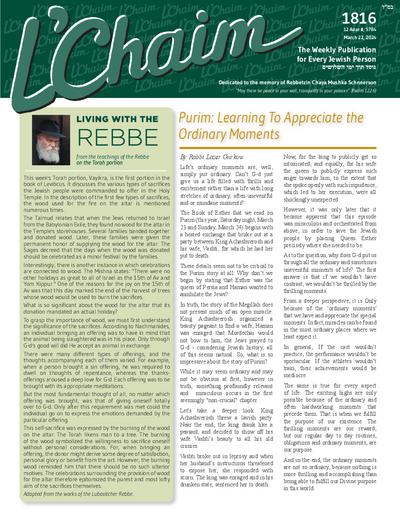

By Rabbi Lazer Gurkow

Life's ordinary moments are, well, simply put ordinary. Can’t G-d just give us a life filled with thrills and excitement rather than a life with long stretches of ordinary, often uneventful and or mundane moments?

The Book of Esther that we read on Purim (this year, Saturday night, March 23 and Sunday, March 24) begins with a heated exchange that broke out at a party between King Achashverosh and his wife, Vashti, for which he had her put to death.

These details seem not to be critical to the Purim story at all. Why don’t we begin by stating that Esther was the queen of Persia and Haman wanted to annihilate the Jews?

In truth, the story of the Megillah does not present much of an open miracle. King Achashverosh organized a beauty pageant to find a wife, Haman was enraged that Mordechai would not bow to him, the Jews prayed to G-d - considering Jewish history, all of this seems natural. So, what is so impressive about the story of Purim?

While it may seem ordinary and may not be obvious at first, however in truth, something profoundly relevant and miraculous occurs in the first seemingly "non-crucial" chapter.

Let's take a deeper look. King Achashverosh threw a lavish party. Near the end, the king drank like a peasant, and decided to show off his wife Vashti’s beauty to all his old cronies.

Vashti broke out in leprosy and when her husband’s instructions threatened to expose her, she responded with scorn. The king was enraged and in his drunken state, sentenced her to death.

Now, for the king to publicly get so intoxicated, and equally, for his wife the queen to publicly express such anger towards him, to the extent that she spoke openly with such impudence, which led to her execution, were all shockingly unexpected.

However, it was only later that it became apparent that this episode was miraculous and orchestrated from above, in order to save the Jewish people by placing Queen Esther precisely where she needed to be.

As to the question, why does G-d put us through all the ordinary and sometimes uneventful moments of life? The first answer is that if we wouldn’t have contrast, we wouldn’t be thrilled by the thrilling moments.

From a deeper perspective, it is Only because of the ‘ordinary moments’ that we have and appreciate the special moments. In fact, miracles can be found in the most ordinary places where we least expect it.

In general, If the cast wouldn’t practice, the performance wouldn’t be spectacular. If the athletes wouldn’t train, their achievements would be mediocre.

The same is true for every aspect of life. The exciting highs are only possible because of the ordinary and often hardworking moments that precede them. That is when we fulfill the purpose of our existence. The thrilling moments are our reward, but our regular day to day routines, obligations and ordinary moments, are our purpose.

And in the end, the ordinary moments are not so ordinary, because nothing is more thrilling and accomplishing than being able to fulfill our Divine purpose in this world.

PDF Preview