Peace Offerings of Cattle
Torah Papers | March 30, 2025
Print This Article
View Original PDF

Peace Offerings of Cattle

Torah Papers | June 27, 2025

Fourth Reading 3:1 Someone wishing to draw close to God by praising Him for some reason can elect to bring a “peace-offering,” so called because it promotes peace in the world in general, and because it promotes commonality among all the participants in the sacrificial rite (the offerer, the priests, and the Altar) by allotting portions of its meat to each.

If his sacrifice is a peace-promoting feast-offering, then if he brings it from cattle, the animal must be either male or female; he may not bring a hermaphrodite or an animal of unknown gender. It must be unblemished. Once the offerer has designated a specific animal as his offering, he must bring it to the entrance of the Tent of Meeting, thus being considered to have presented it before God.

He must then lean his hand forcefully upon the head of his sacrifice and slaughter it anywhere within the precincts of the Courtyard of the Tabernacle, i.e., beyond the entrance of the Tent of Meeting. Those of Aaron’s descendants who are priests—i.e., who have not been demoted from the priesthood—must receive the blood in a consecrated vessel; bring the vessel containing the blood to the Altar; and, while standing on the ground next to the Altar, dash the blood upon the northwest and southeast corners of the Altar such that the blood can be considered to be encircling the Altar.

He must bring a fire-offering to God from the peace-offering, consisting of the following seven parts of the animal that must be burned up on the Altar: (1) the fat covering the innards, i.e., on the omasum and the reticulum; (2) all the fat that is on the innards, i.e., on the abomasum (or, alternatively, on the small intestine); (3) the two kidneys; (4) the fat that is on them; (5) the fat that is on the flanks; he must also remove (6) the diaphragm, along with the kidneys—as stated—and along with (7) part of the liver.

Aaron’s descendants must burn up these seven parts of the animal on the Altar. Like all other sacrifices, this one, too, may be placed on the woodpile only after the daily morning ascent-offering has been offered up and is on top of the wood on the fire. Slaughtering the animal must be performed with the intention that it be a fire-offering, i.e., destined to be consumed by fire, and that it be pleasing to God.
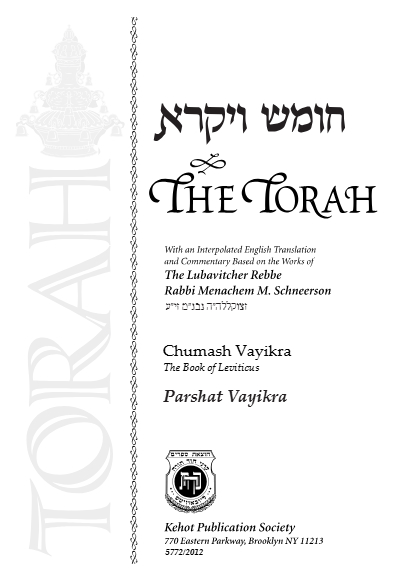
Fourth Reading 3:1 Someone wishing to draw close to God by praising Him for some reason can elect to bring a “peace-offering,” so called because it promotes peace in the world in general, and because it promotes commonality among all the participants in the sacrificial rite (the offerer, the priests, and the Altar) by allotting portions of its meat to each.

If his sacrifice is a peace-promoting feast-offering, then if he brings it from cattle, the animal must be either male or female; he may not bring a hermaphrodite or an animal of unknown gender. It must be unblemished. Once the offerer has designated a specific animal as his offering, he must bring it to the entrance of the Tent of Meeting, thus being considered to have presented it before God.

He must then lean his hand forcefully upon the head of his sacrifice and slaughter it anywhere within the precincts of the Courtyard of the Tabernacle, i.e., beyond the entrance of the Tent of Meeting. Those of Aaron’s descendants who are priests—i.e., who have not been demoted from the priesthood—must receive the blood in a consecrated vessel; bring the vessel containing the blood to the Altar; and, while standing on the ground next to the Altar, dash the blood upon the northwest and southeast corners of the Altar such that the blood can be considered to be encircling the Altar.

He must bring a fire-offering to God from the peace-offering, consisting of the following seven parts of the animal that must be burned up on the Altar: (1) the fat covering the innards, i.e., on the omasum and the reticulum; (2) all the fat that is on the innards, i.e., on the abomasum (or, alternatively, on the small intestine); (3) the two kidneys; (4) the fat that is on them; (5) the fat that is on the flanks; he must also remove (6) the diaphragm, along with the kidneys—as stated—and along with (7) part of the liver.

Aaron’s descendants must burn up these seven parts of the animal on the Altar. Like all other sacrifices, this one, too, may be placed on the woodpile only after the daily morning ascent-offering has been offered up and is on top of the wood on the fire. Slaughtering the animal must be performed with the intention that it be a fire-offering, i.e., destined to be consumed by fire, and that it be pleasing to God.

PDF Preview