Some Insight into What A Pleasing Aroma to Hashem Means
Limuday Moshe | March 22, 2024
Print This Article
View Original PDF

Some Insight into What A Pleasing Aroma to Hashem Means

Limuday Moshe | June 27, 2025

In this week’s parsha we are introduced to the various korbanos [sacrificial offerings] that were offered in the Mishkan. After listing the pertinent laws governing each korban, the Torah often concludes the discussion by stating that it will be a: ריח ניחח לה' – “pleasing aroma to Hashem”. Although this expression is typically understood as describing the korban, Rav Eliezer Ashkenazi posits in his sefer Ma’aseh Hashem (Ma’aseh Bereishis 27) that it refers not to the korban, but to the person who brings it.

Rav Yissocher Frand gives a moshul [parable] to help us appreciate this interpretation. A person who enters his home on Friday afternoon will be greeted by the savory smell of Shabbos food wafting from the kitchen. Whether it is fresh challah, chicken soup, or other delicacies, the mouthwatering aroma that welcomes him home gets him excited for Shabbos. Even without tasting a morsel, the fragrant smell in the air is enough for him to know that a delicious meal awaits him later that night. For this reason, smell is used as a metaphor for knowledge about the feature.

The Ramban writes (Vayikra 1:9) that the root of the word korban isקרב - to come close, because the offering enables a person to receive atonement for a transgression that distanced him from Hashem. Accordingly, it is not the animal being sacrificed that Hashem desires, but the motivation of the person bringing it as part of the teshuvah process. Just as the enticing aroma of a Jewish kitchen on erev Shabbos portends the delectable meal to come, so too someone bringing a korban due to a heartfelt desire to draw near to Hashem smells sweet in heaven because it foreshadows his improved behavior and desire to rekindle their relationship. (R’ Ozer Alport)
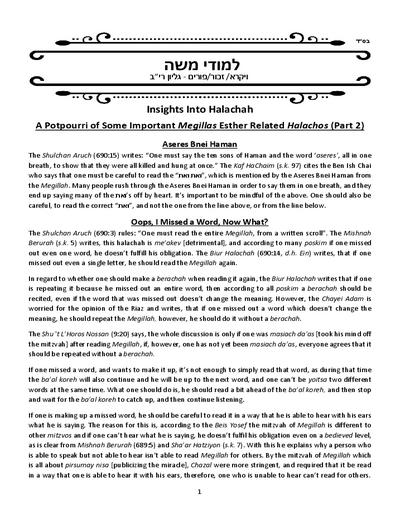
In this week’s parsha we are introduced to the various korbanos [sacrificial offerings] that were offered in the Mishkan. After listing the pertinent laws governing each korban, the Torah often concludes the discussion by stating that it will be a: ריח ניחח לה' – “pleasing aroma to Hashem”. Although this expression is typically understood as describing the korban, Rav Eliezer Ashkenazi posits in his sefer Ma’aseh Hashem (Ma’aseh Bereishis 27) that it refers not to the korban, but to the person who brings it.

Rav Yissocher Frand gives a moshul [parable] to help us appreciate this interpretation. A person who enters his home on Friday afternoon will be greeted by the savory smell of Shabbos food wafting from the kitchen. Whether it is fresh challah, chicken soup, or other delicacies, the mouthwatering aroma that welcomes him home gets him excited for Shabbos. Even without tasting a morsel, the fragrant smell in the air is enough for him to know that a delicious meal awaits him later that night. For this reason, smell is used as a metaphor for knowledge about the feature.

The Ramban writes (Vayikra 1:9) that the root of the word korban isקרב - to come close, because the offering enables a person to receive atonement for a transgression that distanced him from Hashem. Accordingly, it is not the animal being sacrificed that Hashem desires, but the motivation of the person bringing it as part of the teshuvah process. Just as the enticing aroma of a Jewish kitchen on erev Shabbos portends the delectable meal to come, so too someone bringing a korban due to a heartfelt desire to draw near to Hashem smells sweet in heaven because it foreshadows his improved behavior and desire to rekindle their relationship. (R’ Ozer Alport)

PDF Preview