The Walking Program
Toras Avigdor | April 04, 2025
Print This Article
View Original PDF

The Walking Program

Toras Avigdor | June 27, 2025

And what is that lesson? The Torah wants to emphasize here the procedure for coming close to Hashem. Because what is a korban after all? It’s a declaration of a person’s desire lehiskarev – to come close to his Creator and to gain His favor. And whatever we learn therefore in the Torah regarding the procedure of bringing a korban, we have to know that it’s also teaching us about coming close to Hashem. And so, if the Torah tells us that holacha is essential, it’s teaching us that if you want to come close to Hashem, if you want to achieve kirvas Elokim, then holacha, physical movement, is indispensable.

Now, we understand of course that included in kirvas Elokim is the great career of the mind – thinking as much as possible about Hakadosh Baruch Hu. Absolutely, we’re expected to be close to Hashem intellectually. If you’re learning Torah, you’re utilizing your mind to come close to Him. When you’re thinking inyanei emunah, that’s kirvas Elokim. All the great emotions of yiras Hashem and ahavas Hashem, bitachon and everything else, that’s a greatness of mind! That certainly is called kirvas Hashem!

But Hakadosh Baruch Hu desires more than that. The avodah of holacha, of walking towards the mizbeach, is intended to teach us, among other things, that He wants you to come close to Him physically. The great lesson of יבוƒר¿ ̃ƒה¿ו is that in order to achieve kirvas Elokim you have to bring your body close to Hashem. And it’s an idea that is very frequently reiterated in the nevi’im and in the dinim of the Torah.
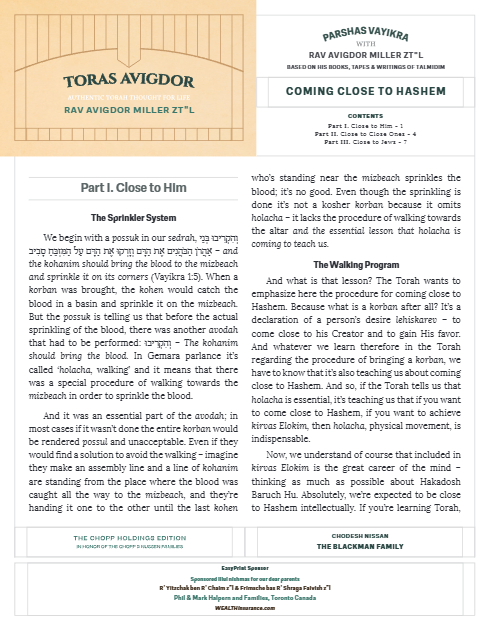

And what is that lesson? The Torah wants to emphasize here the procedure for coming close to Hashem. Because what is a korban after all? It’s a declaration of a person’s desire lehiskarev – to come close to his Creator and to gain His favor. And whatever we learn therefore in the Torah regarding the procedure of bringing a korban, we have to know that it’s also teaching us about coming close to Hashem. And so, if the Torah tells us that holacha is essential, it’s teaching us that if you want to come close to Hashem, if you want to achieve kirvas Elokim, then holacha, physical movement, is indispensable.

Now, we understand of course that included in kirvas Elokim is the great career of the mind – thinking as much as possible about Hakadosh Baruch Hu. Absolutely, we’re expected to be close to Hashem intellectually. If you’re learning Torah, you’re utilizing your mind to come close to Him. When you’re thinking inyanei emunah, that’s kirvas Elokim. All the great emotions of yiras Hashem and ahavas Hashem, bitachon and everything else, that’s a greatness of mind! That certainly is called kirvas Hashem!

But Hakadosh Baruch Hu desires more than that. The avodah of holacha, of walking towards the mizbeach, is intended to teach us, among other things, that He wants you to come close to Him physically. The great lesson of יבוƒר¿ ̃ƒה¿ו is that in order to achieve kirvas Elokim you have to bring your body close to Hashem. And it’s an idea that is very frequently reiterated in the nevi’im and in the dinim of the Torah.

PDF Preview