Words of affection as a path to success in Torah
Print This Article
View Original PDF

Words of affection as a path to success in Torah

טיב הקהילה English | June 27, 2025

דברי חיבה כדרך להצלחה בתורה

He called to Moshe, and Hashem spoke to him from the Tent of Meeting, saying. (1:1)

Rashi explains: He called to Moshe – ‘Calling’ preceded every statement, and every saying, and every command. It is a language of affection, the language that the ministering angels use, as it says (Yeshayah 6:3) 'וקרא זה אל זה ואמר קדוש' – ‘One called to the other and said, “Holy...”’. But prophets of the nations of the world, He revealed Himself to them in language of transitoriness and impurity, as it says (Bamidbar 23:4), 'ויקר אלקים את בלעם' – ‘G-d happened upon Balaam.’

This speech is the first recorded in the Torah after the erection of the Mishkan. Therefore, the Torah specifically mentions the calling of Moshe before speaking to him, to establish that all subsequent commandments and statements were also preceded by a calling.

Rashi seeks to understand what practical difference it makes whether the calling preceded the speech or not, and why we need to know this detail. He answers that the calling is a sign of affection. The Torah wished to reveal that every command given to Moshe was spoken with a display of love and endearment.

This is meant to teach us to follow Hashem’s ways and apply this principle to teaching Torah to students—that it must be done with expressions of love. The words of Torah will only settle in the hearts of students if they feel cherished by their teacher. When students recognize that their teacher is instructing them out of a genuine desire to benefit them, they become willing to listen and absorb his teachings.

This affection requires daily reinforcement. A teacher must constantly show that his love for his students remains strong, just as HaKadosh Baruch Hu did with Moshe—always preceding His commandments and statements with a loving call.

Additionally, we must recognize that this affection must be given to every student. It is not merely a tool to encourage weaker or average students, but even outstanding students with sharp intellects also need expressions of love to motivate them in their Torah learning.

For who is greater than Moshe, the faithful shepherd, about whom it is said (Bamidbar 12:7-8): 'בכל ביתי נאמן הוא, פה אל פה אדבר בו ומראה ולא בחידות' - ‘In all My house, he is faithful. I speak with him mouth to mouth, in a clear vision and not in riddles...’ and similarly, (Devorim 34:10): 'ולא קם נביא עוד בישראל כמשה אשר ידעו ה' פנים אל פנים' - ‘No prophet has arisen in Israel like Moshe, whom Hashem knew face to face.’ Yet despite his greatness, Hashem still saw fit to precede every command with an affectionate calling.

This concept also serves as a reason for the Jewish custom of beginning young children’s Torah learning with Parashas Vayikra, as it contains the theme of calling with affection, which they so greatly need.

This point must serve as a fundamental principle for every parent and educator. They must understand that the very essence of their children’s and students’ success depends on the measure of affection they receive. When children and students see that their parents and teachers value and cherish them, they are encouraged to persist in their studies and ascend the heights of Torah and service of Hashem. However, when affection is not shown, they see no reason to exert themselves or utilize their talents. This is especially true for weaker students who are already aware of their limitations—they may become broken by their situation, believing that they are rightly undeserving of recognition, and thus feeling that they have no place in the House of Hashem.

Tragically, this can sometimes lead to situations where young men, both students and scholars, prefer to spend their days engaged in business rather than seeking refuge in the study of Torah. In more extreme cases, some may even drift away entirely from the path passed down through generations. Yet, had they received even a small measure of affection, it could have uplifted them. And even if it did not lead them to extraordinary success, at the very least, it would have kept them connected to the Bais Medrash. Simply being within its walls would leave an impression on them, enabling them to remain steadfast in the ways of Torah and tradition.

The Rambam elaborates on this idea in his commentary on the Mishnah (Sanhedrin, Chapter 10) regarding the Mishnah "All of Israel has a share in the World to Come." He explains that young children must be given treats and sweets to draw them toward Torah and mitzvos. Here are some of his beautiful words:

"Consider a young child who is brought to a teacher to learn Torah. This is the greatest good for him in terms of the perfection he will attain. However, due to his young age and weak intellect, he does not yet understand the value of this good or the perfection it will bring him. Therefore, it is necessary for the teacher—who possesses greater wisdom—to encourage him to learn through things that he finds desirable at his young age. The teacher says to him: 'Study, and I will give you nuts or figs; I will give you a little honey...'" [The Rambam continues at length, explaining that this method is the foundation of learning Torah shelo lishma (not for its own sake), but the ultimate goal is to encourage and motivate the child to study Torah.]

For young children, this encouragement is done through sweets and treats, but for older students, it is achieved through sweet words and expressions of love.

This idea may also explain what the Gemara (Shabbos 30b) teaches about Rava, who used to begin each lesson with a humorous remark before teaching Torah. He did this to show his students that he loved and cherished them, thereby drawing their hearts toward him. As a result, they were able to receive his Torah teachings in the most meaningful way.

Based on what has been stated, we can understand the intent behind the words of the Ba'al HaTurim, who writes: "‘Vayikra el Moshe’—this phrase is an acronym for ‘Emo’ (his mother), as in 'בעטרה שעטרה לו אמו' - ‘with the crown with which his mother crowned him’ (Shir HaShirim 3:11)."

At first glance, his words appear obscure and difficult to comprehend. What is the connection between the calling of Moshe and the concept of a mother?

However, based on our discussion, we can explain that the Ba'al HaTurim is teaching that the calling that was directed toward Moshe should also become a habitual practice in the speech of Jewish mothers. Children are deeply connected to their mothers, and the affection that mothers show them has the greatest influence on their spiritual growth. Therefore, it is the mother’s duty to express abundant love and encouragement when urging her children to devote themselves to Torah. The more warmth and love she expresses, the more her children will cling to the Tree of Life.

This is why the Torah of children is attributed to their mothers, as it says (Mishlei 1:8): 'שמע בני מוסר אביך ואל תטוש תורת אמך' - ‘Hear, my son, the instruction of your father, and do not forsake the Torah of your mother.’ It is specifically through the mother’s loving encouragement that a child merits success in Torah.

Indeed, we see in the words of Chazal that this is the primary merit of women. The Gemara (Berachoss 17a) asks: "In what merit do women earn a share in the World to Come?" The answer given is: "By bringing their children to study Torah in the Beit HaKnesses."

It is therefore fitting that parents and educators pray for divine wisdom to understand how to encourage and strengthen their children in a way that will only uplift and inspire them. May we all merit to raise children and students who grow into great Torah scholars.
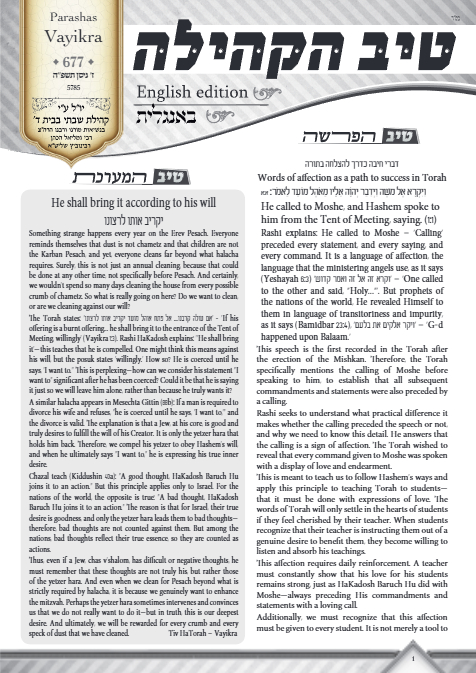
דברי חיבה כדרך להצלחה בתורה

He called to Moshe, and Hashem spoke to him from the Tent of Meeting, saying. (1:1)

Rashi explains: He called to Moshe – ‘Calling’ preceded every statement, and every saying, and every command. It is a language of affection, the language that the ministering angels use, as it says (Yeshayah 6:3) 'וקרא זה אל זה ואמר קדוש' – ‘One called to the other and said, “Holy...”’. But prophets of the nations of the world, He revealed Himself to them in language of transitoriness and impurity, as it says (Bamidbar 23:4), 'ויקר אלקים את בלעם' – ‘G-d happened upon Balaam.’

This speech is the first recorded in the Torah after the erection of the Mishkan. Therefore, the Torah specifically mentions the calling of Moshe before speaking to him, to establish that all subsequent commandments and statements were also preceded by a calling.

Rashi seeks to understand what practical difference it makes whether the calling preceded the speech or not, and why we need to know this detail. He answers that the calling is a sign of affection. The Torah wished to reveal that every command given to Moshe was spoken with a display of love and endearment.

This is meant to teach us to follow Hashem’s ways and apply this principle to teaching Torah to students—that it must be done with expressions of love. The words of Torah will only settle in the hearts of students if they feel cherished by their teacher. When students recognize that their teacher is instructing them out of a genuine desire to benefit them, they become willing to listen and absorb his teachings.

This affection requires daily reinforcement. A teacher must constantly show that his love for his students remains strong, just as HaKadosh Baruch Hu did with Moshe—always preceding His commandments and statements with a loving call.

Additionally, we must recognize that this affection must be given to every student. It is not merely a tool to encourage weaker or average students, but even outstanding students with sharp intellects also need expressions of love to motivate them in their Torah learning.

For who is greater than Moshe, the faithful shepherd, about whom it is said (Bamidbar 12:7-8): 'בכל ביתי נאמן הוא, פה אל פה אדבר בו ומראה ולא בחידות' - ‘In all My house, he is faithful. I speak with him mouth to mouth, in a clear vision and not in riddles...’ and similarly, (Devorim 34:10): 'ולא קם נביא עוד בישראל כמשה אשר ידעו ה' פנים אל פנים' - ‘No prophet has arisen in Israel like Moshe, whom Hashem knew face to face.’ Yet despite his greatness, Hashem still saw fit to precede every command with an affectionate calling.

This concept also serves as a reason for the Jewish custom of beginning young children’s Torah learning with Parashas Vayikra, as it contains the theme of calling with affection, which they so greatly need.

This point must serve as a fundamental principle for every parent and educator. They must understand that the very essence of their children’s and students’ success depends on the measure of affection they receive. When children and students see that their parents and teachers value and cherish them, they are encouraged to persist in their studies and ascend the heights of Torah and service of Hashem. However, when affection is not shown, they see no reason to exert themselves or utilize their talents. This is especially true for weaker students who are already aware of their limitations—they may become broken by their situation, believing that they are rightly undeserving of recognition, and thus feeling that they have no place in the House of Hashem.

Tragically, this can sometimes lead to situations where young men, both students and scholars, prefer to spend their days engaged in business rather than seeking refuge in the study of Torah. In more extreme cases, some may even drift away entirely from the path passed down through generations. Yet, had they received even a small measure of affection, it could have uplifted them. And even if it did not lead them to extraordinary success, at the very least, it would have kept them connected to the Bais Medrash. Simply being within its walls would leave an impression on them, enabling them to remain steadfast in the ways of Torah and tradition.

The Rambam elaborates on this idea in his commentary on the Mishnah (Sanhedrin, Chapter 10) regarding the Mishnah "All of Israel has a share in the World to Come." He explains that young children must be given treats and sweets to draw them toward Torah and mitzvos. Here are some of his beautiful words:

"Consider a young child who is brought to a teacher to learn Torah. This is the greatest good for him in terms of the perfection he will attain. However, due to his young age and weak intellect, he does not yet understand the value of this good or the perfection it will bring him. Therefore, it is necessary for the teacher—who possesses greater wisdom—to encourage him to learn through things that he finds desirable at his young age. The teacher says to him: 'Study, and I will give you nuts or figs; I will give you a little honey...'" [The Rambam continues at length, explaining that this method is the foundation of learning Torah shelo lishma (not for its own sake), but the ultimate goal is to encourage and motivate the child to study Torah.]

For young children, this encouragement is done through sweets and treats, but for older students, it is achieved through sweet words and expressions of love.

This idea may also explain what the Gemara (Shabbos 30b) teaches about Rava, who used to begin each lesson with a humorous remark before teaching Torah. He did this to show his students that he loved and cherished them, thereby drawing their hearts toward him. As a result, they were able to receive his Torah teachings in the most meaningful way.

Based on what has been stated, we can understand the intent behind the words of the Ba'al HaTurim, who writes: "‘Vayikra el Moshe’—this phrase is an acronym for ‘Emo’ (his mother), as in 'בעטרה שעטרה לו אמו' - ‘with the crown with which his mother crowned him’ (Shir HaShirim 3:11)."

At first glance, his words appear obscure and difficult to comprehend. What is the connection between the calling of Moshe and the concept of a mother?

However, based on our discussion, we can explain that the Ba'al HaTurim is teaching that the calling that was directed toward Moshe should also become a habitual practice in the speech of Jewish mothers. Children are deeply connected to their mothers, and the affection that mothers show them has the greatest influence on their spiritual growth. Therefore, it is the mother’s duty to express abundant love and encouragement when urging her children to devote themselves to Torah. The more warmth and love she expresses, the more her children will cling to the Tree of Life.

This is why the Torah of children is attributed to their mothers, as it says (Mishlei 1:8): 'שמע בני מוסר אביך ואל תטוש תורת אמך' - ‘Hear, my son, the instruction of your father, and do not forsake the Torah of your mother.’ It is specifically through the mother’s loving encouragement that a child merits success in Torah.

Indeed, we see in the words of Chazal that this is the primary merit of women. The Gemara (Berachoss 17a) asks: "In what merit do women earn a share in the World to Come?" The answer given is: "By bringing their children to study Torah in the Beit HaKnesses."

It is therefore fitting that parents and educators pray for divine wisdom to understand how to encourage and strengthen their children in a way that will only uplift and inspire them. May we all merit to raise children and students who grow into great Torah scholars.

PDF Preview