A Wise Woman Once Said
L’Chaim | December 12, 2024
Print This Article
View Original PDF

A Wise Woman Once Said

L’Chaim | June 27, 2025

By Rabbi Baruch Epstein

A wise woman once said: the difference between a healthy person and an unhealthy person is that the former is working on their issues while the latter has resigned themselves to theirs.

How do Jacob and Esau, the twin sons of Isaac and Rebeca wind up so different? Same milk, same upbringing and yet they grow up to be so drastically different. They are the paradigm of all literary accounts of “the good and evil twins;” a metaphor for the endless internal struggles of our character; pitted against the forces of our nature.

Each brother has a burden to bear. Esau is born ruddy and hairy, his twin brother Jacob tugging on his heel. Esau means complete, done, ready nothing more to accomplish. Jacob means heel, the conscience pulling on his brother trying to restrain him.

Jacob grows and blossoms, Esau remains and festers in his identity. Esau sees himself as he is from the start and that is who he will be until he dies, he sees no reason to ever address his other side, ever “work it out” with his brother or even within himself. He is and is content to remain so.

Jacob is born with his persona as the underdog, his mother’s favorite. Jacob dares to incorporate his Esau side. Jacob masters his internal Esau, brings it out into the daylight, tries it on and smooths out its rough edges.

How does one confront their Esau and not become Esau?

Jacob succeeds, impresses his father enough to secure the blessing. Then is thrust out of the family nest all alone in the forest left to deal with his newfound self; to encounter the mean street, to face his fears. Jacob discovers inner strengths only his mother had imagined and gets strong enough to meet his brother face to face, no more grabbing at his ankles, he stares him down and is not afraid.

We all have our “issues” our inner Esau. The easiest path is to let sleeping dogs lie. “Going there” only seems to unearth fears better left buried. But if we don’t, we surrender to him.

That is the dividing point between them. Both Jacob and Esau had another side to their identity, Jacob harnessed his and became Yisroel, the man who struggled and prevailed; Esau ignored his Jacob side and it withered.

There are two ruling forces within each of us, when one rises the other falls. When we rock the boat, we emerge stronger, sweep our issues under the rug and they pile up until we trip over them.

We have all been there; something wrong is said or done and there is an awkward silence, we have a choice, we can address it (Jacob) or we can resign ourselves to it (Esau).

When we go where we fear most to tread, we come out the other side as Yisroel, we have struggled, and we have succeeded.
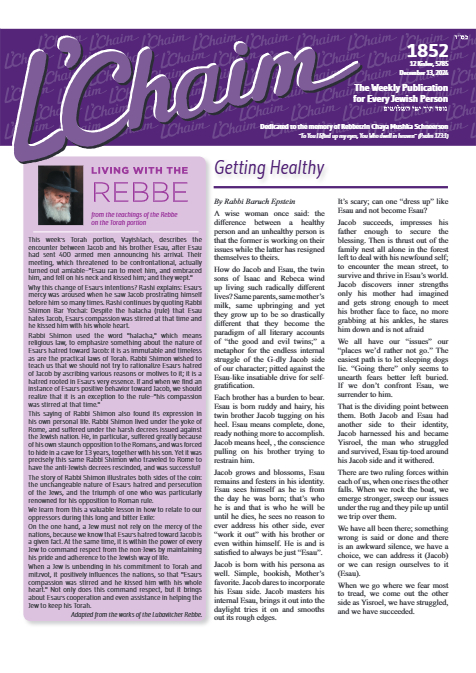

By Rabbi Baruch Epstein

A wise woman once said: the difference between a healthy person and an unhealthy person is that the former is working on their issues while the latter has resigned themselves to theirs.

How do Jacob and Esau, the twin sons of Isaac and Rebeca wind up so different? Same milk, same upbringing and yet they grow up to be so drastically different. They are the paradigm of all literary accounts of “the good and evil twins;” a metaphor for the endless internal struggles of our character; pitted against the forces of our nature.

Each brother has a burden to bear. Esau is born ruddy and hairy, his twin brother Jacob tugging on his heel. Esau means complete, done, ready nothing more to accomplish. Jacob means heel, the conscience pulling on his brother trying to restrain him.

Jacob grows and blossoms, Esau remains and festers in his identity. Esau sees himself as he is from the start and that is who he will be until he dies, he sees no reason to ever address his other side, ever “work it out” with his brother or even within himself. He is and is content to remain so.

Jacob is born with his persona as the underdog, his mother’s favorite. Jacob dares to incorporate his Esau side. Jacob masters his internal Esau, brings it out into the daylight, tries it on and smooths out its rough edges.

How does one confront their Esau and not become Esau?

Jacob succeeds, impresses his father enough to secure the blessing. Then is thrust out of the family nest all alone in the forest left to deal with his newfound self; to encounter the mean street, to face his fears. Jacob discovers inner strengths only his mother had imagined and gets strong enough to meet his brother face to face, no more grabbing at his ankles, he stares him down and is not afraid.

We all have our “issues” our inner Esau. The easiest path is to let sleeping dogs lie. “Going there” only seems to unearth fears better left buried. But if we don’t, we surrender to him.

That is the dividing point between them. Both Jacob and Esau had another side to their identity, Jacob harnessed his and became Yisroel, the man who struggled and prevailed; Esau ignored his Jacob side and it withered.

There are two ruling forces within each of us, when one rises the other falls. When we rock the boat, we emerge stronger, sweep our issues under the rug and they pile up until we trip over them.

We have all been there; something wrong is said or done and there is an awkward silence, we have a choice, we can address it (Jacob) or we can resign ourselves to it (Esau).

When we go where we fear most to tread, we come out the other side as Yisroel, we have struggled, and we have succeeded.

PDF Preview