I Am Humbled For With Just My Staff I Crossed This Jordan
מגדל אור | December 11, 2024
Print This Article
View Original PDF

I Am Humbled For With Just My Staff I Crossed This Jordan

מגדל אור | June 27, 2025

“I am humbled... for with just my staff I crossed this Jordan, and now I have become two camps” (Beraishis 32:11)

When Yaakov heard that Esav was coming to greet him with four hundred generals, he knew Esav intended to fight. In preparation for this, Yaakov divided his camp into two, so that at least some of his entourage would survive. He begins to pray.

He says to Hashem, “You are the G-d of my fathers, Who told me to return to my land and that You would be good to me. You have already done more than I deserve, for I crossed the Jordan alone and now have become two camps. And now, I ask for more, please save me from Esav.” This is a lesson on how to look at what we have in our lives, and realize that we benefit from Hashem’s grace, and not from the merits we earn. Then, too, because Hashem is so great, we need not stop asking Him for more, for His ability is endless.

But let’s examine what Yaakov said. He is now “two camps.” He didn’t have two camps out of necessity, because his group was too large to remain one. He divided it for strategic purposes. If so, why does he compare his original situation to now?

Simply understood, originally, yes, he was alone, unable to divide into two groups, and now he has that capability. This is a great gift. The ability to support one another is a basic tenet of two being better than one. He therefore thanks Hashem for the ability to be two camps even by choice.

More than that, though, he is able to praise Hashem for giving him two camps because he is seeking the positive kindness Hashem showed him. If one has a loaf of bread and divides it, but can be grateful he has two packages of bread, that is someone who has learned the power of gratitude.

Being able to see all the small acts of kindness which we experience on a constant basis takes work, and that is what our forefather Yaakov did. He worked on himself to appreciate every little act of Hashem, and to realize that it wasn’t small at all.

Hashem’s great plan for us is made up of all those “small” occurrences, and when we are able to point to different things, we can not only appreciate them more, but more properly praise Hashem.

There is another aspect to consider as well. Yaakov divided into two camps, but it wasn’t an even division. One was the camp of his family and their basic essentials, while the other was his servants, possessions, and wealth.

Yaakov was grateful to Hashem for being able to distinguish that he had two camps: one that was his family and one that was his fortune. He still had his priorities straight and didn’t become misguided by his wealth. This is indeed something to be grateful for.

While driving to a busy mall, Meir and Dovi schmoozed and discussed all sorts of things. As they approached, Meir uttered a little prayer. “Please, Hashem, let us find a good parking spot close to the door.”

Amused, Dovi said, “Meir, no offense, but I hope G-d has more important things to do than give you a parking space.” “Nope,” replied Meir, “He doesn’t. He does everything.” He then added, “Please, Hashem, show Dovi that it’s true.”

As he finished, a car pulled out of the space next to the entrance, and Meir pulled into the close spot he’d asked for, just where G-d wanted him.

©2024 – J. Gewirtz
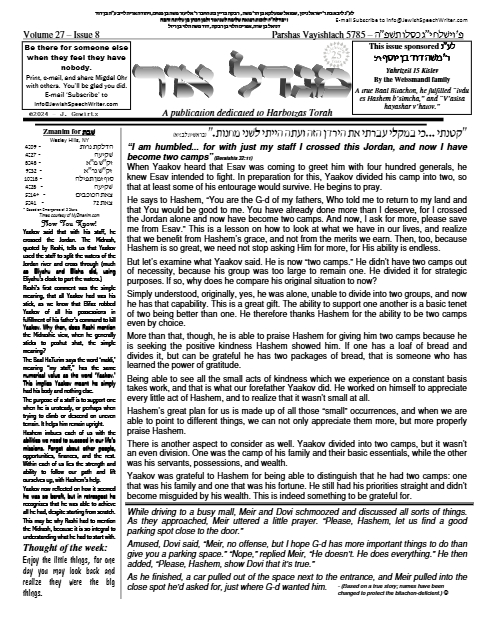
“I am humbled... for with just my staff I crossed this Jordan, and now I have become two camps” (Beraishis 32:11)

When Yaakov heard that Esav was coming to greet him with four hundred generals, he knew Esav intended to fight. In preparation for this, Yaakov divided his camp into two, so that at least some of his entourage would survive. He begins to pray.

He says to Hashem, “You are the G-d of my fathers, Who told me to return to my land and that You would be good to me. You have already done more than I deserve, for I crossed the Jordan alone and now have become two camps. And now, I ask for more, please save me from Esav.” This is a lesson on how to look at what we have in our lives, and realize that we benefit from Hashem’s grace, and not from the merits we earn. Then, too, because Hashem is so great, we need not stop asking Him for more, for His ability is endless.

But let’s examine what Yaakov said. He is now “two camps.” He didn’t have two camps out of necessity, because his group was too large to remain one. He divided it for strategic purposes. If so, why does he compare his original situation to now?

Simply understood, originally, yes, he was alone, unable to divide into two groups, and now he has that capability. This is a great gift. The ability to support one another is a basic tenet of two being better than one. He therefore thanks Hashem for the ability to be two camps even by choice.

More than that, though, he is able to praise Hashem for giving him two camps because he is seeking the positive kindness Hashem showed him. If one has a loaf of bread and divides it, but can be grateful he has two packages of bread, that is someone who has learned the power of gratitude.

Being able to see all the small acts of kindness which we experience on a constant basis takes work, and that is what our forefather Yaakov did. He worked on himself to appreciate every little act of Hashem, and to realize that it wasn’t small at all.

Hashem’s great plan for us is made up of all those “small” occurrences, and when we are able to point to different things, we can not only appreciate them more, but more properly praise Hashem.

There is another aspect to consider as well. Yaakov divided into two camps, but it wasn’t an even division. One was the camp of his family and their basic essentials, while the other was his servants, possessions, and wealth.

Yaakov was grateful to Hashem for being able to distinguish that he had two camps: one that was his family and one that was his fortune. He still had his priorities straight and didn’t become misguided by his wealth. This is indeed something to be grateful for.

While driving to a busy mall, Meir and Dovi schmoozed and discussed all sorts of things. As they approached, Meir uttered a little prayer. “Please, Hashem, let us find a good parking spot close to the door.”

Amused, Dovi said, “Meir, no offense, but I hope G-d has more important things to do than give you a parking space.” “Nope,” replied Meir, “He doesn’t. He does everything.” He then added, “Please, Hashem, show Dovi that it’s true.”

As he finished, a car pulled out of the space next to the entrance, and Meir pulled into the close spot he’d asked for, just where G-d wanted him.

©2024 – J. Gewirtz

PDF Preview