Laws and Customs of Chanukah
According to Shulchan Aruch Harav, Mishna Berurah and Nittei Gavriel
All times listed are for Jerusalem only as per www.myzmanim.com
Based on Rabbi Shmuel Lesches's Halachah Sheets
Reviewed by Reb Elimelech Rabinowicz שליט"א, Rav of Tzeirei Kehal Chassidim, Shaarei Chessed
Compiled by Yossi Fraenkel in memory of his grandparents
ר' ראובן בן הרב משה אליעזר הלוי ע"ה וחיה ברכה בת ר' נפתלי משה ע"ה רבינוביץ
ר' יוסף בן ר' אורי ע"ה ומלכה בת ר' יצחק צבי הלוי ע"ה פרנקל
EREV CHANUKAH
On Erev Chanukah, we say Tachanun during Shacharit but not at Mincha.
Some have the custom to take out and prepare their Menorah three days before Chanukah and they keep it out till the third day after Chanukah.
MENORAH LIGHTING: WHO?
All men light the Menorah. Boys are also trained to do so from a young age.
Women are obligated to light the Menorah. Practically, a married woman fulfils her obligation through her husband’s lighting, and a girl fulfils her obligation through her father’s lighting. Therefore, they should be present when the Menorah is lit, and they should have in mind to fulfil their obligation. Even very young girls should be present when the Menorah is lit. For this reason, the Menorah lighting should be scheduled at a time when everyone can be present. [Nevertheless, they have still fulfilled their obligation even if not present.]
In the following circumstances, a woman should recite the Brachot and light the Menorah herself:
- An unmarried woman who does not permanently live with her father. [This includes seminary girls.]
- A woman who is temporarily away from her family home and husband/father, and she is not guesting with someone who is lighting the Menorah, e.g. she is in a hotel, hospital, or empty home.
- A woman who remains at home, but her husband/father is away for the night.
A woman who is temporarily away from her family home and husband/father, but she is guesting with a host who is lighting the Menorah, she automatically fulfils her obligation through her father’s/husband’s lighting at the family home, unless:
- It is daytime in her time-zone when her husband/father lights Menorah.
- Her husband/father is away from the family home and lighting elsewhere.
In these two cases, the woman should participate in her host’s lighting by sharing in the expenses of the oil and wicks, and she should also be present when the Menorah is kindled.
MENORAH LIGHTING: VENUE
One must light at home (where he usually eats and sleeps) and nowhere else. Even if eating out, one must still light the Menorah at home.
If one is away from home the entire night, he should light at the place where he is lodging. If he is still there the following night, he may light there as well, even if he intends to relocate later during the night.
One should avoid crossing the International Dateline during Chanukah. Similarly, one should avoid travel plans that prevent him from lodging overnight in a dwelling. One who finds himself in such a situation should consult a Rav.
MENORAH LIGHTING: WHERE?
Some hold the Menorah is lit inside, some hold it should be lit in a doorway, some hold by the window and others hold outside.
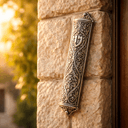
For those who hold the Menorah is situated at a doorway, on the side opposite the Mezuzah. If there is no Mezuzah, such as in a hotel, the Menorah is placed at the right side of the door. [If the Menorah was placed on the wrong side, one has still fulfilled his obligation.]
The Menorah should be placed within the actual doorway, as close to the doorpost as possible. [If this is not feasible, it should at least be placed within a Tefach (8cm) of the doorway.] It does not matter if the flames span north-south or east-west.
It is preferable to use the doorway of the room where one eats, as opposed to the doorway of the room where one sleeps.
Although it is preferable for the head of the household to light at the main eating area, nevertheless, each child should light at the entrance to his personal bedroom, unless there are safety concerns.
When more than one person lights at the same venue, each set of flames should be noticeably distinct from the others. In practice, this is easily accomplished when everyone uses a separate Menorah. However, when two people improvise by sharing the same Menorah (e.g. during the first nights of Chanukah), or by not using a Menorah at all, there should be a clear gap between each set of flames.
Those who have the custom to light in the window should make sure it is safe to do so. The Menorah should be lit facing the street rather than the back of the house. It should be lit on the right side of the window.
Some have the custom to light outside on the edge of their property closer to public property. If one regularly lights outside, yet someone gave them a new silver Menorah, in fear of it being stolen one should rather light their old Menorah outside.
Those in a Yeshivah dormitory, seminary or at an overnight camp should follow the instructions of their Hanhalah.
The Menorah is situated so that the flames are anywhere between 3 Tefachim (24cm) and 10 Tefachim (80cm) from the floor. If the Menorah is placed higher, it is still acceptable (unless the flames are higher than twenty Amot – 9.6 meters). A large Menorah which is taller than 10 Tefachim may be used even in the first instance.
The Menorah must not be situated in a place where there is a strong possibility that it will be extinguished, e.g. by winds or vandals.
PREPARING THE MENORAH
Ideally, a nice Menorah should be used. The Lubavitcher Rebbe discouraged the use of Menorahs with round branches as per Rashi’s interpretation. Instead, Chabad use either a Menorah with diagonal (or square-shaped) branches, or one with no branches at all.
The Menorah must be designed so that all the flames are in a straight line and at the same height. The flames should not be too close together, as they need to appear noticeably distinct. [Furthermore, wax candles need to be sufficiently spaced so that the heat of the flames do not melt the wax of the adjacent candles.] One should be especially attentive to this when improvising without a Menorah.
Each day of Chanukah, the Menorah is prepared in advance, so that it is ready at the appropriate time. The Shamash is situated higher or separate than the other flames. One Shamash is sufficient for multiple Menorahs when they are right next to each other, but not when they are situated in different parts of the room.
THE WICKS
Wicks are preferably made of cotton or linen. [If these are unavailable, the wicks may be made of any material.] Some have the practice to replace the wicks every day and some have the custom not to do so, being that used wicks are easier to kindle. [According to the latter custom, the newly added lamp is prepared with the wick that was lit first on the previous night.]
THE FUEL
Ideally, olive oil is used to fuel the flames, and a beeswax candle for the Shamash. [If these are not available, one should use a type of oil or wax candle that burns a clear flame. If this is not possible, any type of oil or wax candle may be used.] The Menorah may be prepared with oil remaining from the previous night.
Before kindling, one ensures that the Menorah has sufficient fuel to last the required duration – at least 50 minutes in total, and at least 30 minutes after Tzeit Hakochavim (whichever is longer).
Some candles manufactured for Chanukah typically burn for only half-hour. If these are lit before Tzeit Hakochavim, one would not be able to recite the Brachot. Furthermore, even if lighting after Tzeit Hakochavim, such candles tend to burn for less than half-hour in a warm environment. Therefore, longer lasting candles should be used. [When necessary, there is room to be lenient for a child under Bar Mitzvah who is unaware that the candles are burning less than they should.]
If one realized after lighting that there is insufficient oil, he should not merely add more oil. Instead, he must extinguish the flames, add more oil, and then relight the flames without the Brachot.
MENORAH LIGHTING: WHEN?
Many light the Menorah after Maariv and some light immediately after sunset, between Mincha and Maariv. If that is not possible, one should light as soon as possible after that time. [Technically, one may light all night, until dawn. However, if very late, one should arrange for another person to be awake and present for the Menorah lighting.]
When lighting after Tzeit Hakochavim, one davens Maariv first, unless there is no Minyan scheduled until later, or unless he regularly davens with a Minyan that is scheduled later. If one cannot light the Menorah at night, he may also light any time after Plag Hamincha. [In this case, one will need to use additional oil, enough to last until half-hour after Tzeit Hakochavim.] One may not light before Plag Hamincha. If he did so, he must relight at the correct time, and recite the Brachot again.
BEFORE LIGHTING
Once the sun sets, one may not perform any activity that might distract him from lighting the Menorah. Therefore, one may not eat more than 57 grams of bread, drink alcoholic beverages, perform work, or even study Torah. Similarly, one should not begin these activities within the half-hour period prior to sunset, unless he appoints a Shomer (guardian) to remind him to light the Menorah at sunset. Nevertheless, one may learn during this time.
If, for whatever reason, one began these activities within the half-hour period prior to sunset, he may continue until sunset. At that time, he must immediately stop whatever he is doing. One may begin these activities before the half-hour period prior to sunset and continue until sunset. [Technically, he may continue even after sunset and light the Menorah afterwards. Nevertheless, it is commendable to stop as soon as the sun sets in order to light the Menorah.]
One may not take a nap within the half-hour period before sunset, or afterwards, until he lights the Menorah. All the above applies to all men and women, even if he or she will discharge their obligation through watching or participating in someone else’s lighting of the Menorah. [Nevertheless, there is room to be lenient for those who are not actually lighting the Menorah themselves.]
MENORAH LIGHTING: HOW?
Before making the Brachot, one lights the Shamash. While making the Brachot and lighting the flames, the Shamash is held in the right hand. On the first night, three Brachot are said. On the following nights, only two Brachot are recited, as Shehecheyanu is omitted.
One must recite the Brachot and kindle the flames whilst standing unsupported, without leaning on anything. If this is not possible, or after the fact, the Mitzvah is fulfilled even if sitting. After one completely finishes reciting all of the Brachot, the flames are lit without delay, from left to right.
One may not speak between the Brachot and the conclusion of lighting the Menorah. [If one did speak, he does not repeat the Brachot, unless he said something totally unrelated to the lighting of the Menorah, and he did so before kindling even one flame.]
Although the Menorah is not supposed to be moved once lit, one may move it a Tefach or two if this is necessary to facilitate its lighting, and then return it to its original position. (This may be practically relevant for someone who is infirm and cannot reach the Menorah.)
Some hold that Haneirot Halalu is said or sung after the first flame is lit and some hold that only after all the flames are completely lit and the Shamash is set down, followed by Maoz Tzur in many communities.
AFTER LIGHTING
The flames should burn for at least 50 minutes in total, and for at least 30 minutes after Tzeit Hakochavim (whichever is longer). If a flame extinguished during this time, it is appropriate to relight it (without reciting the Brachot).
During this time, the Chanukah flames may not be used for any purpose. This includes using a flame to light another Chanukah flame or the Shamash. Similarly, benefit may not be derived from any of the light generated by the flames. This is one of the reasons why the Shamash flame is placed higher than the other flames, in order that any inadvertent benefit may be attributed to the Shamash. Nevertheless, one should not rely on the Shamash, and instead ensure that the room is well-lit.
The Menorah should not be moved during this time. It is customary for women and men to refrain from any labor (i.e. sewing, knitting, laundering or ironing) during this time. It is also preferable to avoid leaving the house to go shopping, or the like. One should sit by the Menorah for at least half-hour, and utilize the time for learning, or for Chanukah inspiration.
After the flames have burned for the required amount of time, the Menorah may be moved, even if the flames are still burning. Similarly, at this time, women may perform labor outside the view of the burning flames. Even after the required amount of time has passed, it is still inappropriate to derive benefit from the flames or to extinguish them (unless leaving them unattended would create a safety hazard).
During Chanukah, the Menorah should not be used for any other purpose. Similarly, after the Menorah flames are extinguished, the leftover wicks and fuel should not be discarded or used for other purposes. Instead, it should be kept until the last day of Chanukah.
SHUL MENORAH
The Shul Menorah is situated at the southern side of the Shul, with the flames spanning east-west. The Shul Menorah should be easily visible to the entire Shul. It is therefore placed higher than 10 Tefachim (80cm).
Except for Motzei Shabbat, the Shul Menorah is lit after Mincha and before Maariv. Some schedule Mincha so that the Menorah will be lit after Plag Hamincha, but before sunset. The Shul Menorah is prepared before Mincha so as not to disturb anyone’s concentration during Mincha. Just as with a personal Menorah, it must be prepared with enough fuel to burn until at least half-hour after Tzeit Hakochavim.
At the end of Mincha, immediately before Aleinu, one of the congregants recites the Brachot and lights the Menorah. Afterwards, all present say or sing Haneirot Halalu (and Maoz Tzur), followed by Aleinu.
On the first night of Chanukah, the Shul Menorah should not be lit by an Avel (within 12 months of a parent’s passing or within 30 days of a spouse, child or sibling’s passing).
One does not fulfil his obligation with the Menorah that is lit in Shul. Even the one who kindles the Menorah in Shul must relight at home, with the Brachot. [On the first night, he does not repeat Shehecheyanu, unless he is also lighting on behalf of others who have not yet fulfilled their obligation.]
Throughout the 24 hours of each day of Chanukah, the flames of the Shul Menorah (including the Shamash) remain lit whenever people are present in the Shul, provided that there are no safety concerns. At the very least, the flames should remain lit during the times of davening. [If the flames need to be relit during the course of the 24 hours, they are lit with a Shamash, but without reciting the Brachot.]
PIRSUMEI NISSA
A major emphasis of Chanukah is Pirsumei Nissa. Most years this would include Menorah lightings in the most public places possible, and events which promote the spirit of Chanukah, however, due to the pandemic, it is more important to adhere to the Ministry of Health relevant for one’s country or city. If permissible by the authorities, one should try to participate in these activities and help ensure their success, even if this requires postponing one’s personal Menorah lighting to a later hour.
The flames of the public Menorah must be no taller than twenty Amot (9.6 metres) from the ground. The public Menorah should not be situated in a place where there is a strong possibility that it will be extinguished, e.g. by winds or vandals.
Since it is ideal for the Brachot to be recited when kindling a public Menorah, the lighting should be scheduled after Plag Hamincha, and the Menorah should have enough fuel to burn at least half-hour after Tzeit Hakochavim, just as with a personal Menorah. [Otherwise, the public Menorah should still be lit, but without the Brachot.]
The Brachot are recited when burning a liquid or solid fuel – as opposed to gas, butane, propane or electricity. The Brachot are recited only by the one who is lighting the Menorah. [On the first night, he recites Shehecheyanu – even if he already recited it beforehand when lighting the Shul Menorah or at home.] The audience should be forewarned not to recite the Brachot along with him, but rather, just to answer Amen.
The flames should be lit without moving the lamps out of place. Just as in Shul, one does not fulfil his obligation by attending (or lighting) a public Menorah. The participants should be made aware of this. [Even the one who kindles the public Menorah must relight at home, with the Brachot. On the first night, he does not repeat Shehecheyanu, unless he is also lighting on behalf of others who have not yet fulfilled their obligation.]
One should try to reach out to those in hospitals, old-age homes and prisons. When the person lighting the Menorah does not know the Brachot, one may prompt him word by word, or recite the Brachot on his or her behalf. [In the latter instance, if one will still need to fulfil the Mitzvah himself at a later time, he should have in mind to be Motzeh the listeners but not himself.]
Shehecheyanu is said the first time one fulfils the Mitzvah, even if it is after the first day of Chanukah. When visiting a hospital or old age home, one should be mindful as to whether it is a place where the Brachot may be recited. If not, the Menorah should be lit without reciting the Brachot.
Gatherings should be arranged for adults and children, especially for those not yet familiar with Chanukah. The opportunity should be utilized to rejoice with them; to teach them about Chanukah; to share words of Torah; to light the Menorah and give Tzedakah with them; and to give them Chanukah Gelt. Where possible, these gatherings should be scheduled to allow the Menorah to be lit after Plag Hamincha, so that the Brachot will be recited. If this is not practical, the Menorah should still be lit, but without the Brachot.
When distributing doughnuts, latkes or other food, one should ensure that the appropriate Brachot are made for each food item.
TACHNUN & V’AL HANISSIM
Tachnun is not recited from Mincha of Erev Chanukah until after Chanukah. V’al Hanissim is recited in each Amidah of Chanukah. [One should not intentionally skip V’al Hanissim to recite Kedushah or Modim with the Minyan.] If one forgot V’al Hanissim at the appropriate place in the Amidah, he may recite it before saying Hashem’s name at the end of that Brachah. After that point, he does not recite it.
V’al Hanissim is recited each time one bentches during Chanukah. If one forgot V’al Hanissim at the appropriate place in bentching, he may recite it before saying Hashem’s name at the end of that Brachah. After that point, he may recite it as a Harachaman, as per the Nusach printed in some siddurim.
HALLEL
Full Hallel is recited each day of Chanukah, right after The Amidah of Shacharit. If the Chazzan is a mourner (for a deceased parent) during the first eleven months, someone else takes over for Hallel, but not for the Kaddish which follows. One must recite Hallel whilst standing unsupported. If this is not possible, or after the fact, the Mitzvah is fulfilled even if sitting.
One may not interrupt full Hallel other than for those things that one may respond to during the Brachot of Kriat Shema. [E.g. If the Chazzan recites Kaddish, one answers Amen Yehei Shmei etc, and Amen to d’amiran b’alma. One also answers Barchu and Amen when the Brachot are recited before and after an Aliyah, and may also recite the Brachot if he is called up for an Aliyah.]
It is preferable to recite Hallel with the Minyan. If one is not up to the Minyan, this creates a dilemma; on the one hand it is appropriate to recite Hallel with the congregation, and on the other hand, it is appropriate that one should daven in the correct order. One should therefore make a point of being up to the Minyan when Hallel is said.
If one forgot to recite Hallel, he should recite it with a Brachah as soon as he remembers, unless the sun already set. If one mistakenly recited half-Hallel, he must repeat the entire Hallel (without a Brachah). After Hallel, the Chazzan recites only half Kaddish. [If he mistakenly said Kaddish Titkabel, he should recite half Kaddish after U’va L’tziyon.]
CHANUKAH CUSTOMS
The days of Chanukah should be utilized to give extra Tzedakah and to learn additional Torah. Children should also be encouraged in this regard. One may not fast on Chanukah – not even a Chattan or Kallah on the day of their Chuppah, or for a Yahrzeit.
It is customary to eat foods fried in oil, such as Latkes and doughnuts, to commemorate the miracle of the oil. It is also customary to eat dairy foods, to commemorate the miracle of Yehudit.
It is customary to eat special meals to celebrate the miracles of Chanukah and the reinauguration of the Beit Hamikdash. These meals are regarded as a Seudat Mitzvah if they are accompanied by song and praise for the miracles Hashem wrought, or when their purpose is to publicize the miracle of Chanukah and enhance the observance of its Mitzvot.
On one of the nights of Chanukah, the Rebbeim of Chabad would conduct a gathering of sorts for their family members (both men and women), which was referred to as “Latkes evening”. The stories related at these gatherings included several that were repeated every single Chanukah.
The days of Chanukah should be utilized to arrange and/or participate in family, school, workplace and communal Chanukah gatherings. The purpose of these gatherings is to tell the story and spread the message of Chanukah, along with the lessons derived from it.
One gives Chanukah Gelt to his or her spouse and children (whether minors or adults) each day of Chanukah, with a special addition (double or triple) on the fourth or fifth night of Chanukah. [For Shabbat, one gives Chanukah Gelt either the day before or after. One who is stringent about handling money on Motzei Shabbat should refrain from giving Chanukah Gelt until Sunday.] One gives Chanukah Gelt to his students. It is appropriate for children to give Chanukah Gelt to each other.
There is no source for giving Chanukah gifts other than Gelt. [If one nevertheless does so, he should bear in mind that gifts may not be given on Shabbat unless they are used on Shabbat itself.]
It is customary to play Dreidel (sevivon). One should not play for money (unless the initial understanding is that all “wins” will be returned). It goes without saying that gambling or playing-cards is not in the spirit of Chanukah, and is in fact a desecration. The Kedushat Levi writes that each playing-card contains tremendous impurity of the unmentionable type.
EREV SHABBAT CHANUKAH
When possible, public Menorah lightings should still be conducted after Plag Hamincha, despite the busy hour. The Minyan for Mincha is scheduled earlier than usual, to allow for the Menorah at home to be lit after Mincha. Nevertheless, Mincha should be late enough for the Shul Menorah to be lit after Plag Hamincha.
One should endeavor to daven Mincha with a Minyan before lighting Menorah. [If this is not possible, it is preferable to daven with a Minyan after lighting the Menorah than to daven without a Minyan before lighting the Menorah.]
The Menorah at home is lit just before the Shabbat candles are lit. The lighting of the Menorah should be scheduled so that it does not interfere with the lighting time for the Shabbat candles. Being that the Menorah is lit on Erev Shabbat earlier than usual, one should ensure that there is enough fuel for the flames to burn for half-hour after Tzeit Hakochavim. Similarly, a longer-lasting Shamash should be used.
On Erev Shabbat, one need not sit next to the flames for half-hour. The Menorah should be situated so that its flames are not fanned or extinguished by the opening or closing of any doors or windows, or by people passing by.
Everything beneath a lit Menorah becomes a “Bassis L’Issur” on Shabbat, and may not be moved. If the place where the Menorah is situated needs to be used, one can prevent the chair or table from becoming a Bassis L’Issur by placing a Challah or bottle of wine on it from sunset until Tzeit Hakochavim.
Similarly, one may place the Menorah on a tray which is not designated exclusively for use with a candelabra or candlesticks, and place a Challah or bottle of wine on the tray from sunset until Tzeit Hakochavim. In both of these situations, the chair or tray – along with all of its contents – may be moved on Shabbat, but only once the location is actually needed. The chair or tray may not be moved simply for the sake of protecting the Menorah.
The chair or tray should be moved carefully, as the Menorah itself cannot be directly handled. Were the Menorah to fall whilst being moved, one would not be able to catch it or support it directly with his hands. Furthermore, if the flames are still burning, and they are fueled by oil, one must be careful that the liquid doesn’t rise or fall and cause the flame to become bigger or smaller.
Another option: The Menorah (as well as the Bassis beneath it) may be moved by a non-Jew – but only if one had in mind (and preferably verbalized) at the onset of Shabbat that a non-Jew would move it after the flames extinguished.
SHABBAT CHANUKAH
Haneirot Halalu should not be sung on Shabbat. However, one may sing the ending (i.e. Al Nissecha). During Birchat Hamazon, one should remember to recite V’al Hanissim and Retzei, as well as the Harachaman for Shabbat.
Two Sifrei Torah are taken out for Kriat Hatorah. One for the Parshat Hashavuah and the second for Maftir for Chanukah. The Chanukah Haftorah is read. Av Harachamim and Tzidkatecha are not recited.
MOTZEI SHABBAT
Maariv should be davened promptly. The Shul Menorah is lit, Haneirot Halalu (and Maoz Tzur) are sung right before Aleinu. As usual, Havdallah in Shul is not recited until Maariv is completely finished. In communities where they say V’Yiten Lechah in Shul before Aleinu, they should light before V’Yiten Lechah.
One should go home quickly, in order to light the Menorah as soon as possible. At home, most make Havdallah first, followed by Menorah lighting, Haneirot Halalu, Maoz Tzur and V’Yiten Lechah, some make Havdallah after Menorah lighting, and some make Havdallah and say V’Yiten Lechah prior to Menorah lighting.
ROSH CHODESH
Tuesday night, December 12th, is Rosh Chodesh. Throughout davening, one should remember to recite Ya’aleh Veyavo. If one forgot Ya’aleh Veyavo in davening, or is unsure whether he recited it:
- At Maariv, one does not correct his omission.
- At Shacharit and Mincha, if he realized before saying Hashem’s name at the end of Hamachazir Shechinato L’tziyon, he goes back. If he remembered between the conclusion of that Brachah and Modim, he recites it at that point, without going back. If he remembers any time after that point, but before he began reciting (the second) Yih’yu L’ratzon, he returns to the beginning of Retzei. If he remembered only afterwards, he must repeat the entire Amidah.
- If one forgot Ya’aleh Veyavo during Shacharit, and only realized after Musaf, he does not repeat Shacharit.
- If one forgot Ya’aleh Veyavo during Mincha, and only realized after the Zman Tefillah has passed, he must recite an additional Amidah during Maariv, as compensation.
- When repeating the Amidah, one should wait the span of time to walk four Amot (approx. two meters), and preferably, one should recite words of supplication between them.
During Birchat Hamazon, one should remember to recite V’al Hanissim and Ya’aleh Veyavo. One should recite the Harachaman for Rosh Chodesh. If one forgot Ya’aleh Veyavo in Birchat Hamazon:
- If he remembered before saying Hashem’s name at Bonei Yerushalayim, he goes back.
- If he remembered after that, but before beginning the next Brachah, he recites the extra Brachah as printed in some Bentchers.
Although one normally recites half-Hallel on Rosh Chodesh, full Hallel is recited when it falls on Chanukah. Two Sifrei Torah are taken out for Kriat Hatorah, with the first three Aliyot for Rosh Chodesh, and the fourth for Chanukah. It is customary to eat something special in honor of Rosh Chodesh, distinct from the foods eaten in honor of Chanukah.
ZOT CHANUKAH (FRIDAY)
The last night and day of Chanukah is known as Zot Chanukah. The wicks and oils remaining from the Menorah are gathered together and burned on the last day of Chanukah. [This does not apply to the wicks or oil that were not used at all, such as any oil remaining in the flask.] No benefit should be derived from this fire.