The Curse and the Cure
It is said of the 2nd Rebbe of Chabad, Rabbi Dovber [Shneuri] of Lubavitch, referred to as the Mitteler Rebbe, that he lived and breathed chasidut (chasidic teachings) in all his 248 limbs and 365 sinews.
His son-in-law the Tzemach Tzedek remarked, "If one were to cut his hand, chasidut would flow out instead of blood."
The Mitteler Rebbe wrote and lectured chasidut with great elaboration, and also demanded of his chasidim to teach chasidut in every place they found themselves, and of the chasidim that came to spend time by him in Lubavitch, to repeat in all the towns they passed through on their way home, the chasidut they heard from him while there.
Once, one of his chasidim, a man gifted with outstanding ability to expound, complained to him that he was afraid that the compliments and appreciation he received when teaching would cause him to become arrogant (a repugnant character trait). The Mitteler famously answered him "You may sprout in the ground like an onion, but you will continue to teach chasidut in public!"
In the beginning of his leadership, in 1812, after the passing of his father, Rabbi Shneur-Zalman of Liadi, the founder of the Lubavitcher dynasty [referred to in Chabad as the Alter Rebbe], there arrived in the town of Lubavitch the chasid Reb Yitzchak Moshe of Jassy. He had been a chasid of the Alter Rebbe, and immediately after the latter's passing he became a fervent and devoted follower of his oldest son, the Mitteler Rebbe.
The Mitteler Rebbe highly valued Reb Yitzchak Moshe. The chasidim also loved to speak with him, to enjoy his intelligent and inspiring talks. Whenever he was in Lubavitch, the younger chasidim would surround him, begging him to tell them of his memories of the Alter Rebbe. Eventually it would be time for him to leave, and he would make his way back to his city Jassy, in Romania.
A long and exhausting trip awaited R. Yitzchak Moshe but that didn't stop him for following the Mitteler Rebbe's directive of giving over the chasidut he heard from him in Lubavitch.
248 + 365 = 613, the total number of commandments in the Torah. [The Zohar teaches that each commandment is connected to a particular limb, vein or organ in the human body.]
When he arrived in his city, he entered one of the batei midrash (‘study halls’) and offered those present to hear words of chasidut. They readily agreed and he closed his eyes in concentration and started lecturing.
As mentioned before, R. Yitzchak Moshe was an extraordinary gifted speaker. Soon a big circle of fascinated listeners formed around him, drinking in his every word.
R. Yitzchak Moshe wasn't aware that he was in the beit midrash of the Apter Rebbe, Rabbi Avraham Yehosua Heshel, who had moved to Jassy several years before, in 1808, after serving eight years as the chief rabbi of Apta. While speaking, R. Yitzhak Moshe didn't notice the Apta Rav, who had entered the beit midrash and was watching what was going on.
The Apter Rebbe followed a different path in his service of his Creator than the spreading of the teachings of chasidut. His opinion was that the teaching of the esoteric parts of the Torah are only for the tzadikim (pure, ‘righteous’ Jews) and those others on an elevated spiritual level. So when he saw the Chabad chasid passionately giving over deep concepts in chasidut, he became extremely angry.
Suddenly the voice of the Apter Rebbe rang out in the hall. "What!" he thundered. "You would also conquer the Queen with me in the house?!!" [see Esther 7:8]
A shocked silence fell. Reb Yitzchak Moshe stood frozen in his place and turned white as a sheet. The flow of his words, received so enthusiastically a moment ago in the beit midrash (study hall), was cut off as if with a knife. Tension suddenly filled the hall. All those present looked up in shocked astonishment.
The Rebbe's face reflected his anger and he proclaimed to Reb Yitzchak Moshe that he would not live out the year!
Reb Yitzhak Moshe trembled in fear upon hearing these threatening words. Without saying a word, he left the beit midrash and immediately set off for Lubavitch. With his mind in turmoil he hurried to the Mitteler Rebbe and told him all that had happened, emphasizing the angry words the Apter Rebbe had said to him.
"Did you insult the Rebbe?" asked the Mitteler.
"G-d forbid!" said R. Yitzchak Moshe, "Not only didn't I insult him, I didn’t say a single word to him. The whole thing was an innocent mistake. I had no idea that it was the Apter Rebbe's beit midrash. Nor did I know that he is against the spreading of chasidut. My only intention was to follow the Rebbe's instruction to give over the chasidut we learned here. I was happy to find a public thirsty for the word of G-d."
The Mitteler Rebbe smiled. "You can calm down, there is no reason to worry, you will live out the year."
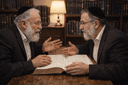
But the Rebbe's words did not quite reassure the chasid. He wanted to hear a more concrete promise. The Rebbe leaned his arms on the table and said "You will live longer than the Apter Rebbe.!"
Reb Yitzhak Moshe remained uneasy and frightened. The Apter Rebbe was close to seventy years old and he, Yitzchak Moshe was still young. Even if he would live longer that the Apter Rebbe it still didn't mean that he would live to old age. Feeling desperate, he gave his Rebbe a pleading look and begged him to completely overturn the anger of the Apter Rebbe.
Once again the Mitteler Rebbe leaned on his arms. After a few moments passed, his face lit up. He looked at his devoted chasid and said decisively, "You will live longer than his children!"
And so it was. Reb Yitzhak Moshe merited that the Mittler Rebbe's blessing was fulfilled. He lived till over a hundred in good health. Even in his venerable old age, till his very last days, he managed to fulfill an instruction that the Alter Rebbe had personally given him: to learn Torah all night long every Thursday night.
Source: Adapted, annotated and supplemented by R. Yerachmiel Tilles from the translation by Mrs. C.R. Benami, long-time editorial assistant for AscentOfSafed.com, from the popular Israeli weekly, Sichat HaShavua (#1663).
Biographical notes:
Rabbi DovBer Shneuri was the eldest son and successor to Rabbi Shneur Zalman, founder of the Chabad movement. The author of numerous deep, mystical texts, he is known in Lubavitch circles as "the Mitteler (Middle) Rebbe" [in between his father and the third rebbe, his son-in-law]. Tet [9th] Kislev (this Wednesday) is the birthdate (in 1773) and the passing date (in 1827) of the Mitteler Rebbe, while Yud [10th] Kislev the anniversary of his release [in 1825] from interrogation and false arrest.
Rabbi Avraham Yehosua Heshel of Apta (1755- 5 Nissan 1825), known as the Apter Rebbe or the Apter Rav, was a main disciple of the Rebbe Elimelech of Lizhinsk. He is also often referred to as "the Ohev Yisrael," both after the title of the famous book of his teachings, and also because its meaning ("Lover of Jews") fits him so aptly.