Addendum
Ma'amorim Illuminated | October 10, 2024
Print This Article
View Original PDF

Addendum

Ma'amorim Illuminated | June 27, 2025

This Ma’amer explains the process of Teshuva, and the various manifestations and degrees of G-dliness that are revealed through Teshuva. What may be unique to this Ma’amer is that it does so in an intellectual process. It uses the comprehension of various levels of the intellect as a comparative to the degree of levels of G-dliness reached. With this we learn as well of the intellectual process, what the intellect can or cannot grasp. Through the limitations of the intellect it is revealed that G-d’s Essence is unknowable, even to a knowledge of what He is not. The comparison or inability to compare intellect to the infinite and G-d’s Essence teaches us about G-d and His Essence, and how unfathomable G-d’s Essence truly is. Yet through Teshuva the Essence of G-d is revealed.

The Ma’amer can be broken into two segments. The first describes the soul's Teshuva-Return to G-d. Meaning the soul's spiritual migration upwards and inwards to its true self as being verily a piece of G-d. This manifestation of its inner true self and essence i.e. to be verily a piece of G-d, cleanses the soul of its sin, for sin does not exist in the essence of the G-dly soul. The second segment is the drawing down of this manifestation of the soul's G-dly essence outwards into the soul, as it dwells in the body on earth. This Teshuva-Return is the soul’s manifesting its essence downwards and outwards into the body, towards full practice of Torah and Mitzvot. Indeed, the practice of Torah and Mitzvot on earth is the only true destiny and purpose of the soul's descent to earth. And it is only through full practice of Torah and Mitzvot, will G-d’s desire for a dwelling place on earth be fulfilled.

First Segment of the Ma’amer

As mentioned, the first segment of the Ma’amer describes the soul's Teshuva-Return to G-d in order to be cleansed of sin. For this it first explains the divine level of Memala which is associated with creation and then Sovev which is above creation. And how for Teshuva the Sovev must be drawn down and revealed into Memala. More so that Sovev is not only revealed into Memala, but becomes the vitality and power of Memala. After the cleansing of the sin, an even higher manifestation of G-dliness is revealed, and that is how Sovev becomes equal to Memala. This is when the Ohr Ein Sof - the infinite divine light is revealed. Sovev is then considered only as a Tzimtzum, a concealment before the Ohr Ein Sof.

This equalization before Ohr Ein Sof applies even to the highest names of G-d i.e. even where Havaya is pronounced as Elokim. Thus, Keter as well, the level that transcends creation is also a Tzimtzum, a concealment before Ein Sof. This includes even Atik the higher level of Keter, not only Arich - the lower level of Keter. Thus Teshuva reveals, not only Sovev and Keter, but reveals the Ohr Ein Sof that enters into the Keter, and not only how the Keter is a vessel to the Ohr Ein Sof.

This is vital for the Teshuva to be complete, because the Ohr Ein Sof, once revealed, is where G-d, so to speak, is not only not limited by His will for Mitzvot and is able to forgive a breach in them as in the level of Ba’al HaRatzon. But rather in the level of Ohr Ein Sof, forgiveness for sinning is not even necessary to begin with, for no separation or concealment that sin causes between G-d and the Jew exists in G-d’s Essence. For the Jew is a piece of G-d’s Essence and one with Him.

To explain, the level of Ohr Ein Sof - G-d’s essence is not like the level of G-d called Ba’al HaRatzon - the Master of the will, who is able to pardon sin for He is not bound by it. But rather than the Ohr Ein Sof, a manifestation of the Essence of G-d is higher than the level of Ba'al HaRatzon. Thus in the level of Ba'al HaRatzon in which an act of forgiveness is needed to be atoned; it is only because the Ba'al HaRatzon is transcendental of His own will i.e. He is Master over it, He is able to forgive a breach in it. However, in G-d’s Essence no forgiveness is needed from the start for no defect, separation, concealment exists or can occur there.

In G-d's Essence forgiveness is not only due to not being limited by His will, as in the level of Ba’al HaRatzon, but rather because in G-d’s Essence only G-d exists. Only He and that which is part of Him i.e. the Jew exists. Thus because the essence of the Jew and G-d are one, for a Jew is verily a piece of G-d therefore no separation or concealment that is brought about through sin is possible, and forgiveness is not even needed for it is as if the sin never occurred.

~

Second Segment of Ma’amer

The second segment of the Ma’amer describes the manifestation of the G-dly soul's essence into the body. The downward trek of the soul’s Teshuva - i.e. the observance of G-d laws as a Jew in daily life in the body. To take this manifestation of the soul's essence where blemish due to sin does not exist into the lower levels of the soul where the blemish did occur. This important step reveals that the essential bond between G-d and Jew is not only in the innermost aspects of the soul - Yechida but even in Nefesh - the lowermost aspect of the soul. The Jew remains connected to G-d even when in his body and had sinned. This is because the blemish caused by sin is superficial and has not affected any true separation. This teaches us a vital lesson, that the essence of the Jewish soul which is a piece of G-d’s Essence, is not only its essence in the innermost part of the soul, but is its essence in the outermost part of the soul as well. This is because there is only one soul with one essence, which is the essence to all parts of the soul equally. The Jewish soul as a piece of G-d - whose essence is G-dliness is so in every part and all levels of the soul, in all its migration. The various levels of higher and lower in the soul are only degrees of manifestation, but all of the Jewish soul with all of its levels remains G-dly and inseparable from G-d at all times, even when sinning.

Teshuva for the Ba'al Teshuva and the Tzadik

Through Teshuva a Jew corrects, is cleansed, and atones sin. However, the true concept of Teshuva and its Avoda-service is more than just regretting the past and correcting the effect of the sin. It is about revealing the essence of the soul and thereby the essence of G-d. Therefore Teshuva is not only for one who sins, but for the Tzadik - the righteous one as well. For it is only through the Teshuva process that G-d’s Essence is revealed. And it is specifically the manifestation of G-d's Essence which fulfills the purpose of creation, the making of a dwelling place for G-d’s on earth. Hence the Tzadik too must do Teshuva, not in order to be atoned but to reveal G-d’s Essence. The Ma’amer can thus be viewed as a guide to Teshuva for all Jews on every level. It explains to every Jew how to climb the rungs of his soul in the spiritual ladder to return to his true essence. A ladder where the G-dly soul climbs upwards and inwards and then downwards and outwards. First upwards and inwards to the essence of the soul - its true self - which is verily a part of G-d. This part of the journey cleanses the effects sin had on the lower levels of the soul. Having achieved this, then begins the second part of the journey. Downwards and outwards to the soul as it is in the body. This is in order to reveal the essence of the soul into the body where the sin occurred, however, this time the soul takes with it into the body the G-dly Essence it revealed. With this second step of descent the Teshuva reveals that the soul even while in the body and sinning, no separation between G-d and the Jew is possible. In addition this downward trek to reveal the Essence of G-d and the Jew, is the aspect of Teshuva that is not only for sinners but for the Tzadik - righteous, one who has never sinned. The true purpose of Teshuva is to manifest G-dliness into the world on a level that only Teshuva can bring, which is the revelation of G-d’s Essence. Only through Teshuva can the dwelling for G-d that He desires on earth occur, for Teshuva reveals His Essence on earth.

Transcending the Intellect

As mentioned, this Ma’amer explains the process of Teshuva and the various manifestations and degrees of G-dliness that are revealed through Teshuva. What may be unique to this Ma’amer is that it does so in an intellectual process. It uses the comprehension of various levels of the intellect as a comparative to the degree of levels of G-dliness reached. With this we learn as well of the intellectual process, what the intellect can or cannot grasp. Through the limitations of the intellect, it is revealed that G-d’s Essence is unknowable, even to a knowledge of what He is not. The comparison or inability to compare intellect to the infinite and G-d’s Essence teaches us about G-d and His Essence and how unfathomable G-d’s Essence truly is. Yet through Teshuva the Essence of G-d is revealed.

Thus this Ma’amer can be viewed as a guide teaching the mind of how to transcend its own thinking. It offers a glimpse into the meaning of knowing or not knowing, or beyond any association to knowing. The known, the above knowing, that which is unknown and the unknowable due to being beyond any form of knowledge. From lower to higher forms of knowing.

There is the:

  1. Yedias Hachiuv: a direct form of human “knowing” with complete comprehension.
  2. Yedias Hashlila: an indirect form of knowing through the process of negation. Knowing what is not and understanding how it is above human comprehension.
  3. Yedias Elokus: G-d’s ability to know though not like any form of knowing as we know it (See Tanya Chapter 2). Yet it has a Shachus - an association to “knowing”. Though it is not comparative neither in the positive nor in negative, but somehow has an association to knowledge by saying it is above human logic or even Shlilo.
  4. Atzmus: The unknown or not knowable even to Elokus so to speak for it has no association to any form of knowledge and description at all. For Atzmus is not in the realm of knowledge in any and all forms.

It is the Stema Dchol Steman: The concealed of all concealments i.e. the unknowable. The concealed even onto itself which cannot be described as above or below any and all forms of knowledge and knowing in the intellectual process.

Whether direct knowledge, indirect knowledge, or any association to knowing - even if used in a non-comparative fashion and is negated. The completely unknown is not in our realm of intellect or any limitation or description. It is not associated with knowing at all. Not even a non-comparative, or indirect knowing, or even to say it is above knowing, for to say this gives it an association to limitation even if not connected to it.

How the Essence of G-d is of a realm so removed from the intellect and limitations, that when hearing any attempt to describe or compare Atzmus - the Essence with any type of intellect or level, would elicit laughter. This is indicative of G-d’s Essence being not only removed from the intellect and above it, but of a completely different realm, as if it is a joke to even attempt to comprehend. And yet the Ma’amer teaches that it is his fourth level where the manifestation of G-d’s Essence, the Stema Dchol Steman - the unknowable, that occurs through Teshuva.

Thank You To:

Alexander Sender Ben Raisa and Family
Avraham Yakov ben Devora and Family
Avrohom Yitzchok ben Rochel and Family
David Akiva ben Shoshana and Family
Eliyahu ben Sara Mina and Family
Elyokim Mayer Ben Segal and Family
Hillel ben Sara and Family
Mayer Moshe Yakov ben Sarah Toba Frieda and Family
Nechemia bas Rochel and Family
Peretz Leib ben Esther and Family
Rafael Eliyahu Ben Hinda Raizel and Family
Shimon Yerucham ben Mira and Family
Shlomo Ben Ratza Brendel and Family
Yehuda Yechezkal Chaim Ben Malka Rochel Halevi and Family
R’ Yissachar Dov ben Rivka Halevi and Family
Yisroel ben Faige and Family
Yisroel ben Malka and Family
Yitzchok Ben Bluma and Family
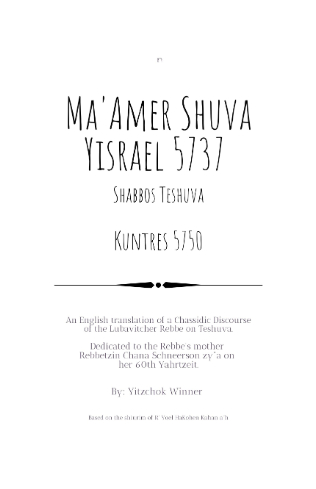
This Ma’amer explains the process of Teshuva, and the various manifestations and degrees of G-dliness that are revealed through Teshuva. What may be unique to this Ma’amer is that it does so in an intellectual process. It uses the comprehension of various levels of the intellect as a comparative to the degree of levels of G-dliness reached. With this we learn as well of the intellectual process, what the intellect can or cannot grasp. Through the limitations of the intellect it is revealed that G-d’s Essence is unknowable, even to a knowledge of what He is not. The comparison or inability to compare intellect to the infinite and G-d’s Essence teaches us about G-d and His Essence, and how unfathomable G-d’s Essence truly is. Yet through Teshuva the Essence of G-d is revealed.

The Ma’amer can be broken into two segments. The first describes the soul's Teshuva-Return to G-d. Meaning the soul's spiritual migration upwards and inwards to its true self as being verily a piece of G-d. This manifestation of its inner true self and essence i.e. to be verily a piece of G-d, cleanses the soul of its sin, for sin does not exist in the essence of the G-dly soul. The second segment is the drawing down of this manifestation of the soul's G-dly essence outwards into the soul, as it dwells in the body on earth. This Teshuva-Return is the soul’s manifesting its essence downwards and outwards into the body, towards full practice of Torah and Mitzvot. Indeed, the practice of Torah and Mitzvot on earth is the only true destiny and purpose of the soul's descent to earth. And it is only through full practice of Torah and Mitzvot, will G-d’s desire for a dwelling place on earth be fulfilled.

First Segment of the Ma’amer

As mentioned, the first segment of the Ma’amer describes the soul's Teshuva-Return to G-d in order to be cleansed of sin. For this it first explains the divine level of Memala which is associated with creation and then Sovev which is above creation. And how for Teshuva the Sovev must be drawn down and revealed into Memala. More so that Sovev is not only revealed into Memala, but becomes the vitality and power of Memala. After the cleansing of the sin, an even higher manifestation of G-dliness is revealed, and that is how Sovev becomes equal to Memala. This is when the Ohr Ein Sof - the infinite divine light is revealed. Sovev is then considered only as a Tzimtzum, a concealment before the Ohr Ein Sof.

This equalization before Ohr Ein Sof applies even to the highest names of G-d i.e. even where Havaya is pronounced as Elokim. Thus, Keter as well, the level that transcends creation is also a Tzimtzum, a concealment before Ein Sof. This includes even Atik the higher level of Keter, not only Arich - the lower level of Keter. Thus Teshuva reveals, not only Sovev and Keter, but reveals the Ohr Ein Sof that enters into the Keter, and not only how the Keter is a vessel to the Ohr Ein Sof.

This is vital for the Teshuva to be complete, because the Ohr Ein Sof, once revealed, is where G-d, so to speak, is not only not limited by His will for Mitzvot and is able to forgive a breach in them as in the level of Ba’al HaRatzon. But rather in the level of Ohr Ein Sof, forgiveness for sinning is not even necessary to begin with, for no separation or concealment that sin causes between G-d and the Jew exists in G-d’s Essence. For the Jew is a piece of G-d’s Essence and one with Him.

To explain, the level of Ohr Ein Sof - G-d’s essence is not like the level of G-d called Ba’al HaRatzon - the Master of the will, who is able to pardon sin for He is not bound by it. But rather than the Ohr Ein Sof, a manifestation of the Essence of G-d is higher than the level of Ba'al HaRatzon. Thus in the level of Ba'al HaRatzon in which an act of forgiveness is needed to be atoned; it is only because the Ba'al HaRatzon is transcendental of His own will i.e. He is Master over it, He is able to forgive a breach in it. However, in G-d’s Essence no forgiveness is needed from the start for no defect, separation, concealment exists or can occur there.

In G-d's Essence forgiveness is not only due to not being limited by His will, as in the level of Ba’al HaRatzon, but rather because in G-d’s Essence only G-d exists. Only He and that which is part of Him i.e. the Jew exists. Thus because the essence of the Jew and G-d are one, for a Jew is verily a piece of G-d therefore no separation or concealment that is brought about through sin is possible, and forgiveness is not even needed for it is as if the sin never occurred.

~

Second Segment of Ma’amer

The second segment of the Ma’amer describes the manifestation of the G-dly soul's essence into the body. The downward trek of the soul’s Teshuva - i.e. the observance of G-d laws as a Jew in daily life in the body. To take this manifestation of the soul's essence where blemish due to sin does not exist into the lower levels of the soul where the blemish did occur. This important step reveals that the essential bond between G-d and Jew is not only in the innermost aspects of the soul - Yechida but even in Nefesh - the lowermost aspect of the soul. The Jew remains connected to G-d even when in his body and had sinned. This is because the blemish caused by sin is superficial and has not affected any true separation. This teaches us a vital lesson, that the essence of the Jewish soul which is a piece of G-d’s Essence, is not only its essence in the innermost part of the soul, but is its essence in the outermost part of the soul as well. This is because there is only one soul with one essence, which is the essence to all parts of the soul equally. The Jewish soul as a piece of G-d - whose essence is G-dliness is so in every part and all levels of the soul, in all its migration. The various levels of higher and lower in the soul are only degrees of manifestation, but all of the Jewish soul with all of its levels remains G-dly and inseparable from G-d at all times, even when sinning.

Teshuva for the Ba'al Teshuva and the Tzadik

Through Teshuva a Jew corrects, is cleansed, and atones sin. However, the true concept of Teshuva and its Avoda-service is more than just regretting the past and correcting the effect of the sin. It is about revealing the essence of the soul and thereby the essence of G-d. Therefore Teshuva is not only for one who sins, but for the Tzadik - the righteous one as well. For it is only through the Teshuva process that G-d’s Essence is revealed. And it is specifically the manifestation of G-d's Essence which fulfills the purpose of creation, the making of a dwelling place for G-d’s on earth. Hence the Tzadik too must do Teshuva, not in order to be atoned but to reveal G-d’s Essence. The Ma’amer can thus be viewed as a guide to Teshuva for all Jews on every level. It explains to every Jew how to climb the rungs of his soul in the spiritual ladder to return to his true essence. A ladder where the G-dly soul climbs upwards and inwards and then downwards and outwards. First upwards and inwards to the essence of the soul - its true self - which is verily a part of G-d. This part of the journey cleanses the effects sin had on the lower levels of the soul. Having achieved this, then begins the second part of the journey. Downwards and outwards to the soul as it is in the body. This is in order to reveal the essence of the soul into the body where the sin occurred, however, this time the soul takes with it into the body the G-dly Essence it revealed. With this second step of descent the Teshuva reveals that the soul even while in the body and sinning, no separation between G-d and the Jew is possible. In addition this downward trek to reveal the Essence of G-d and the Jew, is the aspect of Teshuva that is not only for sinners but for the Tzadik - righteous, one who has never sinned. The true purpose of Teshuva is to manifest G-dliness into the world on a level that only Teshuva can bring, which is the revelation of G-d’s Essence. Only through Teshuva can the dwelling for G-d that He desires on earth occur, for Teshuva reveals His Essence on earth.

Transcending the Intellect

As mentioned, this Ma’amer explains the process of Teshuva and the various manifestations and degrees of G-dliness that are revealed through Teshuva. What may be unique to this Ma’amer is that it does so in an intellectual process. It uses the comprehension of various levels of the intellect as a comparative to the degree of levels of G-dliness reached. With this we learn as well of the intellectual process, what the intellect can or cannot grasp. Through the limitations of the intellect, it is revealed that G-d’s Essence is unknowable, even to a knowledge of what He is not. The comparison or inability to compare intellect to the infinite and G-d’s Essence teaches us about G-d and His Essence and how unfathomable G-d’s Essence truly is. Yet through Teshuva the Essence of G-d is revealed.

Thus this Ma’amer can be viewed as a guide teaching the mind of how to transcend its own thinking. It offers a glimpse into the meaning of knowing or not knowing, or beyond any association to knowing. The known, the above knowing, that which is unknown and the unknowable due to being beyond any form of knowledge. From lower to higher forms of knowing.

There is the:

  1. Yedias Hachiuv: a direct form of human “knowing” with complete comprehension.
  2. Yedias Hashlila: an indirect form of knowing through the process of negation. Knowing what is not and understanding how it is above human comprehension.
  3. Yedias Elokus: G-d’s ability to know though not like any form of knowing as we know it (See Tanya Chapter 2). Yet it has a Shachus - an association to “knowing”. Though it is not comparative neither in the positive nor in negative, but somehow has an association to knowledge by saying it is above human logic or even Shlilo.
  4. Atzmus: The unknown or not knowable even to Elokus so to speak for it has no association to any form of knowledge and description at all. For Atzmus is not in the realm of knowledge in any and all forms.

It is the Stema Dchol Steman: The concealed of all concealments i.e. the unknowable. The concealed even onto itself which cannot be described as above or below any and all forms of knowledge and knowing in the intellectual process.

Whether direct knowledge, indirect knowledge, or any association to knowing - even if used in a non-comparative fashion and is negated. The completely unknown is not in our realm of intellect or any limitation or description. It is not associated with knowing at all. Not even a non-comparative, or indirect knowing, or even to say it is above knowing, for to say this gives it an association to limitation even if not connected to it.

How the Essence of G-d is of a realm so removed from the intellect and limitations, that when hearing any attempt to describe or compare Atzmus - the Essence with any type of intellect or level, would elicit laughter. This is indicative of G-d’s Essence being not only removed from the intellect and above it, but of a completely different realm, as if it is a joke to even attempt to comprehend. And yet the Ma’amer teaches that it is his fourth level where the manifestation of G-d’s Essence, the Stema Dchol Steman - the unknowable, that occurs through Teshuva.

Thank You To:

Alexander Sender Ben Raisa and Family
Avraham Yakov ben Devora and Family
Avrohom Yitzchok ben Rochel and Family
David Akiva ben Shoshana and Family
Eliyahu ben Sara Mina and Family
Elyokim Mayer Ben Segal and Family
Hillel ben Sara and Family
Mayer Moshe Yakov ben Sarah Toba Frieda and Family
Nechemia bas Rochel and Family
Peretz Leib ben Esther and Family
Rafael Eliyahu Ben Hinda Raizel and Family
Shimon Yerucham ben Mira and Family
Shlomo Ben Ratza Brendel and Family
Yehuda Yechezkal Chaim Ben Malka Rochel Halevi and Family
R’ Yissachar Dov ben Rivka Halevi and Family
Yisroel ben Faige and Family
Yisroel ben Malka and Family
Yitzchok Ben Bluma and Family

PDF Preview