Leadership Succession and the Legacy of Moshe and Yehoshua
Peninim on the Torah | September 27, 2023
Print This Article
View Original PDF

Leadership Succession and the Legacy of Moshe and Yehoshua

Peninim on the Torah | December 31, 2025

Bnei Yisrael bewailed Moshe....then the data of tearful mourning for Moshe ended....Yehoshua bin Nun was filled with the spirit of wisdom, because Moshe had laid his hands upon him. (34:8, 9)

When a Torah giant is niftar, passes away, it leaves a void which cannot be filled. The next tzaddik, righteous person, will establish his own position, approach and following. He will not replace his predecessor. Each Torah giant is on his own individual spiritual plane and has his own unique impact on his followers. Moshe Rabbeinu took leave of his beloved nation. The void that the Bnei Yisrael felt was immediately filled by Yehoshua, Hashem's hand-picked successor to Moshe. While Yehoshua was a capable leader who navigated the nation throughout their war with the seven nations and the apportioning of Eretz Yisrael, he was not Moshe. Yehoshua was Yehoshua – Moshe was Moshe, and it is the scenario whenever we become bereft of one leader and another one assumes the helm of leadership.

Horav Moshe Shternbuch, Shlita, observes that, when one leader is niftar, we are to move on in support of the next leader. We do not dwell upon the past but move on to the present. Va’yitmu eivel b’chi Moshe. ViYehoshua bin Nun malei b’ruach chochmah, “The days of tearful mourning for Moshe ended. Yehoshua bin Nun was filled with the spirit of wisdom.” This teaches that the nation was not absorbed in painful mourning; the weeping had ended. Now was the time to raise up the banner of Klal Yisrael, to confirm its new leader, Yehoshua. Indeed, the mere fact that Moshe left over a talmid, student, who could seamlessly move into his position of leadership was, in and of itself, an indication that Moshe was still “alive,” his presence felt throughout the nation.

Rav Shternbuch explains that this idea was the basis of the contrast between Yaakov Avinu and Rachel Imeinu in understanding the name to be given to their youngest child, Binyamin. Rachel named him Ben Oni, literally, son of my mourning, while Yaakov named him Binyamin, son of the right/power. Rachel focused on the pain she had endured in his birth, coupled with the awareness that she would not live to raise him. Yaakov preserved part of the name, but added yemin, right, which would then transform Oni, “My mourning,” into Oni, “My strength.” Rachel wanted everyone to remember the tragedy that had accompanied his birth. Yaakov did not want to perpetuate the painful memories. He understood that to serve Hashem properly, one must emphasise the positive. We pray; we have faith; we hope for Hashem's salvation. The past is gone. We must glean and incorporate its lessons into the present, so that we can hope for a stronger and brighter future.
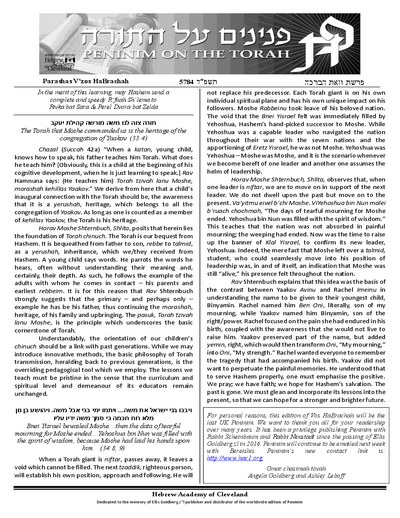

Bnei Yisrael bewailed Moshe....then the data of tearful mourning for Moshe ended....Yehoshua bin Nun was filled with the spirit of wisdom, because Moshe had laid his hands upon him. (34:8, 9)

When a Torah giant is niftar, passes away, it leaves a void which cannot be filled. The next tzaddik, righteous person, will establish his own position, approach and following. He will not replace his predecessor. Each Torah giant is on his own individual spiritual plane and has his own unique impact on his followers. Moshe Rabbeinu took leave of his beloved nation. The void that the Bnei Yisrael felt was immediately filled by Yehoshua, Hashem's hand-picked successor to Moshe. While Yehoshua was a capable leader who navigated the nation throughout their war with the seven nations and the apportioning of Eretz Yisrael, he was not Moshe. Yehoshua was Yehoshua – Moshe was Moshe, and it is the scenario whenever we become bereft of one leader and another one assumes the helm of leadership.

Horav Moshe Shternbuch, Shlita, observes that, when one leader is niftar, we are to move on in support of the next leader. We do not dwell upon the past but move on to the present. Va’yitmu eivel b’chi Moshe. ViYehoshua bin Nun malei b’ruach chochmah, “The days of tearful mourning for Moshe ended. Yehoshua bin Nun was filled with the spirit of wisdom.” This teaches that the nation was not absorbed in painful mourning; the weeping had ended. Now was the time to raise up the banner of Klal Yisrael, to confirm its new leader, Yehoshua. Indeed, the mere fact that Moshe left over a talmid, student, who could seamlessly move into his position of leadership was, in and of itself, an indication that Moshe was still “alive,” his presence felt throughout the nation.

Rav Shternbuch explains that this idea was the basis of the contrast between Yaakov Avinu and Rachel Imeinu in understanding the name to be given to their youngest child, Binyamin. Rachel named him Ben Oni, literally, son of my mourning, while Yaakov named him Binyamin, son of the right/power. Rachel focused on the pain she had endured in his birth, coupled with the awareness that she would not live to raise him. Yaakov preserved part of the name, but added yemin, right, which would then transform Oni, “My mourning,” into Oni, “My strength.” Rachel wanted everyone to remember the tragedy that had accompanied his birth. Yaakov did not want to perpetuate the painful memories. He understood that to serve Hashem properly, one must emphasise the positive. We pray; we have faith; we hope for Hashem's salvation. The past is gone. We must glean and incorporate its lessons into the present, so that we can hope for a stronger and brighter future.

PDF Preview