Haftorah of Sidra Yisro
Questions on the Sidra | February 10, 2025
Print This Article
View Original PDF

Haftorah of Sidra Yisro

Questions on the Sidra | June 27, 2025

This week’s Haftorah, for Sefaradim, is Sefer Yeshayohu, Chapter 6. Ashkenazzim continue with Chapter 7 verse 1 until verse 7 and then Chapter 9 verses 5 — 6

1.

Reading a Haftorah was originally instituted by our Chachommim to be a temporary replacement for the public Torah Reading which had been banned by the anti-Jewish government of those times. As such, the Haftorah chosen would recall something of the Sidra it had to replace. But in a general way, too, the intention was that the Haftorah should keep alive in the minds of the people the practice of the public Torah Reading — which is one of the reasons for the Haftorah being read aloud by a Reader. Indeed, the very number of Pessukim of the Haftorah mirrors the Torah Reading itself. In the public Torah Reading, no Aliyah is less than three Pessukim and on Shabbos morning there are at least seven Aliyos, making twenty-one Pessukim, and so the Haftorah is at least twenty-one Pessukim. There are a number of exceptions, usually where the chosen Haftorah, although fitting, is nevertheless a small self-contained unit, so to speak, and because of this, the Haftorah is shorter.

2.

This week’s Haftorah is a case in point. The Sidra and its Haftorah obviously share a theme. They both describe the incredible revelation of the Divine. In the Sidra, the Torah describes Mattan Torah, when we received the Torah from HaShem Himself as He descended in glory upon this world to give us His Torah. Never before or since has there been such a revelation of HaShem’s glory in the presence of a great gathering of living humans as at Sinai. And the Haftorah, too, is the vision shown to Yeshayohu at the beginning of his mission as HaShem’s prophet to us. Yeshayohu answers the call of HaShem and he is appointed to be His Novvi and the Pessukim go on to describe in mystical prophetic language the glory of HaShem, enthroned On High and surrounded by His holy angels. This excerpt is really quite short but is clearly a self-contained paragraph which is eminently suited to the Sidra. For this reason, therefore, despite its brevity, Sefaradim end their Haftorah at the end of this chapter, making it an unusually short Haftorah. In these thirteen Pessukim is portrayed the Heavenly chorus of praise to HaShem, called “Kedushah.” This Kedushah forms a prominent and sublime part of our davvening (appearing three times in Shacharis and once in Mincha but not at all in Maariv) where we declare our wish “to proclaim the holiness of HaShem down here, on earth, in the same way as they do in the High Heavens.”

3.

The custom of Ashkenazzim, however, is to continue the Haftorah into the next chapter. Thus, even though the subject matter which follows is not really connected to the Sidra, the Haftorah conforms to the regulation number of Pessukim. In this next part, Yeshayohu is instructed to bring a message of encouragement to the Jewish people, albeit to the unworthy King Ochoz ben Yosom ben Uzziyohu, king of Yehudah, who are threatened with invasion by the rival King of Israel who is coming against them together with Retzin, the king of Arram.

4.

The Haftorah ends with two Pessukim from a later chapter, where Yeshayohu prophesises about the imminent birth of a son to King Ochoz. A righteous person, he will be a true successor to the throne of the Royal House of King Dovid and will serve the Jewish People well. This son, Chizkiyohu, will be instrumental in undoing some of the evil of his father. For whereas Ochoz had tried so hard to stop the Jewish People from learning Torah, Chizkiyohu, by his own example and by his encouraging others, ensured that Torah study once again became the primary concern of the Jewish People.
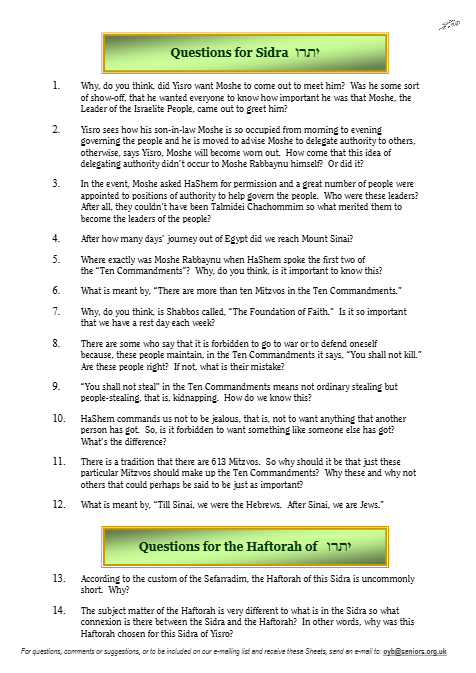
This week’s Haftorah, for Sefaradim, is Sefer Yeshayohu, Chapter 6. Ashkenazzim continue with Chapter 7 verse 1 until verse 7 and then Chapter 9 verses 5 — 6

1.

Reading a Haftorah was originally instituted by our Chachommim to be a temporary replacement for the public Torah Reading which had been banned by the anti-Jewish government of those times. As such, the Haftorah chosen would recall something of the Sidra it had to replace. But in a general way, too, the intention was that the Haftorah should keep alive in the minds of the people the practice of the public Torah Reading — which is one of the reasons for the Haftorah being read aloud by a Reader. Indeed, the very number of Pessukim of the Haftorah mirrors the Torah Reading itself. In the public Torah Reading, no Aliyah is less than three Pessukim and on Shabbos morning there are at least seven Aliyos, making twenty-one Pessukim, and so the Haftorah is at least twenty-one Pessukim. There are a number of exceptions, usually where the chosen Haftorah, although fitting, is nevertheless a small self-contained unit, so to speak, and because of this, the Haftorah is shorter.

2.

This week’s Haftorah is a case in point. The Sidra and its Haftorah obviously share a theme. They both describe the incredible revelation of the Divine. In the Sidra, the Torah describes Mattan Torah, when we received the Torah from HaShem Himself as He descended in glory upon this world to give us His Torah. Never before or since has there been such a revelation of HaShem’s glory in the presence of a great gathering of living humans as at Sinai. And the Haftorah, too, is the vision shown to Yeshayohu at the beginning of his mission as HaShem’s prophet to us. Yeshayohu answers the call of HaShem and he is appointed to be His Novvi and the Pessukim go on to describe in mystical prophetic language the glory of HaShem, enthroned On High and surrounded by His holy angels. This excerpt is really quite short but is clearly a self-contained paragraph which is eminently suited to the Sidra. For this reason, therefore, despite its brevity, Sefaradim end their Haftorah at the end of this chapter, making it an unusually short Haftorah. In these thirteen Pessukim is portrayed the Heavenly chorus of praise to HaShem, called “Kedushah.” This Kedushah forms a prominent and sublime part of our davvening (appearing three times in Shacharis and once in Mincha but not at all in Maariv) where we declare our wish “to proclaim the holiness of HaShem down here, on earth, in the same way as they do in the High Heavens.”

3.

The custom of Ashkenazzim, however, is to continue the Haftorah into the next chapter. Thus, even though the subject matter which follows is not really connected to the Sidra, the Haftorah conforms to the regulation number of Pessukim. In this next part, Yeshayohu is instructed to bring a message of encouragement to the Jewish people, albeit to the unworthy King Ochoz ben Yosom ben Uzziyohu, king of Yehudah, who are threatened with invasion by the rival King of Israel who is coming against them together with Retzin, the king of Arram.

4.

The Haftorah ends with two Pessukim from a later chapter, where Yeshayohu prophesises about the imminent birth of a son to King Ochoz. A righteous person, he will be a true successor to the throne of the Royal House of King Dovid and will serve the Jewish People well. This son, Chizkiyohu, will be instrumental in undoing some of the evil of his father. For whereas Ochoz had tried so hard to stop the Jewish People from learning Torah, Chizkiyohu, by his own example and by his encouraging others, ensured that Torah study once again became the primary concern of the Jewish People.

PDF Preview